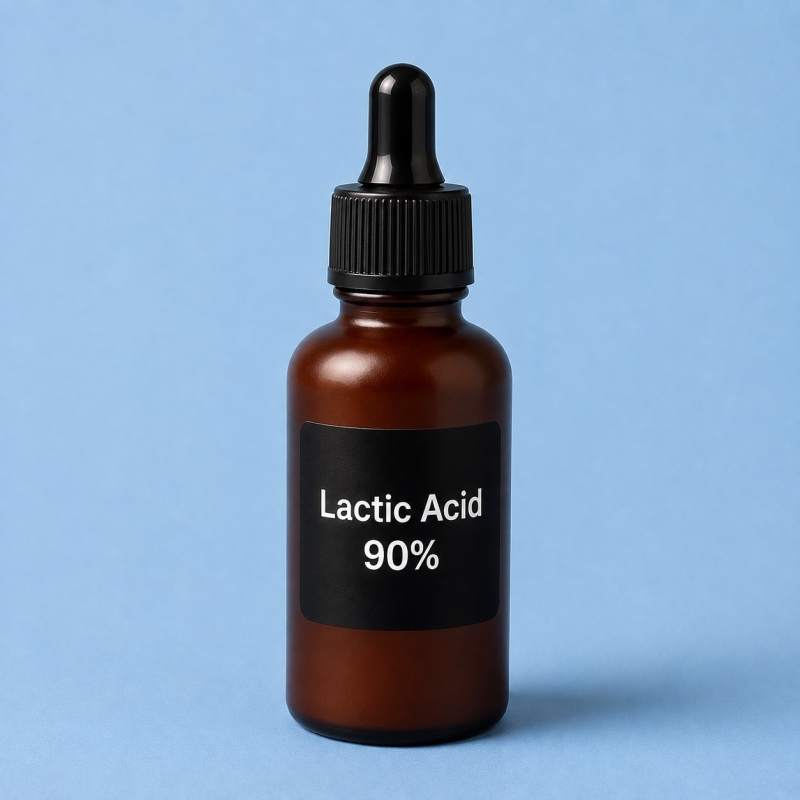
What Lactic Acid 90% Represents
Lactic Acid 90% is a liquid cosmetic raw material listed under the INCI name Lactic Acid. It functions as an ingredient for professional formulation of anti-aging creams, serums, brightening creams, emulsions and cosmetics for blemish-prone skin. The product is supplied in 20 g packaging designed for transportation and requires dilution prior to any use in finished products. This raw material appears as a clear liquid suitable for incorporation into water-based systems and supports consistent results across multiple batches.
Key Properties
The ingredient presents as a liquid with appropriate color and demonstrates solubility in water, alcohol and glycerin. Its pH range measures between 10.5 and 11, which influences how it integrates into emulsions and solutions. These characteristics make it compatible with many standard cosmetic bases used in professional laboratories. Because of its solubility profile, Lactic Acid 90% disperses evenly when first combined with appropriate solvents.
Recommended Applications
Formulators incorporate Lactic Acid 90% into anti-aging creams and serums to support skin elasticity and address the appearance of fine lines. It also appears in brightening creams and emulsions intended for even tone. Additional uses include cosmetics for blemish-prone skin where surface cleansing properties are desired. Explore related options in the moisturizing actives section and the broader cosmetic actives catalog for complementary ingredients. The material suits both leave-on and rinse-off formats when concentration limits are respected.
How to Introduce the Ingredient
Dilute Lactic Acid 90% before addition to any base. Concentrations above 10 percent require guidance from a qualified cosmetologist. Introduce the diluted solution during the cool-down phase of emulsion preparation once the temperature drops below 40 degrees Celsius. First combine the material with water, alcohol or glycerin to achieve uniform distribution throughout the batch. Measure the required amount accurately using calibrated scales and stir gently to avoid incorporating excess air.
Storage Guidelines
Store the container in a cool, dark location with the lid securely closed after every use. The material maintains stability until October 2028 when kept under these conditions. Avoid exposure to direct light or elevated temperatures that could affect quality over time. After opening, return the packaging to its designated storage area promptly and check the appearance before each new formulation session.
Sample Serum Recipe
Prepare a basic hydrating serum using 80 ml distilled water, 10 ml glycerin, 5 g Lactic Acid 90% pre-diluted in 5 ml water, and 0.5 g xanthan gum. Heat the water and glycerin together to 35 degrees Celsius. Gradually sprinkle the xanthan gum into the warm mixture while stirring continuously until a smooth gel forms. Slowly add the diluted acid and continue mixing for an additional two minutes to ensure homogeneity. Transfer the finished serum into a sterile bottle and allow it to cool completely before sealing. Further formulation ideas appear in the anti-age actives section.
Compatibility Notes
Lactic Acid 90% combines well with most water-soluble humectants and standard emulsifiers used in cosmetic production. It requires careful testing when paired with high levels of other exfoliating agents to maintain formula integrity. Conduct small-scale trials before committing to full production runs. The ingredient remains effective across a range of pH values typical for leave-on products. Proper documentation of all test results supports consistent quality in finished goods.
FAQ
Can Lactic Acid 90% be used directly on skin?
No, the material requires dilution and must never be applied in its pure form or above 10 percent without professional guidance from a cosmetologist.
What is the recommended introduction temperature?
Add the diluted ingredient during the cool-down stage once the batch temperature falls below 40 degrees Celsius to preserve full activity.
Is the product suitable for food formulations?
The supplied data covers cosmetic use only; any food application requires separate regulatory verification by the manufacturer.
How should the material be stored after opening?
Return the container to a cool dark place and ensure the lid remains tightly closed between uses to maintain stability until the stated expiration date.