-
 Absolutes
-
 Active Complexes
-
 Actives & Peptides
-
 Amino Acids & Proteins
-
 Food Flavors
-
 Ayurvedic Ingredients & Herbs
-
 Vitamins & Coenzymes
-
 Chocolate Making Supplies
-
 Thickeners & Gelling Agents
-
 Hydrosols & Floral Waters
-
 Hydrolyzed Proteins
-
 Fragrance Ingredients
-
 Nutraceutical Ingredients
-
 Acids, Salts, Alcohols & Alkalis
-
 Preservatives & Antioxidants
-
 Cosmetic Ingredients
-
 Colorants, Micas & Glitters
-
 Masks, Scrubs & Botanicals
-
 Oils & Butters
-
 Candle Making Supplies
-
 Melt and Pour Soap Bases
-
 Cream, Lotion & Hair Care Bases
-
 Fragrance Oils & Industrial Aromatics
-
 Cleansing Agents & Surfactants
-
 Peeling Actives & Acids
-
 Cosmetic Powders
-
 Solvents & Humectants
-
 Silicones & Conditioning Agents
-
 Bottles, Jars & Vials
-
 Silicone & Plastic Molds, Tools
-
 Botanical Extracts
-
 Cosmetic Emollients
-
 Emulsifiers
-
 Essential Oils
- Fragrance Oils from England 8
- Fragrance Oils Germany 17
- Fragrance Oils for Creams and Lotions 13
- Fragrance Oils Spain 67
- Lori Fragrance Oils (Latvia) 81
- Polish Fragrance Oils 3
- Fragrance Oil US 365
- Ukrainian Fragrance Oils 344
- French Fragrance Oils 170
- Water Soluble Fragrances 30
- Hypoallergenic fragrances 12
- Home Fragrance Collection 4
- Polymer Granules for Sachets 17
- Lipstick Flavors Oils 21
- Toothpaste fragrances 1
- Cold & Hot Process Soap Fragrance Oils 45
- Laundry detergent fragrance oils 16
- Japanese Fragrance Oils 30
- Perfume compositions 957
- Perfume Fragrance Oils 957
- Fragrance Oils Wholesale 4338
Toothpaste fragrances
 Add to cart
Flavor and aroma compounds built for oral care bases
This section offers concentrated flavor and fragrance compounds formulated for oral care manufacturing. These blends are engineered to remain stable and pleasant tasting when mixed with abrasives, humectants, surfactants and other components typical of toothpaste and tooth powder bases.
Unlike standard perfume oils, these compounds are built to withstand the alkaline environment and foaming action common in oral care products, so the taste holds up through mixing, storage and use. Formulators use them in toothpaste, tooth powder, whitening gels and other oral hygiene bases where a clean, long lasting flavor profile matters. The same compounds can also work in other rinse off or foam based formulations where taste or scent perception needs to survive contact with surfactants.
Manufacturers scaling up production sometimes look toward broader collections such as Fragrance Oils Wholesale, while those sourcing regionally produced blends often check Ukrainian Fragrance Oils for comparison.
Profile types and how they differ
Within this category, compounds range from single note mint and herbal profiles to layered blends that combine cooling agents with fruit, spice or sweet undertones. Some are formulated as straightforward flavor concentrates meant to sit quietly under an abrasive base, while others carry a stronger top note designed to be the dominant sensory signal in a finished tube or powder.
A key difference between compounds is how they behave once diluted into a surfactant heavy or alkaline mixture. Some blends are built specifically to resist flattening out during storage, keeping their intensity from the first use to the last, which matters more in oral care than in most other cosmetic formats because the product sits in the mouth and gets judged instantly. Buyers comparing broader collections such as French Fragrance Oils will notice that oral care flavors are formulated on a different logic than skin or hair fragrance oils, since taste stability under foaming action takes priority over how a scent projects into the air.
Choosing a compound and pairing it in a formula
Selection usually starts with the finished product type. A whitening gel with a lighter abrasive load can carry a more delicate profile, while a dense tooth powder often needs a stronger, more assertive flavor concentrate to come through once mixed with mineral fillers. Concentration and shelf stability under the alkaline pH typical of oral care bases are the two practical filters worth checking before committing to a larger batch.
These compounds are frequently paired with humectants, mild surfactants and sweetening or cooling agents in the same base. Because the underlying chemistry is built for foaming and rinse off contact, the same flavor logic extends well beyond toothpaste tubes. Formulators exploring rinse off formats sometimes cross reference Water Soluble Fragrances for water based systems, or look at Perfume Fragrance Oils when a formula needs a more layered scent rather than a pure taste profile.
Stability in acidic or surfactant heavy environments is also worth checking against the intended base. For teams formulating outside oral care, Acid stable fragrance oils cover a related need where a compound has to hold its character in a low pH system, and Laundry detergent fragrance oils face a comparable challenge with alkaline powders and heavy surfactant loads.
Origin, format and storage notes
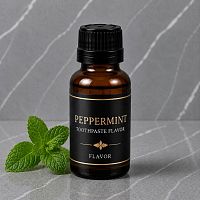
The compounds in this section are produced in Ukraine, which keeps lead times shorter for local manufacturers and simplifies documentation compared to sourcing flavor concentrates from further afield. A practical example within the range is the Peppermint Toothpaste Flavor 5ml, a small format suited to testing a formula before committing to a larger production run.
Store these compounds tightly sealed, away from direct light and heat, since flavor concentrates lose top notes faster than fragrance oils once a container has been opened repeatedly. For teams also formulating scented sachets or dry mix products, Polymer Granules for Sachets offer a different delivery format worth comparing, and Lori Fragrance Oils (Latvia) provide an alternative sourcing point for formulators who want to compare regional profiles side by side before finalizing a recipe.
FAQ
What flavor compounds work best in toothpaste formulations
Mint, peppermint and spearmint profiles remain the most reliable choices for toothpaste bases because they stay stable in alkaline systems and hold their taste through foaming. Fruit and herbal blends are also used, often layered with a cooling note to balance sweetness from humectants and mask abrasive components.
Why can standard fragrance oils not be used in oral care products
Standard perfume oils are not formulated to survive the alkaline pH, surfactant contact and heat exposure typical of toothpaste and tooth powder manufacturing. They can break down, separate or turn bitter during mixing and storage, which is why dedicated flavor compounds engineered for oral bases are used instead.
How much flavor compound is typically added to a toothpaste base
Dosage varies by supplier and profile strength, usually within a small percentage range of the total formula, and depends on the abrasive and surfactant load in the base. Formulators generally start with a low percentage and adjust upward during trial batches to reach the desired taste intensity.
How should oral care flavor compounds be stored
Store compounds in tightly sealed, light protected containers at room temperature, away from heat sources and direct sun. Proper sealing after each use prevents evaporation of volatile aromatic components, which helps the compound keep its intended taste profile until it goes into the base.
Can these compounds be used in products other than toothpaste
Yes, many of these blends also perform well in other rinse off or foaming formulations where taste or scent needs to hold up against surfactants, such as certain mouth rinses or foam based hygiene products. Their core function is stability under alkaline and surfactant conditions, not a single product type.
Recommendations
Choosing the right flavor compound comes down to matching profile strength to your base formula. A heavily abrasive or strongly foaming toothpaste base usually calls for a more concentrated blend to keep the taste noticeable after mixing and storage. Request a small trial size before committing to a larger batch, run it through your actual production base, and confirm the taste holds after a few weeks of storage. Reach out by email with your base composition and target profile so the right compound and quantity can be recommended for your production scale.



