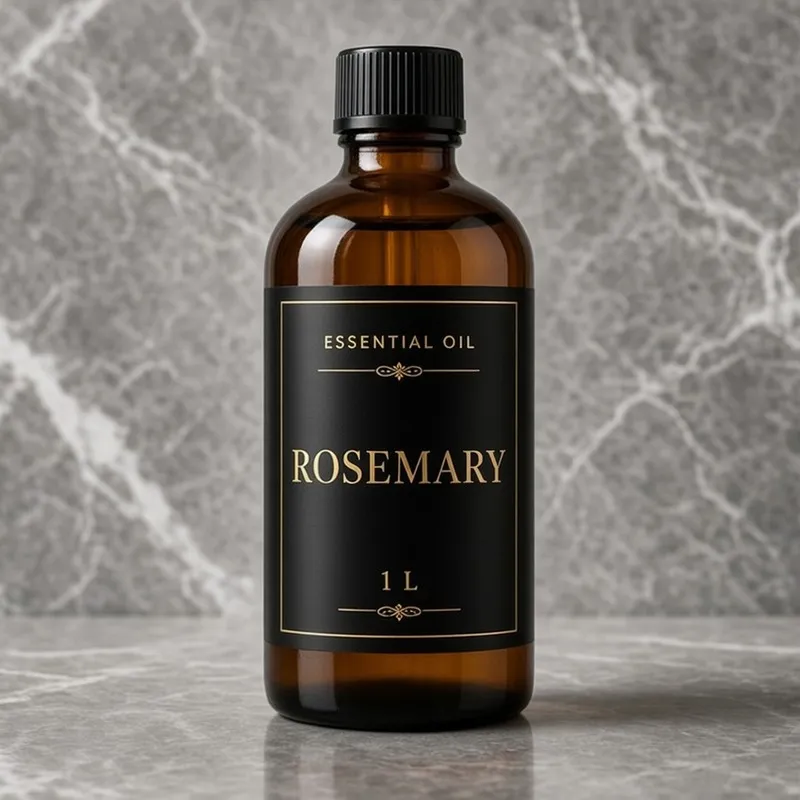
Why Bulk Rosemary Oil Powers Fragrance and Food Manufacturing
Rosemary essential oil in a 1 liter volume belongs to the Essential Oils category and remains one of the most sought-after natural raw materials across global industry. This large format is aimed squarely at industrial and semi-industrial manufacturing: fragrance houses, household chemical plants, cosmetic production lines and food processing facilities that need a steady supply of raw material without constant reordering. The oil is obtained through steam distillation of the plant's green mass, concentrating the compounds responsible for its distinctive camphor-woody aroma and functional properties.
The primary global demand for rosemary oil actually comes from industrial fragrance production rather than home crafting: it appears in men's colognes, fougere and chypre compositions, household chemical scent bases and air fresheners. The second major area of use is hair and scalp care cosmetics, where the oil is included in shampoos, tonics and stimulating masks that support microcirculation. A third significant sector is food manufacturing and spice blending, where rosemary serves as a natural flavoring agent and antioxidant that slows fat oxidation in preserved goods and edible oil production.
Rosemary essential oil in 1 liter volume is used in fragrance compositions and cosmetic manufacturing. See the full range on the page Natural Essential Oils Wholesale. The product is supplied in transport packaging and stored in a cool dark place in a tightly closed container.
In formulations, rosemary oil is used in small dosages: fragrance compositions typically call for 1 to 5 percent of the total blend, while cosmetic emulsions and shampoos need only 0.3 to 1 percent, added at the final stage when the base temperature stays below 40 degrees to preserve volatile compounds. In household chemical and candle production, rosemary can be blended with other oils to build a complex herbal accord.
Rosemary pairs well with other herbal and spice essential oils. A layered herbaceous composition can be built by adding Tarragon Essential Oil, which brings a light anise note, or Thyme Essential Oil, which reinforces the herbal, slightly peppery accent. To soften the blend and add a floral-honeyed depth in fragrance and cosmetic recipes, Melissa essential oil works well, balancing the sharpness of rosemary's camphor notes.
The 1 liter bottle should be stored tightly sealed in dark glass or food-grade aluminum containers, in a cool space away from direct sunlight, at temperatures not exceeding 20-22 degrees. Under proper storage conditions the product remains stable for an extended period, which matters greatly for manufacturers purchasing raw material in bulk batches for continuous production cycles.
Industrial-strength scalp tonic blend
Jojoba oil 500 ml
Rosemary essential oil 15 ml
Thyme essential oil 3 ml
Vitamin E (tocopherol) 10 ml
Pump bottle 500 ml
Combine
the jojoba base oil with vitamin E in a clean container at room temperature,
then add the rosemary and thyme essential oils, stirring thoroughly with a
wooden or silicone spatula for two to three minutes until fully blended.
Transfer the finished mixture into a pump bottle and apply a small amount to
the scalp with gentle massaging motions before washing hair, leaving it on for 20-30
minutes for better absorption.
Listed under the INCI name Rosmarinus Oleum.
FAQ
What is the IFRA and allergen status for rosemary essential oil 1 L?
No specific limits are stated in the general characteristics.
How is rosemary essential oil extracted?
The oil is obtained by steam distillation of the plant’s green mass as described in the product information. Confirmation of the method for a specific batch is available in the accompanying documents.
Does the odor of rosemary essential oil vary between harvests?
Natural variation occurs due to harvest and growing conditions.
What is the shelf life and how does oxidation affect rosemary essential oil?
The indicated expiry date is 10.2028 when stored in a cool dark place in a tightly closed container. Oxidation behavior is assessed via the specification or COA for the batch.