Why Rosemary Oil Remains a Core Ingredient in Fragrance and Hair Care Manufacturing
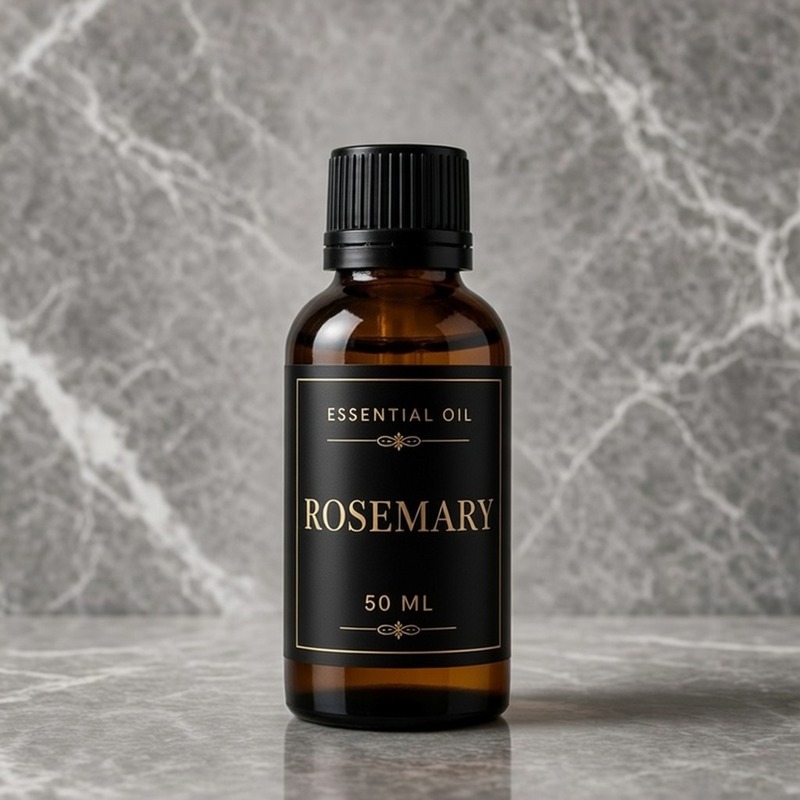
Rosemary essential oil is obtained by steam distillation of fresh sprigs, and its global demand is driven primarily by the fragrance industry, professional hair care manufacturing, and natural home fragrance products, rather than by hobby use alone. Its camphor-woody profile with a herbal edge makes it a common building block in masculine perfumery, shampoos, scalp tonics, and formulations targeting oily or problem skin. This product belongs to our Essential Oils category, where concentrated aromatic materials are supplied for precise dosing in professional formulation work.
In cosmetic manufacturing, rosemary oil is typically added at the cooling stage, once the base has dropped to around 35-40 degrees Celsius, to preserve its volatile aromatic compounds. Standard usage rates in shampoos, conditioners, and creams range from 0.3 to 1.5 percent of total batch weight, while perfume compositions require individual calculation depending on the overall concentration of the fragrance accord. The scent blends well with citrus, lavender, mint, and coniferous notes, and in richer body care blends it is often paired with warmer spicy oils such as Nutmeg Essential Oil, which adds depth and warmth to the overall accord.
Rosemary essential oil is valued in fragrance and cosmetic manufacturing for its camphor-woody scent with herbal freshness. Natural Essential Oils Wholesale supply concentrated materials for precise dosing in formulations.
One of the most widespread applications of rosemary oil is in scalp stimulation and hair strengthening formulas, where it acts as a functional ingredient influencing follicle health and providing a fresh sensation. Beyond personal care, the oil is used extensively in natural room fresheners, sachets, herbal-scented candles, and even in food flavoring for meat products and seasoning blends. In relaxing or invigorating massage blends, rosemary is frequently combined with lighter carrier oils, and for more exotic accords in perfumery a small amount of coconut oil, such as Coconut Essential Oil, can be added to soften the sharpness of the herbal top note.
When working with rosemary oil, moderate dosing is essential, since excessive concentration can irritate skin and mucous membranes, particularly in leave-on products. The oil should never be applied undiluted and must always be blended into a carrier oil or emulsifier system before use. Storage requires a tightly sealed dark glass container kept in a cool place away from direct sunlight, at temperatures not exceeding 25 degrees Celsius, and away from heat sources or open flame. Under proper storage conditions the oil retains its aromatic stability and performance for the manufacturer's stated shelf life. The 50 ml package size is well suited for laboratory trials, small production batches, and formulation development in cosmetic and fragrance studios, allowing formulators to test concentrations before scaling up to industrial volumes.
For more layered multi-component blends, rosemary pairs nicely with additional spicy notes, including a small addition of Fennel Essential Oil, which contributes a sweet anise-like undertone and adds complexity to the finished fragrance.
Invigorating Scalp Tonic Blend
Jojoba oil 40 ml
Rosemary essential oil 6 ml
Peppermint essential oil 2 ml
Vitamin E 1 ml
Combine the jojoba oil with vitamin E, then add the rosemary and peppermint essential oils and mix thoroughly until fully blended. Apply the finished tonic to the scalp with gentle massaging motions 30-40 minutes before washing hair, and store the blend in a glass bottle with a tight lid in a cool, dark place.
The INCI designation used in documentation is Rosmarinus Oleum.
FAQ
Are COA, GC-MS report and specification available for rosemary essential oil?
Current documents for this product are listed in the «Documents» block of the product card.
Does the odor of rosemary essential oil vary between harvests?
Natural variation between harvests is typical for essential oils. Specific batch details are listed in the COA or specification.
How does rosemary essential oil dissolve in oils, alcohol and water?
The oil is soluble in oil, ether and alcohol. Solubility in water requires a solubilizer; exact guidance appears in the product specification.
What extraction method is used for rosemary essential oil?
The oil is obtained by steam distillation.