Product Description
Sourcing and specification overview
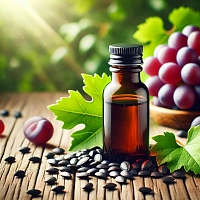
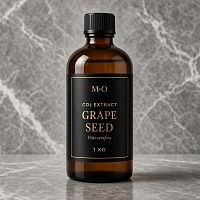
Grape seed extract concentrate arrives from Germany in 50 ml transport containers as a liquid substance with characteristic odor. INCI reads Vitis Vinifera Seed extrac. Extract Concentrates of this type are selected by labs for consistent polyphenol content and water solubility. International manufacturers appreciate the standardized input percentages that simplify scaling from pilot batches to full production runs.
Technical parameters for formulation
Recommended input levels are 2 percent in emulsions and gels, 1 percent in toners and shampoos, and up to 5 percent in masks. The material enters the water phase after cooling to 40 degrees Celsius. These parameters remain stable across batch sizes used by cosmetic laboratories and supplement manufacturers. Grape Seed Extract Concentrate 5 ml provides a convenient reference size for initial compatibility testing before committing to larger volumes.
Integration into dietary supplements and food production
International buyers purchase the concentrate as botanical raw material for dietary supplements and functional food items such as beverages and confectionery. Factories worldwide incorporate it into dry blends and liquid bases in both retail and wholesale volumes. Botanical Extracts like this support clean-label formulations across multiple categories without requiring additional processing steps.
Sample formulation for a dietary supplement blend
A 200 g dry blend contains 180 g maltodextrin carrier, 15 g grape seed extract concentrate and 5 g natural flavor. The liquid extract is first adsorbed onto the carrier, then mixed with flavor and packaged in airtight containers. The blend remains stable when stored in a cool dark place. Producers can adjust carrier ratios to achieve desired flow properties for encapsulation or tableting lines.
Storage conditions and shelf life
Shelf life extends to December 2028. Keep containers tightly closed in a cool dark location to preserve solubility and odor profile. Routine quality checks on incoming lots help maintain consistency in finished goods destined for global markets.
Frequently asked questions
What temperature range is safe during processing?
Processing temperatures should stay below 40 degrees Celsius after the water phase has cooled to protect active compounds.
Is the material suitable for both cosmetic and food-grade formulas?
Yes, the concentrate is used as raw material in cosmetic emulsions as well as in dietary supplement and food industry formulations.
How does the product behave in water-based systems?
The liquid dissolves directly in water and integrates without additional solubilizers when added to the cooled phase.