Why Grape and Collagen Alginate Blends Are a Staple in Professional Skin Treatments
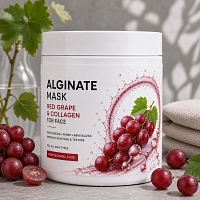
Alginate masks have become a routine tool in professional skincare, and a 1 kg packaging is built specifically for salons, spa centers, and beauty studios that run daily treatment schedules and need a reliable, consistent supply of base powder. This product belongs to the section Alginate Face Masks, which brings together formulas for a wide range of skin goals, from hydration to firming effects.
The working mechanism relies on sodium alginate, which forms a dense, elastic film upon contact with water, creating a mild compression effect that helps active ingredients absorb into the upper skin layers. Here the key actives are red grape extract, rich in polyphenols and resveratrol, and collagen, which supports skin firmness and density. Grape polyphenols act as antioxidants, helping neutralize free radicals, while collagen contributes to a smoother, more elastic feel immediately after the film is peeled off.
In a professional setting, this mask is typically applied after cleansing and light exfoliation, or as the final step of a multi-stage facial protocol. Before the alginate layer, technicians often layer serums — pairing well here is the alginate mask with hyaluronic acid for deeper hydration within a treatment course, while clients showing signs of tired or slack skin may benefit from adding the Argan and Q10 alginate mask as a complementary step. For thinner skin around the eyes and lips, a separate formula is recommended, such as the alginate mask for the skin around the eyes and lips, allowing a layered, multi-texture session on the same client.
The powder is mixed with room-temperature or slightly warm water, roughly 18-22 degrees Celsius — hotter water reduces the stability of active compounds and speeds up premature setting of the mass. The typical ratio is around 1 part powder to 2.5-3 parts water by volume, though the exact proportion should be tested against each specific batch, since the thickness of the mix affects how easily it spreads with a spatula. Contact time on the skin is 15-20 minutes, after which the film is removed in one intact piece.
Store the powder in a dry, cool space in a tightly sealed container, away from moisture and direct sunlight, since alginate is hygroscopic and loses its free-flowing texture when exposed to humid air. Under proper storage conditions, a 1 kg package retains its working properties for an extended period, which makes it convenient for planning regular supply in a studio or salon workflow.
Antioxidant Studio Facial Treatment
Alginate powder with grape and collagen 28 g
Room-temperature water 70 ml
Niacinamide serum 3 ml
Grapeseed oil 2 ml
In a clean non-metal bowl, combine the water, serum, and oil, then gradually sift in the powder while stirring briskly until a smooth, lump-free paste forms. Apply the mixture quickly to cleansed skin in an even layer about 3-5 mm thick, avoiding the eye and lip area, and leave it on for 15-18 minutes until it sets into a firm elastic film, which is then peeled off in one motion from the jawline upward.