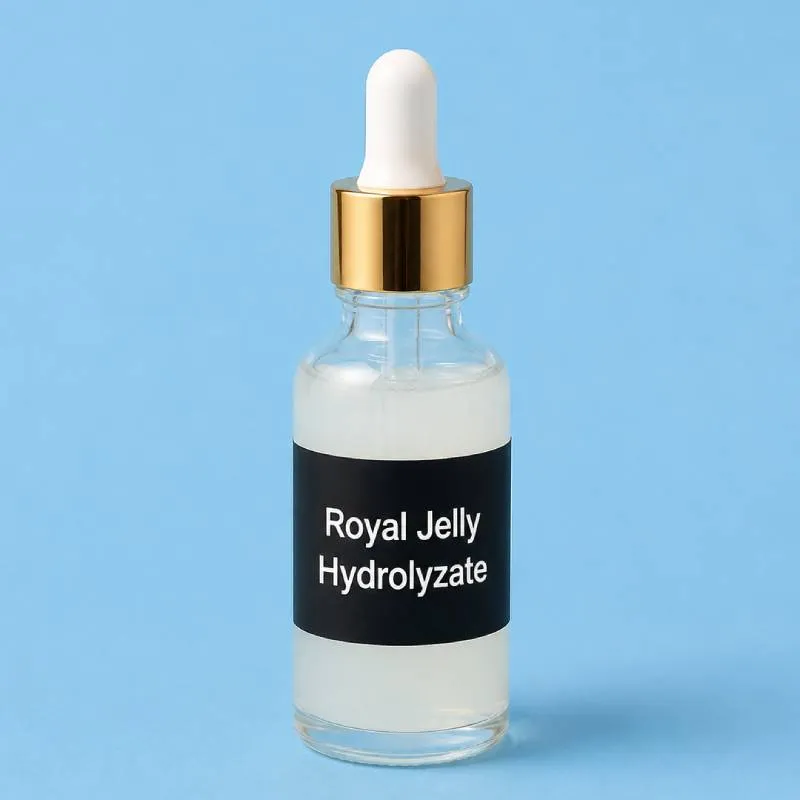
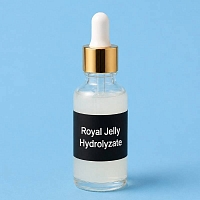
Royal Jelly Hydrolysate 25 ml bearing INCI Hydrolyzed Royal Jelly Protein is derived from royal jelly and dosed at 1-10% (up to 15% in active serums); buy retail or wholesale with shipping from Ukraine is straightforward.
Specification and handling
The ingredient arrives as a clear liquid fully soluble in water. It is produced in France and supplied in 25 ml retail packs suitable for small-batch work. Hydrolyzed Proteins section lists compatible materials for formulators. The hydrolyzed format simplifies incorporation into both aqueous and emulsion systems.
Appearance, solubility and storage
Transparent liquid with neutral odor. Store in a cool dark place in a tightly closed container until 10.2028. After opening use within twelve months. The liquid form allows precise measurement even in laboratory-scale batches.
Formulation guidelines
Add at 1-10% in the cool-down phase below 40 °C. Compatible with glycerin, betaine, hyaluronic acid and other hydrolyzed proteins. Wholesale packs allow consistent production batches. Always verify final viscosity and pH after addition.
Example serum formulation
Purified water 77%, glycerin 5%, betaine 3%, Hydrolyzed Royal Jelly Protein 10%, rice protein hydrolysate 2%, hyaluronic acid solution 2%, preservative 0.8%, lactic acid 0.2%. Total 100%. Blend actives after cooling the base. The finished serum feels light and absorbs quickly.
Applications and compatibility
Used in shampoos, conditioners, hair masks, leave-in sprays, face serums, creams and toners. Royal Jelly Hydrolysate 1 L supports larger production runs. It works well alongside amino acid complexes and botanical extracts.
Wholesale production considerations
Larger volumes benefit from standardized raw material lots. Hydrolyzed Proteins Wholesale section provides options for consistent supply. Monitor color and odor throughout the manufacturing process.
Batch production notes
For wholesale volumes check viscosity, color and pH after each addition. The ingredient remains stable across typical cosmetic pH ranges. Documentation of each batch helps maintain reproducibility.
Frequently asked questions
What is the recommended pH range?
The hydrolysate performs well between pH 4.5 and 6.5.
Can it be used in water-based toners?
Yes, up to 8% added during the final cooling stage.
Does it affect emulsion stability?
No negative effect observed when added below 40 °C.
Is it suitable for scalp products?
It conditions the look of hair and supports scalp comfort in leave-in formulas.