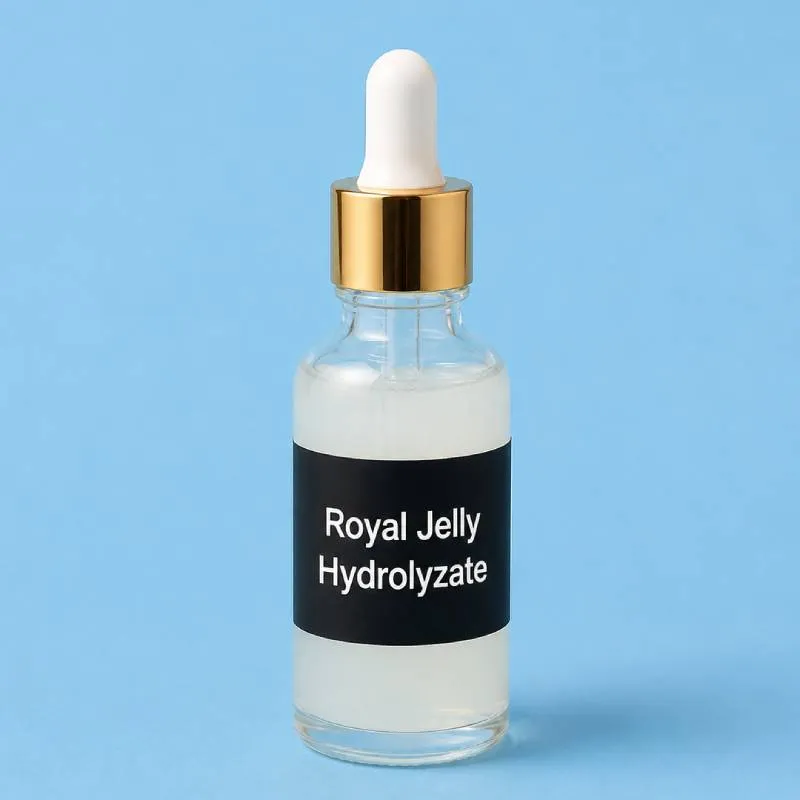
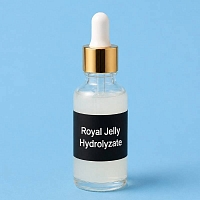
Hydrolyzed Royal Jelly for advanced skin and hair care formulas
Hydrolyzed Royal Jelly is a cosmetic raw material for facial care, hair products, scalp formulas, body cosmetics, and professional treatment concepts. It can be incorporated into serums, creams, masks, shampoos, conditioners, tonics, gels, ampoule-style cosmetics, and lightweight emulsions.
Royal jelly provides a recognizable bee-derived ingredient concept for modern cosmetic development. In hydrolyzed form, the material can support a broad range of formulation directions when used according to the technical properties of the specific commercial grade.
Hydrolyzed Royal Jelly can be positioned as a central ingredient within a product collection or combined with amino acid complexes, hydrolyzed proteins, humectants, botanical extracts, and compatible peptides.
Modern facial serum concepts
Hydrolyzed Royal Jelly can be incorporated into lightweight facial serums and gel concentrates.
Potential formulation partners include Betaine, Glycerin, Hyaluronic Acid, and selected amino acid systems. In more advanced formulations, compatible peptides and botanical extracts may be included after complete formulation compatibility has been confirmed.
The total concentration of dissolved materials should be considered carefully. Combining too many humectants and active solutions can produce an unnecessarily tacky sensory profile.
For transparent products, evaluate the influence of the commercial hydrolysate on color and clarity. Naturally derived raw materials may have characteristic visual differences between commercial grades.
Creams and facial emulsions
Hydrolyzed Royal Jelly can be used in lightweight emulsions, richer cream products, and creamy facial masks.
For a modern lightweight sensory profile, it can be paired with Squalane, Jojoba Oil, Grape Seed Oil, and selected emollients.
Richer night cream concepts may use a more substantial lipid phase, while daily fluid emulsions can be designed with lower oil content.
The ingredient incorporation stage should follow the temperature requirements of the specific commercial material. If the raw material is heat sensitive, it should be introduced during an appropriate cooling stage.
Facial masks and professional products
The ingredient can be used in gel masks, cream masks, and selected professional cosmetic products.
In gel masks, potential combinations include Betaine, Hyaluronic Acid, Glycerin, and compatible amino acid materials.
Cream masks may combine the hydrolysate with botanical oils and modern emollients to create a richer texture.
A coordinated professional collection may include a serum, cream mask, and finishing emulsion built around the same bee-derived and protein-inspired concept.
Shampoo applications
Hydrolyzed Royal Jelly can be considered for shampoos and gentle cleansing formulas.
It may be combined with amino acid systems, hydrolyzed proteins, and selected botanical ingredients.
After incorporation, evaluate shampoo viscosity, color, odor, clarity, foam characteristics, and storage stability.
Water-soluble active materials may influence the rheology of complex surfactant systems. A complete laboratory batch should therefore be prepared before production scale-up.
For a coordinated hair care range, the ingredient can be used across shampoo, mask, and leave-in product concepts while each base is developed independently.
Hair masks and conditioners
Hydrolyzed Royal Jelly can be used in rinse-off masks, conditioners, and selected leave-in products.
Potential formulation partners include Hydrolyzed Oat Protein, Hydrolyzed Rice Protein, amino acid complexes, botanical oils, and conditioning ingredients.
For fine hair concepts, lightweight emulsion structures are generally more appropriate than formulas overloaded with heavy oils.
For dry-feel hair concepts, richer masks may include a carefully balanced combination of botanical lipids and emollients.
When several hydrolyzed proteins are used together, formulators should evaluate the total protein system rather than treating each ingredient independently.
Scalp tonics and lightweight lotions
Hydrolyzed Royal Jelly can be incorporated into scalp tonics, lightweight lotions, and serum-type products.
It may be combined with Betaine, amino acid complexes, and compatible botanical extracts.
For liquid formulas, evaluate appearance, color, odor, and possible sediment formation during storage.
If the product uses a spray pump, the complete formula should also be tested for dispensing compatibility.
Complex scalp formulas containing several botanical extracts and hydrolyzed ingredients should be evaluated in small laboratory batches before scale-up.
Hand and body care
Hydrolyzed Royal Jelly can be incorporated into hand creams, body lotions, cream masks, and professional body care products.
For lightweight body lotions, the ingredient can be combined with Glycerin, Betaine, Squalane, and a carefully balanced lipid phase.
Hand creams may use richer emulsion structures and selected botanical oils.
Professional treatment concepts may include a creamy mask followed by a lightweight finishing lotion sharing the same ingredient story.
Formulation combinations
Hydrolyzed Royal Jelly can be combined with Hyaluronic Acid, Betaine, Glycerin, and amino acid complexes.
For hair care, potential combinations include hydrolyzed oat, rice, and wheat proteins.
In emulsions, the ingredient can be paired with Squalane, Jojoba Oil, Grape Seed Oil, and lightweight emollients.
More complex formulas may include compatible peptides and botanical extracts after pH and complete system compatibility have been evaluated.
How to use Hydrolyzed Royal Jelly
The exact incorporation procedure depends on the concentration, solvent system, and technical specifications of the commercial raw material.
In aqueous serums, add the ingredient gradually under moderate mixing according to the processing requirements of the base.
In emulsions, select the incorporation stage according to the thermal stability of the specific hydrolysate.
In shampoos and conditioners, recheck viscosity after the ingredient has been added.
The finished product should be evaluated for appearance, color, odor, pH, viscosity, uniformity, and storage stability.
Example royal jelly protein hair serum
Purified Water 830 ml
Hydrolyzed Royal Jelly 50 g
Betaine 25 g
Glycerin 20 g
Hydrolyzed Oat Protein 20 g
Hydrolyzed Rice Protein 15 g
Hyaluronic Acid Solution 20 g
Light Conditioning Polymer 10 g
Preservative System 8 g
Fragrance Composition 2 g
Total Batch Weight 1000 g
Dissolve Betaine in the Purified Water and add Glycerin under moderate mixing.
Add the Light Conditioning Polymer according to its processing requirements. Introduce Hydrolyzed Oat Protein and Hydrolyzed Rice Protein gradually.
Add the Hyaluronic Acid Solution and mix until the serum base is uniform. Introduce Hydrolyzed Royal Jelly at the processing stage recommended for the specific commercial grade.
Add the Preservative System and Fragrance Composition. Mix gently until the batch is uniform.
Before scale-up, evaluate pH, appearance, viscosity, odor, storage stability, and packaging compatibility.
Hydrolyzed Royal Jelly offers a versatile ingredient direction for facial serums, creams, hair masks, shampoos, conditioners, scalp tonics, and body care. Its hydrolyzed format supports modern multi-ingredient formulas combining protein systems, amino acids, humectants, botanical extracts, and compatible cosmetic actives.