How Jojoba Wax Supports Consistent Large-Batch Skincare Manufacturing
Jojoba oil is technically a liquid wax rather than a classic triglyceride oil, which explains its exceptional resistance to oxidation and its ability to remain chemically stable through repeated heating and cooling cycles common on production lines. This stability makes it a preferred choice not only in skincare and haircare manufacturing but also in pharmaceutical ointment bases and certain industrial lubricant blends where long shelf life matters. The 1 liter format is built for studio and industrial scale operations, supplying labs and manufacturing facilities that produce creams, serums, balms and hair treatments in consistent batches rather than one-off trials. This product belongs to the Liquid Basic Oils category, which brings together foundational ingredients used to build the oil phase of emulsions and anhydrous formulations.
When formulating creams and lotions, jojoba oil is typically introduced during the oil phase heating stage at around 60-70 degrees Celsius, with usage rates ranging from 3 to 15 percent depending on the desired texture of the final product. It blends smoothly with almost any plant oil and essential oil, functioning as a reliable connective ingredient across complex multi-component formulas. In formulations targeting blemish-prone skin, manufacturers often pair jojoba with Tea Tree Cosmetic Oil for its clarifying properties, while anti-aging formulas frequently incorporate Carotene Oil to enrich the blend with carotenoids that support skin renewal.
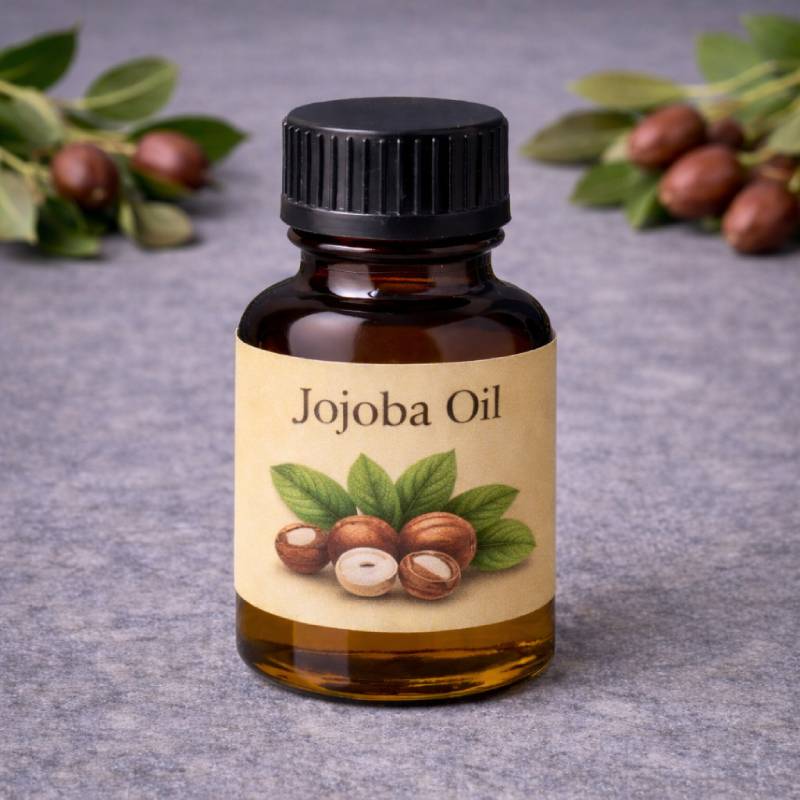
Jojoba oil from HENRY LAMOTTE OILS GMBH is a refined base oil suited for building emulsions and anhydrous formulations in studio and industrial production. It belongs to the Bulk Liquid Oils category and provides stability through repeated heating and cooling cycles.
Beyond facial and body care, jojoba oil is extensively used in hair and beard care products thanks to its lightweight, fast-absorbing feel that leaves no greasy residue. In pharmaceutical manufacturing it serves as a stable base for ointments and gels since it resists rancidity far longer than typical fatty oils, and in perfumery it acts as a carrier that helps fix fragrance compositions and slow the evaporation of volatile aromatic molecules. Decorative cosmetics manufacturers add it to lipsticks, lip balms and cream-based eyeshadow formulas to improve glide and pigment retention. It also pairs well with delicate floral extracts: formulations for mature or sensitive skin often combine jojoba with Violet Cosmetic Oil, which enhances the softening effect and adds a refined finishing note to the blend.
For industrial buyers, the 1 liter container supports steady, uninterrupted supply chains without frequent batch changes, which simplifies quality control and reduces formulation drift between production runs. The oil should be stored in a tightly sealed container, away from direct sunlight and heat sources, ideally at room temperature in a dry, dark space. Under these conditions it maintains its properties over an extended period, which matters greatly for facilities that stock raw materials ahead of scheduled production cycles. Additional uses include premium candle making, where jojoba acts as a softening additive, and household leather care products, where its ability to penetrate material structure without leaving a sticky film is highly valued.
Barrier Repair Night Balm for Industrial Batch Production
Jojoba oil 200 g
Shea butter 100 g
Beeswax 50 g
Carotene oil 15 ml
Vitamin E 10 ml
Melt
the shea butter and beeswax together with jojoba oil in a double boiler at
65-70 degrees Celsius until fully liquid and uniform. Remove from heat and
allow the mixture to cool to approximately 40 degrees, then blend in the
carotene oil and vitamin E thoroughly. Pour the finished mixture into clean
containers immediately and let it set at room temperature for several hours
until it reaches a firm, spreadable consistency.
INCI name for label declarations: Jojoba oil Cosmetic.
FAQ
What is the texture, melting point or viscosity and absorption profile of cosmetic jojoba oil?
The product is described as an oily liquid. Specific viscosity or absorption values are available in the specification on request.
How does cosmetic jojoba oil combine with other oils or actives?
It is compatible with the fatty phase and can be used up to 100 % in hair masks. Exact compatibility data appear in the COA or specification available on request for wholesale items after the order ships.
Where can I obtain the COA and specification for this jojoba oil?
COA and specification documents are provided on request from the supplier.
What is the comedogenic rating of cosmetic jojoba oil?
A numerical rating is not listed in the product data. Check the specification or label for guidance.