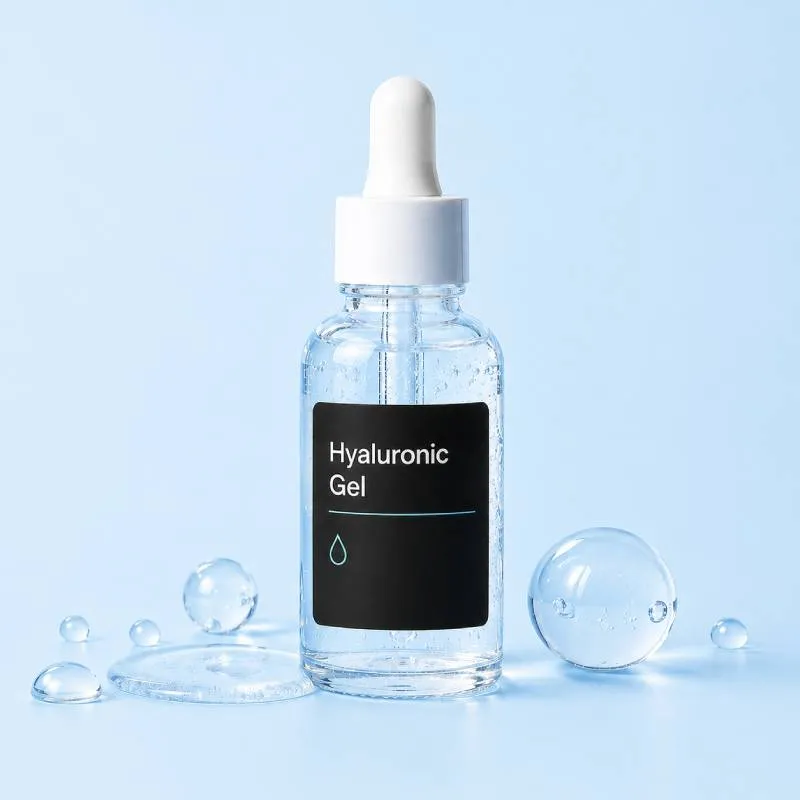
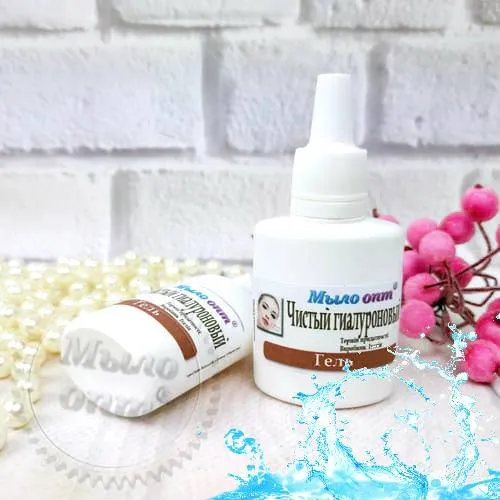
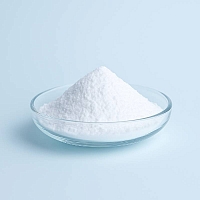
What Is Hyaluronic Gel
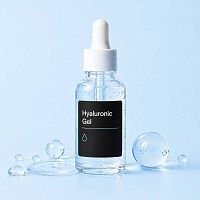
Hyaluronic Gel 25 ml is a preformed water system that combines sodium hyaluronate of different molecular weights with a set of moisture-retaining components. The INCI list includes Water Sterilized, Coffea arabica hydrosol water, Zemea Propanediol-1,3, Lactobacillus Ferment, Trehalose, Biosaccharide gum-1, Sorbitol, Inulin, Sodium Hyaluronate (high-molecular), Salicylic Acid, and Sodium Hyaluronate (low-molecular). The product serves as a ready active water base with stable structure and pronounced hydrating properties for cosmetic formulas. It integrates directly into the water phase without extra preparation steps. The gel appears as a colorless gelatinous liquid and remains stable when added at temperatures not exceeding 40 °C. For related anti-age actives explore the anti-age actives catalog.
Main Properties
High-molecular sodium hyaluronate forms a hydrophilic film on the skin surface that aids moisture retention. Low-molecular sodium hyaluronate distributes evenly throughout the water phase. Trehalose, Sorbitol, and Biosaccharide gum-1 strengthen the system’s ability to hold water. Propanediol improves component distribution while Lactobacillus Ferment and Inulin provide auxiliary stabilization. The gel supports moisture retention inside the formula, improves spread and slip, creates a soft gel texture, and raises sensory qualities without prior dissolution.
This ready gel works as a direct water-phase addition in many formulas and pairs naturally with options from the cosmetic peptides range. Formulators also find it listed among broader cosmetic actives and can compare it with the Pure Hyaluronic Gel, 1 L for different batch sizes. It remains compatible alongside EyeLiss, 5 ml in targeted blends.
Applications
The gel works as a finished product at 100 percent concentration, as a serum base from 1 to 100 percent, as a moisturizing complex in face and body creams at 1 to 5 percent, and in scalp products at 1 to 5 percent. It fits serums, creams, anti-aging gels, and moisturizers of any format from light serums to night creams. The same base supports development of light high-water formulas and systems that require repeatable hydration results. See additional options in the cosmetic actives catalog section and the hyaluronic acid section.
How to Introduce
Add the gel directly into the active phase at temperatures no higher than 40 °C. Percent input ranges from 1 to 100 percent depending on the desired effect. Higher values suit gel systems while lower values fit emulsions. Avoid intense mixing and never heat the ingredient. The product dissolves in water and remains compatible with a wide range of cosmetic components.
Compatibility and Technological Features
The gel integrates smoothly into the water phase and keeps a stable structure without forming sediment. At elevated concentrations it may affect viscosity and transparency. Stability depends on the pH level of the final system. Always avoid eye contact and do not exceed recommended dosage to prevent the opposite effect. The colorless gelatinous liquid comes in 25 ml transport packaging and stays suitable until November 2028 when stored in a cool dark place in a tightly closed container.
Example Application
Moisturizing gel serum: purified water 760 ml, Hyaluronic Gel 25 ml 120 ml, Glycerin 40 ml, Panthenol 10 ml, Niacinamide 20 g, Allantoin 3 g, Phenoxyethanol Ethylhexylglycerin 5 ml, Soft Clean Fragrance Oil 2 ml. Dissolve Glycerin and Niacinamide in water while stirring. Add Panthenol and Allantoin. Introduce Hyaluronic Gel 25 ml at room temperature with gentle mixing. Finish with Phenoxyethanol Ethylhexylglycerin and Soft Clean Fragrance Oil. Stir until uniform.
FAQ
Can Hyaluronic Gel replace the entire water phase?
Yes, the gel can serve as a finished product at 100 percent or as a serum base from 1 to 100 percent while preserving stable hydration.
What temperature limit applies during formulation?
Introduce the gel into the active phase at no more than 40 °C to maintain its structure and performance.
Which concentration range works for creams?
Use 1 to 5 percent in face and body creams or scalp products to add a moisturizing complex without altering texture.
Does the gel require pre-dissolution?
No pre-dissolution is needed. It disperses directly in water and stays compatible with most cosmetic actives.