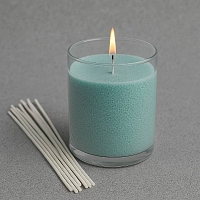
A dependable structuring wax for balms, sticks and beyond
Beeswax Yellow in a 50 g pack is a practical starting size for home formulators and anyone testing a new recipe before committing to larger volumes. This natural byproduct of beekeeping is obtained by rendering honeycomb, retaining its characteristic amber tone and firm texture that makes it valuable for producers of natural personal care products. The item belongs to the Waxes for cosmetics category, which brings together various wax ingredients used across cosmetic and adjacent industries.
Globally, yellow beeswax is most widely used in the production of lip balms, hand and body creams, protective salves, solid perfume sticks and balm bars. It gives formulations a workable plasticity, forms a thin protective layer on skin that helps reduce moisture loss, and stabilizes emulsions by preventing oil and water phases from separating. Beyond skincare, beeswax has long been used in candle making, wood and leather conditioning, thread and cord waxing, and as an ingredient in furniture polishes and protective coatings. In pharmaceutical applications it serves as a structuring agent in ointments and medicated patches.
Yellow beeswax pairs well with a wide range of carrier oils and other waxy ingredients. It is often combined with Beeswax granulated bleached when a lighter finished color is desired without losing the natural benefits of beeswax. For fragrant formulations with a soft texture, it blends nicely with Natura-tec Olive Massage Candle Wax, while for toning skincare recipes formulators sometimes add Green Tea Wax, which brings additional conditioning properties to the mix.
Yellow beeswax should be introduced during the oil phase, melted in a double boiler at around 65-70 degrees together with the carrier oils until fully liquefied. Once the mass is uniform, remove it from heat and let it cool gradually, adding heat-sensitive ingredients and essential oils once the temperature drops below 40 degrees. Typical usage for creams and balms ranges from 5 to 15 percent of the total formula weight, while solid sticks and salves usually require 15 to 25 percent depending on the desired firmness. In candle making, and occasionally as a minor component in soap crafting, the proportion can be increased further.
Store the wax in a dry, cool place away from direct sunlight, in a tightly sealed container. Under proper storage conditions it retains its properties for a long time, which makes the 50 g pack a convenient choice for trial batches and small home projects before scaling up to bigger volumes.
Soothing lip and cuticle balm
Beeswax Yellow 12 g
Shea butter 15 g
Sweet almond oil 10 g
Castor oil 8 g
Vitamin E 1 ml
Peppermint essential oil 3 drops
Melt the beeswax and shea butter together in a double boiler until fully combined, then stir in the almond and castor oils until the mixture is smooth. Remove from heat, let it cool to about 40 degrees, mix in the vitamin E and peppermint oil, then pour into small tins or lip balm tubes and allow to set at room temperature for a couple of hours.