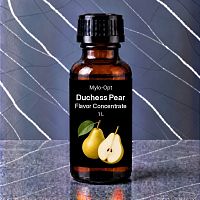
Bringing the taste of ripe duchess pear into large-batch beverage and dessert recipes
This flavoring belongs to the category of Food Flavorings Lithuania Wholesale, a line trusted by beverage, confectionery and dairy manufacturers for its consistent Lithuanian quality and precise concentration of aromatic compounds. Duchess pear is instantly recognizable to consumers for its soft sweetness with a light floral and honeyed edge, which makes it a popular choice whenever a formulation needs a natural fruity character without excessive acidity.
The primary field of use is the food industry. The flavor is commonly added to lemonades, syrups, fruit drinks, compotes, ciders and cocktail bases. In confectionery it works well in marmalade, marshmallow, pastille, caramel, fillings and glazes. Dairy producers use pear flavoring in yogurts, curd desserts and ice cream, while bakeries add it to cupcakes, rolls and laminated dough products with fruit filling. Alcoholic beverage production is another strong niche, where duchess pear blends nicely into liqueurs and infused spirits. To a lesser extent, fruity flavorings also appear in household chemistry and in fragrance blends for cosmetic bars, giving finished goods a recognizable sweet trail.
A typical dosage ranges from 0.1 to 0.3 percent of the finished product weight for beverages and 0.2 to 0.5 percent for confectionery and baked goods - the exact rate is best confirmed with a small test batch for each recipe. The flavor should be added at the final stage of processing, once the mass has cooled to 60-70 degrees Celsius, to preserve the volatile aromatic fraction and prevent it from evaporating during boiling. Store the product in a tightly sealed container, in a dry, cool place away from direct sunlight, at a temperature between 15 and 25 degrees, keeping it away from heat sources.
Duchess pear pairs well with vanilla, caramel and citrus notes, and with citric acid, which balances sweetness and adds freshness to the profile. The 1 liter packaging suits small-batch and studio-scale manufacturing - local bakeries, confectionery workshops, small beverage bottling lines, as well as recipe testing before scaling up to industrial volumes. Beyond the fruity range, the same supplier offers a savory line as well: Seafood Food Flavoring for snacks and sauces, Mushrooms Fresh Food Flavoring for semi-finished products and seasonings, and Cheese Food Flavoring for cheese-flavored snacks - together they let a production facility cover a wide range of taste directions from a single order.
Pear glaze for small-batch cupcake production
Water 500 ml
Sugar powdered 800 g
Glucose syrup 100 g
Citric acid 4 g
Pear-duchesse flavoring 6 ml
Combine
water and powdered sugar in a saucepan and warm gently to about 45 degrees
Celsius, stirring until the sugar fully dissolves and the mixture turns smooth.
Add the glucose syrup and continue stirring until fully incorporated, then
remove from heat and let the glaze cool to around 35 degrees. Dissolve the
citric acid in a small amount of warm water and stir it into the glaze,
followed by the pear-duchesse flavoring added last to protect its volatile
aroma. Whisk until glossy and pour immediately over cooled cupcakes or
pastries, allowing the glaze to set at room temperature for about 20 minutes
before packaging.