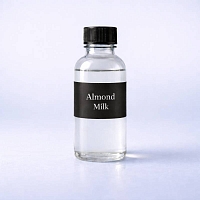
What almond milk brings to lye water and homemade skin creams
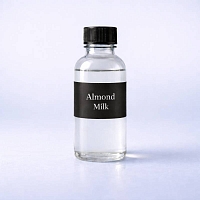
Almond milk is a liquid plant-based product pressed from almonds that serves as an alternative to plain water when dissolving lye, and also works as a nourishing water-phase ingredient in creams, lotions and emulsions. This item belongs to the Cold process ingredients category, and its main function is to enrich a formula with natural fats, sugars and proteins from almonds, which soften the texture of the finished bar and give the lather a creamier, denser feel.
In cold process formulations, almond milk can replace distilled water partially or entirely when preparing the solution. Thanks to its natural sugars and lipids, this substitution speeds up saponification and gives the bar a smoother texture, while the lather becomes gentler on skin. One key detail: the milk should be chilled to around 18-22 degrees Celsius before lye is added slowly in small portions with constant stirring, otherwise the protein fraction may curdle and form flakes. A workable dosage for cold process recipes is 30 to 60 percent of the total liquid phase, with the remainder made up with regular water.
In skincare manufacturing, almond milk is used as part of the water phase when producing creams, lotions, body balms and facial masks. It is typically introduced during the water-phase blending step at 40-55 degrees Celsius alongside the emulsifier, which preserves most of its beneficial compounds without overheating them. Such formulas suit dry, sensitive and irritation-prone skin, since almond milk helps retain moisture and softens the outer layer of the epidermis.
Almond milk pairs well with plant butters and oils that boost the nourishing effect of a formula. Combined with Mango Butter 100 g, it creates a rich fatty base for creams and solid balms, while adding Castor Oil 100 ml helps stabilize lather in cleanser recipes and adds extra viscosity to the finished product. For small test batches, a compact pack of Mango Butter 25 g is a convenient way to trial an ingredient combination before scaling up a recipe.
The 1 liter pack is suited both for home experimentation and for small cosmetic studios and workshops producing goods in limited batches. This volume covers several full batches or a series of cream emulsions without frequent reordering, which is convenient for regular small-scale production.
Almond milk should be stored in a tightly sealed container, in a cool dark place, and refrigerated once opened, with usage limited to a reasonable timeframe since the product contains natural fats and proteins prone to oxidation on contact with air and light. Shake the container before each use, as components may separate during storage.
Soothing almond milk body lotion
Almond milk 130 ml
Distilled water 70 ml
Mango butter 35 g
Castor oil 10 ml
Plant-based emulsifier 20 g
Vitamin E 3 ml
Lavender essential oil 5 drops
Warm
the water phase, almond milk and distilled water, on a water bath to 45 degrees
Celsius. Separately melt the mango butter, castor oil and emulsifier together
at the same temperature until smooth. Slowly pour the oil phase into the water
phase while blending continuously for about 4 minutes until a uniform lotion
forms. Cool the mixture to 35 degrees, stir in vitamin E and lavender oil, then
transfer to a clean jar and store in a cool place.