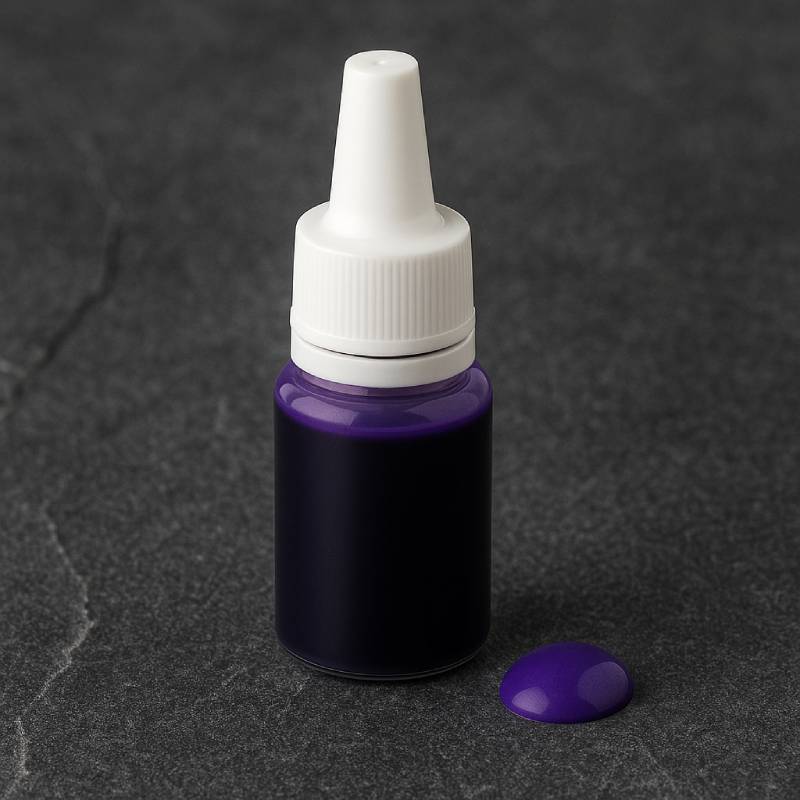
Deep purple shade engineered for large-scale food manufacturing
This 1 liter violet colorant is built for facilities that need consistent, repeatable results across large production runs - confectionery plants, beverage manufacturers, ice cream and jelly producers, and industrial bakeries. It is a water-soluble pigment belonging to the Liquid Water-Soluble Dyes category, which brings together liquid pigments for coloring water-based and mildly alcoholic mediums without settling and with even distribution throughout the entire volume. See additional shades and volumes in the Liquid Migrating Dyes Wholesale section.
The primary field of use for this colorant is food manufacturing: tinting syrups, creams, glazes, jellies, marmalade, alcoholic and non-alcoholic beverages, as well as decorative elements for cakes and desserts. Beyond food applications, similar pigments are commonly used in candle making, bath bombs and household chemical goods, where a stable, saturated color without migration into packaging is equally important. A violet tone is often achieved by blending red and blue components, so this colorant pairs well with other water-soluble pigments - for instance with Blue Food Coloring 10 ml to reach cooler blue-violet notes, or with Olive food colorant 10 ml to produce muted earthy tones for decorative recipes.
For industrial use, the colorant should be introduced during the mixing stage of the liquid base at temperatures not exceeding 60-70 degrees Celsius to prevent pigment breakdown and loss of color intensity. The recommended dosage typically ranges from 0.5 to 3 ml per liter of finished product depending on the desired saturation and the transparency of the base - dense creamy textures require a higher dose, while clear syrups and beverages need only a minimal concentration. Before adding the colorant to a large batch, it is advisable to pre-dilute a small amount in warm water to ensure even color distribution and avoid localized spotting.
The colorant is compatible with most food thickeners, preservatives, flavorings and sweeteners, and blends well with other liquid pigments in the range, including Methylene Blue Water-Soluble Dye 10 g, which is often used for fine-tuning the shade toward a deeper blue undertone. Thanks to the 1 liter volume, this format is convenient for plants working with large production batches, as well as for laboratories developing recipes before scaling up to a full production line.
Store the colorant in a tightly sealed container, in a dark, cool place away from direct sunlight and heat sources, at room temperature without sudden fluctuations. Once opened, use the content within the period stated by the manufacturer, keeping the container free from moisture and contamination.
Violet berry glaze for industrial dessert lines
Purified water 4500 ml
Sugar 2800 g
Citric acid 14 g
Corn starch 60 g
Violet food color 7 ml
Berry flavoring 18 ml
Dissolve the corn starch in a small portion of cold water and set aside, then bring the remaining water and sugar to a gentle boil, stirring until fully dissolved. Slowly whisk in the starch mixture and simmer for 8 to 10 minutes until slightly thickened, then remove from heat and cool to about 60 degrees Celsius. Stir in the citric acid, berry flavoring and the pre-diluted violet colorant until the mixture reaches a uniform deep purple tone, then transfer to storage containers for use as a glaze or filling in dessert production.
Frequently asked questions
What bases accept the 1 L violet food color without sediment?
It dissolves evenly in water, aqueous phase and glycerin for uniform tinting of syrups, creams and jellies. Begin with a small amount and adjust on a test batch to achieve the desired shade in production.
How to store the purple liquid dye until October 2028?
Keep in a dry cool place inside a tightly closed container away from light. The 1 liter pack suits confectionery workshops and beverage makers needing steady supply.
Is a COA available for this food grade violet dye?
A certificate of analysis is supplied on request to confirm compliance with food color standards. Useful for large-scale baking and dessert manufacturers.
Which other dyes mix well with violet in glycerin bases?
Combine with additional water-soluble colors to achieve cooler or muted tones in glazes and drinks. Always test compatibility on a small sample first.