Euxyl K 712 Preservative for Acidic Water-Based Cosmetic Formulations
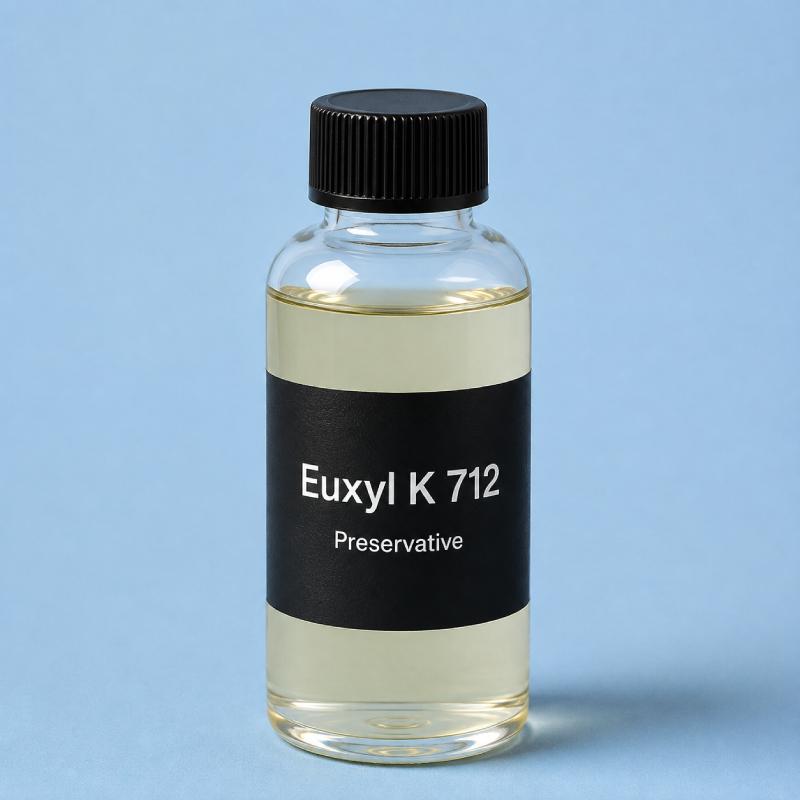
Euxyl K 712 is a liquid preservation system developed for cosmetic and personal care formulations containing water. Its INCI is Sodium Benzoate, Potassium Sorbate, Aqua. The combination is used to support microbiological stability against bacteria, yeasts, and molds in leave-on, rinse-off, and wet wipe applications.
For formulators working with toners, serums, gels, lotions, shampoos, conditioners, cleansing products, and other aqueous systems, Euxyl K 712 provides a practical option when the finished formulation can be maintained within an acidic pH range.
Other preservation systems for professional formulation can be explored in the Preservatives and Antioxidants section, where different preservative technologies can be selected according to formulation type, pH, surfactant system, and processing conditions.
Composition and formulation role
Euxyl K 712 contains sodium benzoate and potassium sorbate in an aqueous carrier. The performance of these preservative components depends strongly on the acidity of the finished product.
For this reason, preservative selection should not be based only on the water content of a formula. The complete composition must be considered, including botanical extracts, hydrosols, surfactants, proteins, electrolytes, humectants, packaging type, manufacturing hygiene, and final pH.
The product is suitable for anionic, cationic, and nonionic systems, which makes it relevant for a broad range of personal care formulations.
It contains no parabens, phenoxyethanol, isothiazolinones, or formaldehyde donors, making it useful in formulation concepts where these preservative technologies are intentionally excluded.
Recommended use level and pH
The recommended use level of Euxyl K 712 is generally 0.5-1.5% of the finished formulation.
Its effective working range is acidic, approximately pH 3.0-5.5. Preservative performance decreases as the formulation moves outside the recommended pH conditions, so the pH of the complete finished batch should always be measured after all major ingredients have been incorporated.
Do not evaluate preservation suitability based only on the pH of distilled water, a hydrosol, or an individual botanical extract.
For pH adjustment, formulators can use ingredients such as Citric Acid. A diluted citric acid solution is easier to dose accurately than dry acid added directly to a finished formulation.
The acid should be added gradually while monitoring pH rather than using a fixed quantity in every batch.
Processing and incorporation
Euxyl K 712 is supplied as a water-soluble liquid and can be incorporated into aqueous and emulsion systems with adequate mixing.
For heated processes, addition during the cooling stage is often convenient. The preservative should not be exposed unnecessarily to prolonged high-temperature processing.
After incorporation, mix the batch thoroughly and check the final pH. If pH adjustment is required, correct it gradually and measure again after complete mixing.
The presence of a preservative alone does not establish the shelf life of a finished cosmetic product. Commercial products should be evaluated as complete formulations, taking into account microbial challenge testing where appropriate, packaging, raw material quality, manufacturing conditions, and intended use.
Compatibility with botanical extracts and functional ingredients
Water-based botanical ingredients can increase formulation complexity and should be considered when designing the preservation system.
For example, Cucumber Glycolic Extract is a water-compatible botanical ingredient with an INCI based on Propylene Glycol, Water, and Cucumber Fruit Extract. Its recommended use level on the Mylo Opt product page is 0.05-5%.
Another suitable ingredient for aqueous systems is Aloe Extract Concentrate, which can be incorporated into toners, gels, serums, and other water-based formulations according to the specification of the selected raw material.
For cleansing and solubilizing systems, Polysorbate 20 can be used as a nonionic surfactant and solubilizing component in suitable cosmetic formulations.
Cucumber and Aloe Micellar Cleansing Water
The following 100 g laboratory formula demonstrates one possible way to use Euxyl K 712 in an acidic water-based cleansing system.
Distilled water - up to 100 g
Polysorbate 20 - 2 g
Vegetable glycerin - 3 g
Cucumber Glycolic Extract - 3 g
Aloe Extract Concentrate - 2 g
Euxyl K 712 - 1 g
10% Citric Acid solution - as required for pH adjustment
Begin by placing most of the distilled water into a clean mixing vessel.
Add vegetable glycerin and mix until uniform.
Slowly introduce Polysorbate 20 while stirring gently to minimize foam formation.
Add Cucumber Glycolic Extract followed by Aloe Extract Concentrate. Continue mixing until the system is visually uniform.
Add 1 g of Euxyl K 712 and mix thoroughly.
Measure the pH of the complete formulation. For this test formula, a practical target can be approximately pH 4.8-5.2 while remaining within the recommended range below pH 5.5.
Prepare a 10% aqueous solution of Citric Acid. Add the diluted acid in small increments, mixing and measuring pH after each addition.
Do not automatically add 1 g of citric acid or citric acid solution. The amount required depends on the actual starting pH of the water and all other raw materials used in the batch.
Once the desired pH has been reached, add enough distilled water to bring the total batch weight to exactly 100 g.
Mix gently until homogeneous and recheck the pH after the formulation has equilibrated.
Appearance and formulation evaluation
The final product should be a low-viscosity cleansing liquid. Its exact clarity and color will depend on the grade, color, and concentration of the botanical extracts used.
For this reason, a finished micellar or cleansing water containing botanical extracts should not automatically be described as crystal clear or completely colorless.
Before commercial production, evaluate the formula for clarity, precipitation, odor changes, pH drift, compatibility with the selected packaging, and overall physical stability.
Preservation performance must be assessed on the complete finished formulation rather than assumed from the addition of Euxyl K 712 alone.
Scaling for professional production
When scaling this formulation from a laboratory sample to a production batch, maintain the same ingredient ratios while controlling mixing conditions, order of addition, temperature, water quality, and final pH.
The preservative concentration should remain within the recommended use range, but an effective preservation strategy also depends on manufacturing hygiene, microbial quality of raw materials, botanical load, packaging design, and consumer use conditions.
Euxyl K 712 is therefore best treated as one part of a complete formulation strategy for acidic water-based cosmetic and personal care products rather than as a standalone guarantee of shelf life.