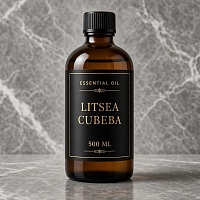
Why Litsea Cubeba Brings a Bright Citrus Edge to Fragrance Blends
Litsea cubeba, also known as may chang, yields an essential oil prized worldwide for its vivid lemony-citrus profile, making it a staple ingredient in the fragrance, cosmetic and food flavoring industries. The oil is produced through steam distillation of the plant's small peppercorn-like fruits, grown mainly across Southeast Asia, and global demand comes largely from perfumers, household chemical manufacturers and personal care brands. This item belongs to the Essential Oils section, which brings together plant-derived concentrates for skincare, home fragrance and technical formulations alike. The 10 ml size is well suited for home-based formulation work, recipe testing and small trial batches before scaling up.
The primary industrial use of litsea cubeba lies in fragrance and scenting applications: it appears in eau de toilette, air fresheners, laundry detergents, body and hair care products thanks to its lasting fresh top note that lifts an entire composition. On a household level, the oil is used to scent candles, sachets and reed diffusers and as part of cleaning routines, while aromatherapy practitioners value it for creating an energizing atmosphere and as a component of massage blends heavily diluted in a carrier oil. In skincare formulations, litsea cubeba is added to products for oily and blemish-prone skin, shampoos, shower gels and deodorants, functioning as a natural fragrance note and supporting ingredient within the overall formula.
When building a fragrance composition, litsea cubeba pairs particularly well with floral and woody notes. It blends smoothly with Melissa essential oil, reinforcing the citrus accord, and complements the delicate floral character of Neroli essential oil, which softens the sharper lemon edge. It also works well alongside Palmarosa essential oil, which adds a subtle green-floral roundness to the overall blend.
Litsea cubeba should be introduced at the final stage of formulation, at temperatures not exceeding 40 degrees, to preserve its volatile aromatic compounds. In cosmetic emulsions and body care products, the typical dosage ranges from 0.1 to 1 percent of the total formula, while in candle and sachet fragrances the ratio is adjusted individually depending on the desired scent strength. For aromatherapy blends and massage oils, concentration should not exceed 1-2 drops per 10 ml of carrier oil. The oil is sensitive to light and heat, so it should be stored in a tightly closed dark glass bottle, in a cool place away from direct sunlight and heat sources.
Energizing Citrus Room Mist
Distilled water 95 ml
Perfumer's alcohol 5 ml
Litsea cubeba essential oil 10 drops
Melissa essential oil 3 drops
Combine the alcohol with both essential oils in a small container and stir until fully blended, then slowly pour the mixture into the distilled water while stirring gently. Transfer the finished blend into a spray bottle, shake lightly before each use, and mist over textiles or into the air to refresh living and working spaces.