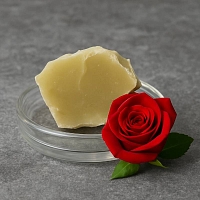
A Floral Wax Built for Fragrance Fixation and Bulk Production
Rose wax is a natural plant-derived product obtained through processing floral raw material, widely used across the fragrance, cosmetic, and food industries. This ingredient belongs to the category of waxes for cosmetics, which brings together plant-based and synthetic thickeners used in manufacturing creams, balms, candles, and decorative products. The 1 kg packaging is aimed at studio and small-batch industrial production, where consistent raw material supply and easy recipe scaling matter for repeatable results.
The primary application of rose wax lies in perfumery, where it acts as a fixative that helps volatile aromatic compounds linger longer on skin or within a finished product. The wax is also valued in premium candle making, giving products a distinctive natural scent without relying on synthetic fragrances, and in confectionery production, where it forms a glossy protective layer on chocolate items and glazes. In skincare formulations, the wax is commonly included in lip balms, body creams, and nourishing masks, where it softens skin and supports moisture retention.
Structurally, rose wax is a hard plant wax with a relatively high melting point, so it should be introduced into the oil phase during the heating stage, typically within a range of 65 to 75 degrees Celsius, allowing it to fully melt before adding other lipid ingredients. Recommended dosage in cosmetic emulsions ranges from 3 to 8 percent of total product mass depending on the desired firmness. For candles and fragrance compositions, the dosage can go up to 10-15 percent when a stronger aromatic effect is needed.
Rose wax pairs well with other plant waxes and oils, allowing formulators to build complex textures. For instance, combining it with lavender wax adds a calming quality suited to formulas for sensitive skin, while blending in sage wax enhances the cleansing character of the finished product. To soften the texture and boost nourishing qualities, many formulators add avocado wax, which complements the dense structure of rose wax with a lighter consistency.
Store rose wax in a tightly sealed container, in a dry place away from direct sunlight, at room temperature not exceeding 25 degrees. Under proper storage conditions, the product retains its properties for an extended period without quality loss. Before working with the full 1 kg volume, it is advisable to portion out the needed amount into a separate container to minimize frequent opening of the main packaging and prevent moisture exposure.
Solid Perfume Bar with Rose Wax
Rose wax 22 g
Jojoba oil 28 ml
Sweet almond oil 18 ml
Fragrance oil 6 ml
Vitamin E 2 ml
Combine the rose wax and jojoba oil in a heatproof container and melt over a water bath at around 70 degrees Celsius until fully liquid. Remove from heat and stir in the sweet almond oil, vitamin E, and fragrance oil, mixing thoroughly with a wooden stick. Pour the warm mixture quickly into small tins or solid perfume tubes and let it set at room temperature for two to three hours until fully hardened.