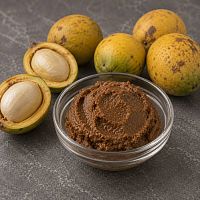
Why Amazonian Tucuma Butter Is a Favorite in Hair Repair Formulas
Tucuma butter is extracted from the fruit of a palm tree native to the Amazon basin, and worldwide it has become a recognized ingredient among formulators working on repair treatments for dry, damaged and curly hair. Its fatty acid profile is similar to babassu and coconut butter, but it offers a more pronounced smoothing effect on the hair cuticle, which is why it frequently appears in leave-in conditioners, hair masks and anti-frizz serums. The compact 10 g size is well suited for home formulators and small-batch testing, letting you trial a new recipe before committing to a larger purchase.
Tucuma butter belongs to the butters category, meaning it stays solid at room temperature and melts on contact with skin or when gently heated. It should be introduced during the oil phase of a formulation, melted on a water bath to around 32-35 degrees Celsius, and the overall mixture should not be heated above 60-65 degrees to preserve the beneficial fatty acids and avoid oxidation.
The most common global use of tucuma butter is in hair care: repair masks for split ends, conditioners for color-treated and chemically processed hair, and scalp treatments for dryness and flaking. In skin care it appears in hand and elbow balms, creams for very dry skin, and protective lip sticks for cold climates. It pairs well with lighter oils such as jojoba, sweet almond and argan, as well as with other butters to adjust the final texture. Combined with the firmer sal tree butter, it produces a more spreadable balm, while adding the fragrant vanilla butter gives a natural scent without synthetic fragrance.
A typical usage rate for tucuma butter in formulations ranges from 5 to 20 percent of the total oil phase, depending on the desired texture and product type. Lighter creams need only a small amount, while thicker balms and masks can use a higher proportion. It also blends nicely with lighter refined butters, such as refined pumpkin seed butter, allowing formulators to layer textures for intensive hand and body treatments.
Store tucuma butter in a cool, dry place away from direct sunlight, in a tightly sealed container, to prevent premature oxidation of the fats. Under proper storage conditions the butter retains its qualities for a long period.
Overnight Repair Balm for Split Ends
Tucuma butter 10 g
Sweet almond oil 15 ml
Vitamin E 2 ml
Essential oil of rosemary 2 drops
Melt
the tucuma butter over a water bath until fully liquid, remove from heat and
let it cool slightly. Stir in the sweet almond oil until fully combined, then
add vitamin E and the rosemary essential oil, mixing gently until smooth. Pour
the mixture into a small clean jar and allow it to solidify at room temperature
for a few hours. Apply a small amount to dry ends before bed for intensive
overnight repair.
The INCI designation used in documentation is Astrocaryum tucuma. Melting point per specification: 25 - 37°C.
FAQ
How does the refined versus unrefined grade of tucuma butter differ?
The product is supplied as unrefined butter with a dense oily texture and a latte-caramel scent. Any further grade details are available in the specification on request.
What is the minimum wholesale batch size and available pack options for tucuma butter?
Current pack size is 10 grams; wholesale batch requirements and other options are listed in the product specification available on request.
What is the shelf life of tucuma butter and how to recognise rancidity?
The indicated date for the current lot is 10.2028. Signs of rancidity and storage advice are given on the label and in the specification.