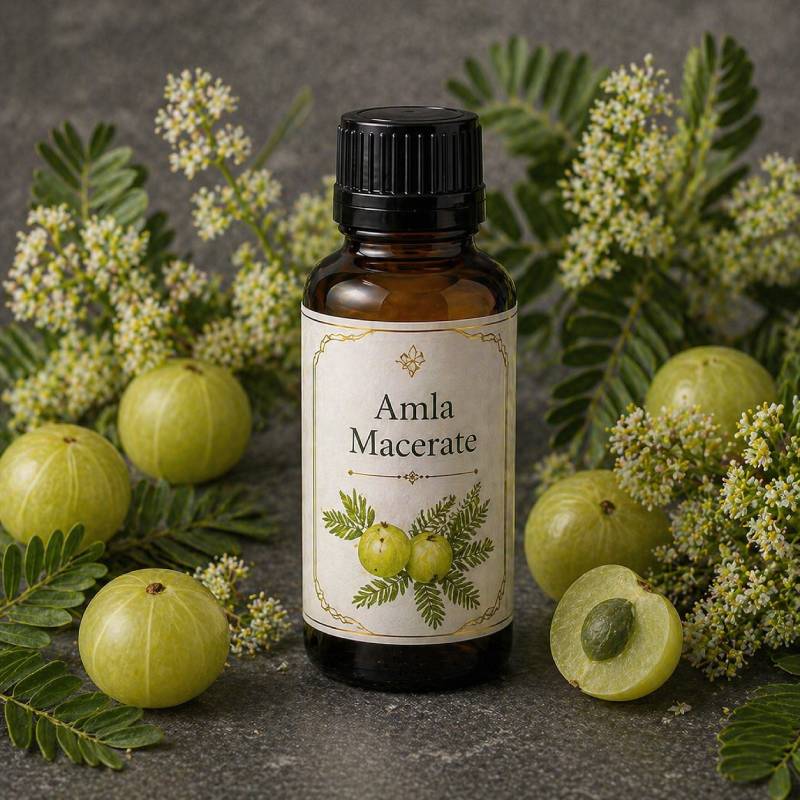
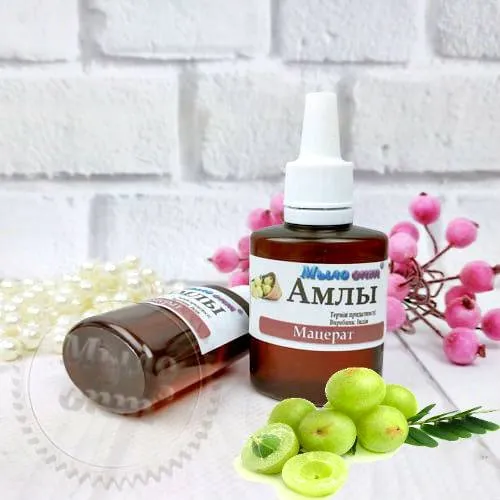
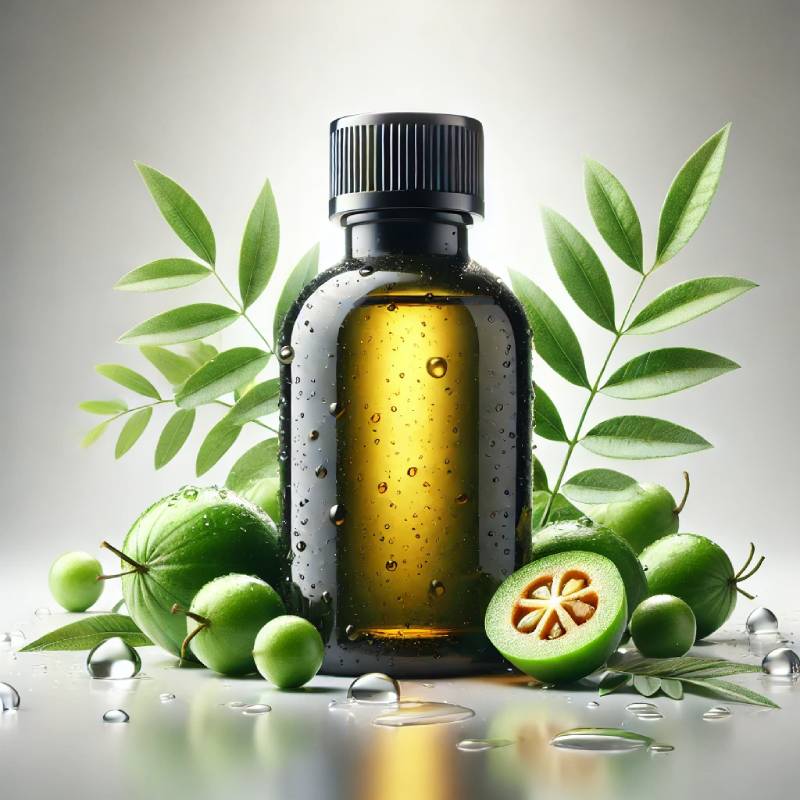
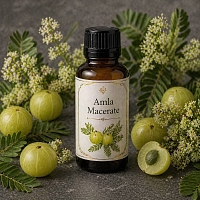
Amla macerate oil botanical lipid ingredient for oil-based formulations and functional systems
Amla macerate oil is a plant-derived lipid extract obtained by infusing amla fruit into a carrier oil, transferring lipophilic compounds into a stable oil phase. This format allows direct use of botanical components in oil systems without additional solubilization steps. It is used in cosmetic formulations, nutraceutical oil systems, SPA applications, aromatic blends and technical processes where lipid-based media are required.
From a formulation perspective, amla macerate oil is a complex of oil-soluble plant constituents already dispersed in a carrier oil. It functions as part of the lipid phase and contributes to the active profile of oil-based systems. Unlike aqueous extracts, it integrates easily into anhydrous formulations and becomes part of the oil phase in emulsions without affecting the structural framework.
Amla macerate is produced by infusing amla fruit into castor seed oil to transfer lipophilic components into the lipid phase. It integrates into anhydrous formulas and emulsions as part of the oil phase. Explore Macerated Oils Wholesale and check .
In cosmetic applications, amla macerate oil is used in oil serums, balms, creams, hair care products and conditioning blends. In hair formulations, it is incorporated into oil-based systems designed for even distribution along the hair surface. In SPA applications, it is used in massage oils and aromatic compositions. In fragrance systems, it can serve as a base component for uniform distribution of aromatic substances. In nutraceutical contexts, similar macerates are used in lipid carriers when formulation compatibility is ensured. In industrial environments, it may be applied in oil-based processing systems requiring stable lipid media.
Functionally, amla macerate oil distributes evenly within the oil phase and supports uniform incorporation of botanical compounds. It contributes to flow properties, compatibility and overall system stability. In emulsified systems, it forms part of the lipid phase, while in oil-only formulations it ensures homogeneity.
In formulation practice, the macerate is added directly into the oil phase during blending. It is compatible with vegetable oils, esters, waxes and oil-soluble additives. It remains stable under standard processing temperatures and can be used both as a base component and as a functional additive.
Usage levels are defined by technical specifications and optimized by the formulator depending on the formulation objectives.
Example formulation: Hair oil serum with botanical base
Argan oil 35 g
Fractionated coconut oil 25 g
Amla macerate oil 15 g
Jojoba oil 15 g
Vitamin E 2 g
Fragrance composition 8 g
Process: base oils are combined and mixed until a uniform blend is achieved. Amla macerate oil is incorporated with continuous mixing to ensure even distribution. Vitamin E and fragrance are added at the final stage. The formulation is mixed until homogeneous and then filled.
Example formulation: Nourishing oil-based body balm
Shea butter 30 g
Cocoa butter 20 g
Amla macerate oil 15 g
Sweet almond oil 20 g
Beeswax 10 g
Vitamin E 2 g
Fragrance composition 3 g
Process: solid components are melted and combined with liquid oils to form a uniform base. Amla macerate oil is added with mixing to ensure proper dispersion. Vitamin E and fragrance are incorporated, and the mixture is cooled under controlled conditions until a stable structure is formed.
Amla macerate oil is used in formulations where incorporation of botanical components into lipid systems is required. It provides uniform distribution, compatibility and stability across cosmetic, SPA and production applications.
When pairing ingredients in one formula, consider Amla Macerate 25 ml.
The INCI designation used in documentation is Ricinus communis seed oil, Emblica officinalis fruit extract.
FAQ
What is the fatty acid profile and oxidative stability of Amla Macerate?
The fatty acid profile and oxidative stability values are not listed in the product data.
What input percentage and phase of addition apply to Amla Macerate?
Recommended input levels are 3-5% in lotions and creams, 5-50% in balms, and 2-5% in hair conditioners. It is added to the oil phase.
How does the extraction method affect the quality of Amla Macerate?
The macerate is obtained by infusing amla fruit in a carrier oil. Details of the method and resulting quality parameters are available in the specification on request.
How does Amla Macerate combine with other oils or actives?
It is compatible with oil-based systems and functions as part of the lipid phase.