What the Amino Acid Complex Represents
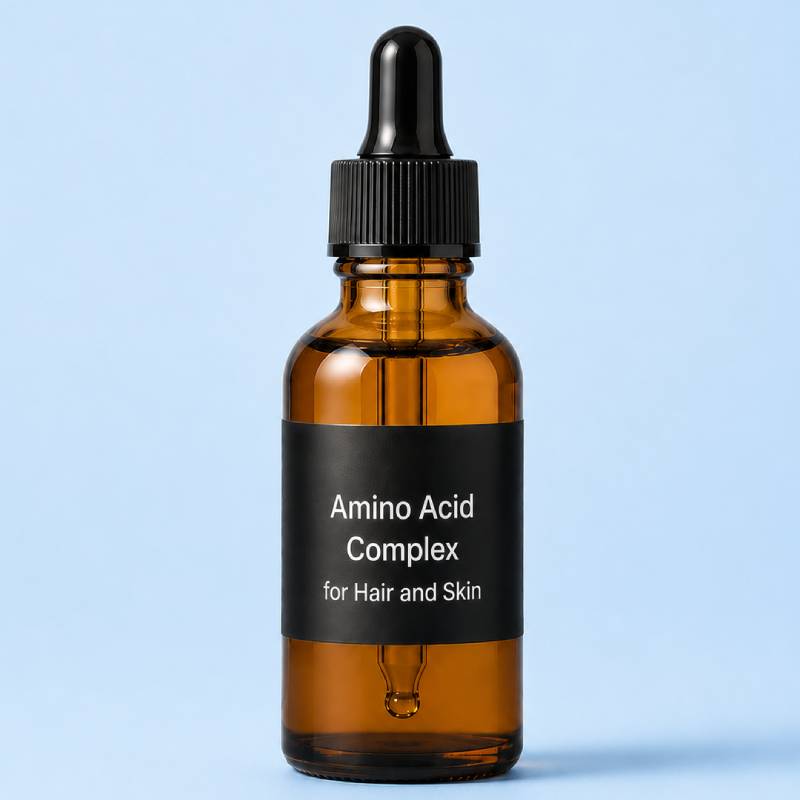
Amino Acid Complex for Skin and Hair 25 ml is a water soluble liquid ingredient known as Prodew 500. It consists of Sodium PCA, Sodium Lactate, Arginine, Aspartic Acid, PCA, Glycine, Alanine, Serine, Valine, Proline, Threonine, Isoleucine, Histidine, Phenylalanine and Water. The product appears as an opalescent liquid and serves as a ready multicomponent system for cosmetic formulations that contain an aqueous phase. This 25 ml pack supports initial testing, sample development and small laboratory batches. For larger production volumes the same ingredient is available in the 1 litre pack.
Main Properties
The complex moisturizes hair and skin. It increases hair strength, smoothness, elasticity and stress resistance. It also helps maintain color in dyed hair. The ingredient remains stable across a pH range of 3.00 to 10.00 and integrates easily into water based systems. Its opalescent appearance does not alter the visual character of most finished products when used within recommended limits.
Applications in Hair Care Products
Formulators use the complex in shampoos, conditioners, hair masks, styling products and care formulas for colored hair. It functions as a moisturizing and conditioning component that supports hair smoothness, shine and silkiness. The complex works within the aqueous phase and pairs with other compatible conditioning materials when the full system is tested in the laboratory. Related options for hair formulas appear in the section dedicated to hair actives.
Applications in Skin Care Products
The same ingredient finds use in creams, lotions, tonics, cleansing products, shower gels, pre and post sun products, makeup bases and foundations. In skin formulas it contributes moisturizing and conditioning effects that complement other water soluble actives. Compatibility with the complete recipe must be verified through laboratory samples because interactions depend on the full ingredient list.
How to Introduce the Complex into Formulations
Add the liquid directly to the aqueous phase during preparation. Typical input levels reach up to 1 percent in hair products and up to 5 percent in skin products. Exceeding these levels may produce the opposite effect, therefore laboratory testing determines the exact concentration for each formula. The product is water soluble and remains effective within the stated pH window, yet the final product pH should reflect the requirements of all components. Avoid eye contact during handling.
Example of Use in a Formulation
A simple moisturizing serum demonstrates practical incorporation. Combine 66 ml purified water with 5 g glycerin and 2 g additional Sodium PCA until uniform. Introduce 10 ml of 1 percent hyaluronic acid solution and 2 g beta glucan, then allow stabilization. Add 12 g Amino Acid Complex for Skin and Hair while stirring. Finish with 3 g panthenol, 1 g preservative and 1 g pH adjuster. Mix until the system reaches a clear stable state. All quantities are expressed in grams or milliliters for precise scaling.
Storage Conditions
Keep the container in a cool dark place with the closure tightly secured. The stated shelf life extends until October 2028 under these conditions. Always confirm the batch specific expiration date on the label before use.
FAQ
Can the complex replace individual amino acids in a formula?
It supplies a prebalanced mixture of Sodium PCA, Sodium Lactate and multiple amino acids, so it serves as a convenient single addition rather than a substitute for separate raw materials listed in the parent catalog of cosmetic actives.
What happens if the recommended percentage is exceeded?
Exceeding the stated input levels may produce the opposite effect on hair or skin feel, therefore laboratory evaluation remains essential before scaling any recipe.
Is the ingredient suitable for both hair and skin systems?
Yes, the same liquid works in hair care and skin care formulas when the dosage is adjusted according to the product type and confirmed through stability testing.
Does the complex require special handling beyond standard cosmetic procedures?
Standard precautions include avoiding eye contact and verifying compatibility with surfactants, thickeners and preservatives in the final system.