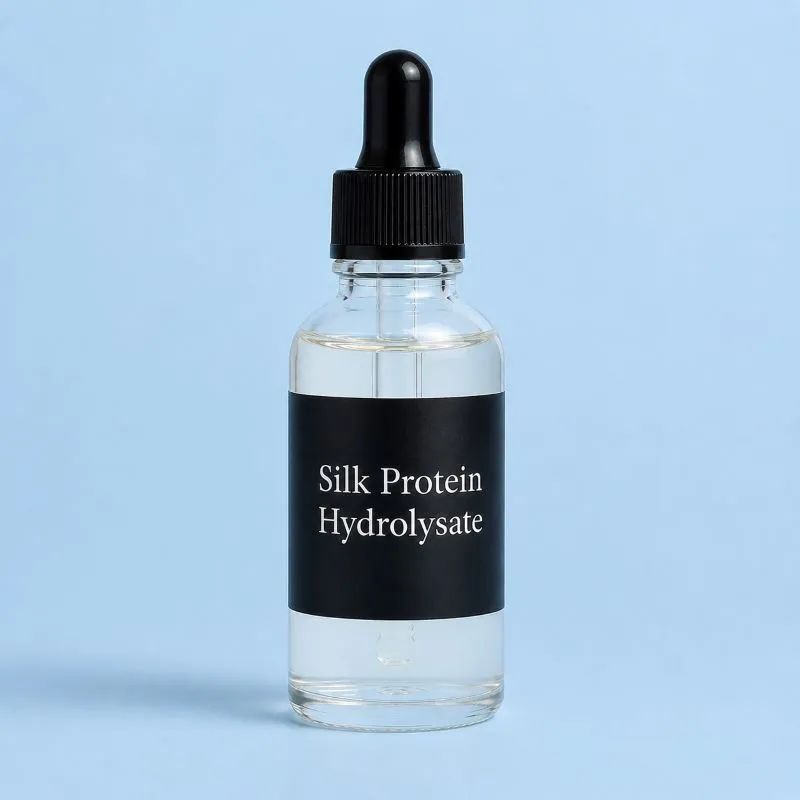
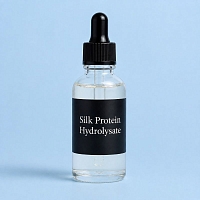
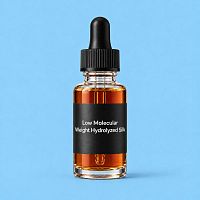
Silk Protein Hydrolyzate 50 ml is Hydrolyzed Silk sourced from silk through enzymatic hydrolysis, incorporated at 1-8% in cosmetic bases with the option to buy wholesale shipping from Ukraine.
Product specifications and handling
Silk Protein Hydrolyzate 50 ml appears as a light or light-yellow liquid with pH 5.0-6.5. It is fully soluble in water at any concentration. The material is produced in Germany from silk via protein hydrolysis. Hydrolyzed Proteins
Form and storage requirements
Store in a dry cool place in airtight containers protected from light. Shelf life until December 2028. The product integrates easily into aqueous and emulsion systems without heating above 40 degrees.
Active components
The hydrolysate contains glycine, alanine, serine, tyrosine, arginine, aspartic acid and threonine. No special certifications are claimed beyond standard cosmetic raw material quality.
Applications for B2B buyers
Formulators add the ingredient to shampoos, conditioners, hair masks, creams, serums and toners. It supports smoother skin appearance and hair that looks softer and shinier. Suitable for production batches and private label lines. Hydrolyzed Proteins Wholesale
Recommended usage levels
Input percentage 1-8%. Cleansing gels use 1-3%, mature skin masks 4-7%, mattifying fluids 1-3%, foot softening 7-8%, shampoos 5-8%, micellar water and hair sprays 3-5%. Add in the cool-down phase. Silk Protein Hydrolyzate 1 L
Example hair serum formulation
Composition: 78% water, 8% humectant, 5% Silk Protein Hydrolyzate, 4% conditioning agent, 3% solubilizer, 2% preservative. Combine water with humectant, add conditioning agent and solubilizer, then incorporate Silk Protein Hydrolyzate and preservative at room temperature. Mix until clear.
Compatibility with formulation systems
This hydrolysate performs reliably in both water-based and light emulsion products. It does not alter viscosity significantly and maintains a light after-feel. International buyers can incorporate it into existing lines for hair care and skin care without reformulation challenges. Stability tests confirm performance across typical pH ranges used in cosmetics.
Wholesale and batch considerations
Wholesale packs are available for larger production runs.
Frequently asked questions
What is the exact appearance?
Light or light-yellow liquid.
At what temperature should it be added?
Maximum 40 degrees Celsius in the cool-down phase.
Is it suitable for leave-in products?
Yes, recommended at 3-5% in sprays and serums.
How does it affect texture?
It supports a light film that leaves skin and hair looking smoother.