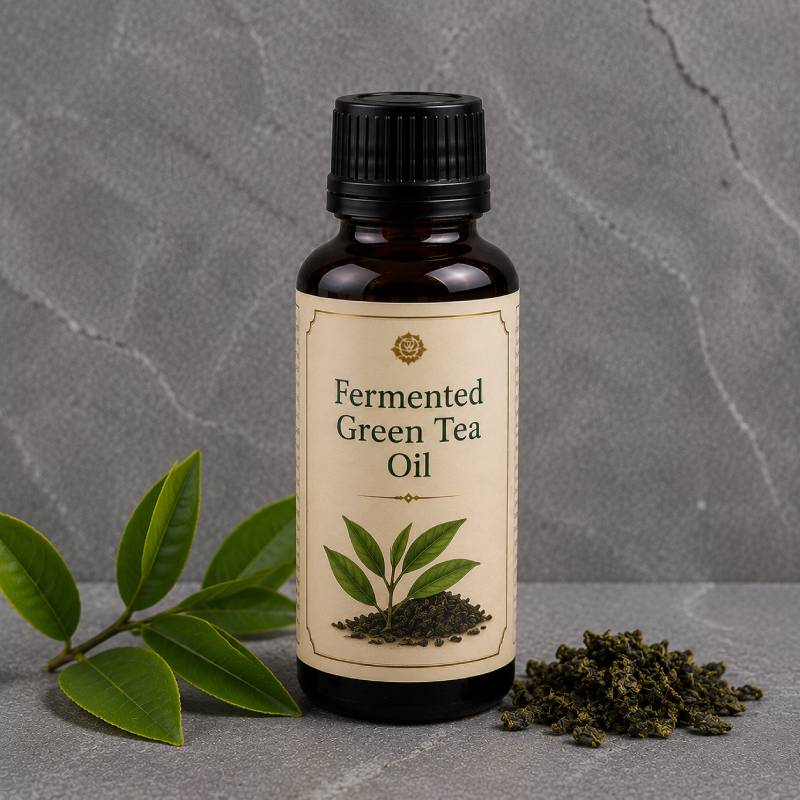
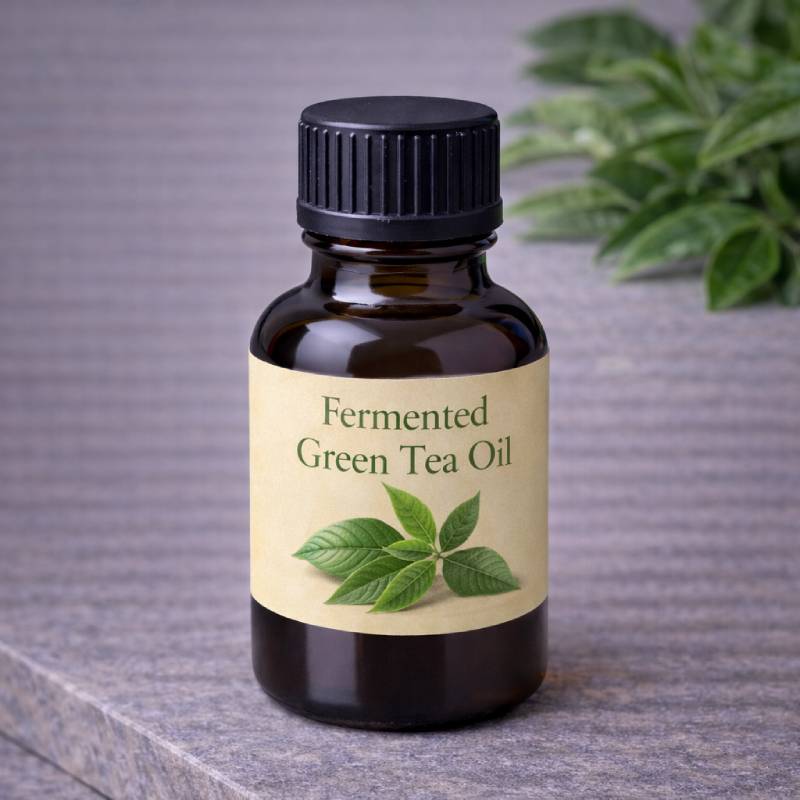
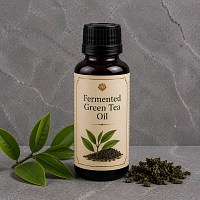
Fermented Green Tea Oil as bio-modified lipophilic ingredient for B2B formulation systems
Fermented green tea oil derived from Camellia sinensis through controlled biotechnological processing is used in formulation systems as a lipophilic ingredient with modified composition of oil-soluble compounds. The fermentation process alters the structure of plant-derived components, improving compatibility, stability, and behavior within oil phase systems. In B2B development, this ingredient is applied to create stable emulsions, anhydrous formulations, and hybrid systems with controlled texture and reproducible performance during industrial scale production.
Functional role in formulation systems
Fermented green tea oil functions as an emollient and structural component within the oil phase, enhancing product distribution and contributing to uniform system formation. In formulation systems, it supports the development of a stable lipophilic matrix, enabling even dispersion of components. Due to its modified structure, the ingredient demonstrates improved compatibility in complex formulations and provides more predictable interaction with other lipophilic materials.
Behavior in formulation
The ingredient is fully soluble in the oil phase and is typically introduced at temperatures between 20–70°C depending on formulation type. It remains stable under moderate heating conditions, although prolonged exposure to high temperatures may affect volatile fractions. In combination with waxes, esters, and emollients, it influences rheological properties such as flow and plasticity. In emulsion systems, proper emulsifier selection is required to maintain structural stability.
Impact on product
Fermented green tea oil contributes to a lighter and more flexible texture, improves spreadability, and enhances formulation uniformity. In creams and emulsions, it supports even application and structural consistency. In oil-based systems, it helps regulate flow properties and reduces the perception of excessive heaviness. When combined with other emollients, it allows fine adjustment of sensory characteristics.
Application areas
The ingredient is used in creams, serums, oils, balms, masks, as well as in shampoos and conditioners. It is applied in SPA formulations, massage systems, and professional care products. Widely used in contract manufacturing and private label development where formulation stability and reproducibility are critical.
Formulation incorporation
Fermented green tea oil is added to the oil phase during the blending stage. Typical usage levels range from 1–10% depending on formulation objectives. It can be combined with base oils, emollients, and structuring agents to achieve the desired texture. Controlled temperature and uniform mixing are essential for optimal performance.
Recipe Oil serum with fermented complex
Ingredients:
Jojoba oil — 40 ml
Grape seed oil — 30 ml
Fermented green tea oil — 10 g
Squalane — 10 ml
Vitamin E — 1 g
Processing
Base oils are blended at 30–40°C until uniform. Fermented green tea oil is then added under continuous mixing to ensure even distribution. Squalane and vitamin E are incorporated afterward, and the system is mixed until homogeneous. The formulation is left to stabilize to achieve final consistency.
Instruction
The ingredient should be incorporated into the oil phase under controlled temperature conditions, avoiding overheating. Proper mixing is required to ensure uniform distribution. In multi-component systems, interactions with waxes and emollients should be considered, as they may influence viscosity and texture. Stability testing under different storage conditions is recommended.
Manufacturing stability
Fermented green tea oil demonstrates stable performance when processing parameters are controlled and scales effectively in industrial production. Control of temperature, mixing speed, and ingredient addition sequence ensures reproducibility and consistency across batches.
The ingredient supports the formation of stable lipophilic systems with controlled flow properties and uniform texture, ensuring predictable performance during production.
In complex formulations, it enhances the distribution of components within the oil phase and improves overall structural stability.
Due to its fermented and bio-modified nature, the ingredient integrates efficiently into multi-component systems and provides more consistent interaction with other formulation components.