-
 Absolutes
-
 Active Complexes
-
 Actives & Peptides
-
 Amino Acids & Proteins
-
 Food Flavors
-
 Ayurvedic Ingredients & Herbs
-
 Vitamins & Coenzymes
-
 Chocolate Making Supplies
-
 Thickeners & Gelling Agents
-
 Hydrosols & Floral Waters
-
 Hydrolyzed Proteins
-
 Fragrance Ingredients
-
 Nutraceutical Ingredients
-
 Acids, Salts, Alcohols & Alkalis
-
 Preservatives & Antioxidants
-
 Cosmetic Ingredients
-
 Colorants, Micas & Glitters
-
 Masks, Scrubs & Botanicals
-
 Oils & Butters
-
 Candle Making Supplies
-
 Melt and Pour Soap Bases
-
 Cream, Lotion & Hair Care Bases
-
 Fragrance Oils & Industrial Aromatics
-
 Cleansing Agents & Surfactants
-
 Peeling Actives & Acids
-
 Cosmetic Powders
-
 Solvents & Humectants
-
 Silicones & Conditioning Agents
-
 Bottles, Jars & Vials
-
 Silicone & Plastic Molds, Tools
-
 Botanical Extracts
-
 Cosmetic Emollients
-
 Emulsifiers
-
 Essential Oils
Australian Merino 24 micron

 Add to cart






 Subscribe


Fine combed fiber for needle and wet felting work
This section offers Australian merino wool with a fiber diameter of 24 micron, a mid range fineness that sits between the softest ultra fine grades and coarser carding wool. The fiber arrives combed and ready to use, sold by weight in a set of natural and dyed color options. It suits crafters who need a fiber that holds shape under a felting needle while still blending smoothly during wet felting.
The 24 micron grade is a common choice for building three dimensional forms such as animal figures, ornaments, and small sculptural pieces, since it has enough body to keep detail work stable without becoming stiff. It also works well for surface layering on flat felted panels, scarves, and wall art, where a slightly firmer fiber helps textures stay defined after fulling. Crafters who want an even softer feel for skin contact projects often pair it with the Australian merino wool 18-21 micron, while those looking for a slightly coarser structural fiber can compare it against the Australian merino wool 23 micron.
Color options and how they differ
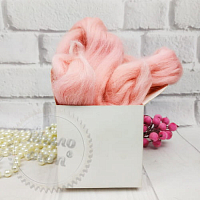
Within the 24 micron grade the range splits into natural undyed tones and dyed shades. The Australian merino 24 microns beige, 25 g keeps close to the fiber's natural color and suits pieces where a soft neutral base works better than a bright accent. Dyed batches such as the Australian merino 24 microns lemon, 25 g and the Australian merino 24 microns pale pink, 25 g carry the dye evenly through the staple, which matters when a project needs consistent shading across a large surface rather than patchy color.
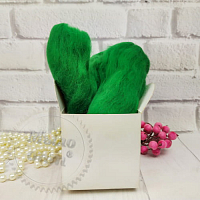
Darker tones behave a little differently under the needle. The Australian merino 24 microns black, 25 g and its larger Australian merino 24 microns black, 50 g pack are often chosen for outlines, shadow detail, and small figures where a strong contrast edge is needed against lighter fill fiber. Green shades follow the same weight logic, with the Australian Merino 24 microns green, 25 g suited to smaller accents and the Australian Merino 24 microns green, 50 g better suited to covering larger background areas without running short mid project.
Choosing a weight and combining fiber types
Weight per pack is the first practical filter. Smaller 25 g portions suit accent work, small figures, or testing a new color before committing to a larger volume, while 50 g packs reduce the chance of running out on background fill or on bigger flat panels. Color choice then follows the piece itself, natural beige for organic looking bases, saturated shades for defined details or graphic patterns.
The 24 micron fiber is rarely used alone in a single piece. Many crafters build a firmer needle felted core or structural layer with this grade, then finish the outer surface with a softer fiber for a smoother hand feel, or reverse the order depending on the technique. For projects that mix felting with other textile or fiber based decorative work, it also pairs naturally with material sourced through the wider Felting wool Ukraine range, which covers additional fiber options for layering and blending.
Origin and storage
Stock in this section is sourced from Italy and Ukraine. Keeping the fiber dry and away from direct sunlight helps colored batches hold their shade over time, and storing it loosely rather than tightly compressed keeps the staple easier to pull apart when starting a new piece. Sorting leftover fiber by color and weight after a project also makes it faster to match tones again for future work.
FAQ
What is 24 micron merino wool best used for
This fineness works for needle felted sculptures, animal figures, and ornaments where the fiber needs to hold sharp detail, as well as surface layering on wet felted panels, scarves, and wall art that benefit from a slightly firmer texture after fulling.
How does 24 micron wool differ from finer or coarser grades
It sits between ultra soft grades used for skin contact pieces and coarser wool chosen for structural strength. The 24 micron fiber offers a middle ground, firm enough to keep shape during needle work yet still workable for blending in wet felting.
Can natural and dyed 24 micron wool be blended together
Yes, natural and dyed tones from this grade blend smoothly since they share the same fiber diameter and preparation. Crafters often layer or card them together to build gradients, shading, and custom color mixes within a single project.
How should combed merino wool be stored between projects
Keep it dry, away from direct sunlight, and sealed in a breathable bag or container to prevent compression and pest exposure. Loosely stored combed fiber retains its loft and is easier to draft when you return to it later.
Recommendations
When choosing a batch of 24 micron merino wool, consider the balance between detail work and softness your project needs, and check whether natural or dyed tones better suit your color plan. Ordering by weight lets you match quantity to project scale without excess. For questions on available colors or bulk quantities, reach out by email and our team will help you confirm the right selection before your order is prepared.



