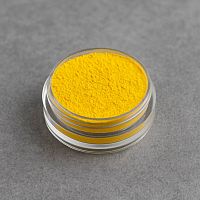
A Sunny Shade Built for Small-Batch Testing and Craft Projects
A 10 g pack of yellow cosmetic pigment is an ideal starting point for makers who want to test a new formula or work in small quantities before committing to a larger stock. This size lets you evaluate color strength and compatibility with a specific base without unnecessary waste. The pigment belongs to the Pigments section, which brings together stable coloring agents resistant to alkaline environments, elevated temperatures and UV exposure, making them useful across dozens of production fields.
Worldwide demand for pigments like this one comes from several overlapping industries. In soap making, yellow pigment is used for honey, citrus and sunny swirl designs, since it does not migrate through the base and keeps swirl patterns crisp and defined. In bath bomb and bath product manufacturing, it colors water evenly without leaving stains on tub surfaces. A particularly large segment of demand comes from epoxy resin art, where the pigment disperses smoothly, resists fading during the curing reaction, and allows both translucent watercolor-style effects and solid opaque pours. It is also widely used for decorative candle making, coloring plaster casts, polymer clay projects, and even small-batch decorative plaster or concrete work.
Yellow pigment blends well with other colorants to create custom shades: adding a small amount of red produces orange, combining it with blue gives green, while diluting with white pigment or titanium dioxide yields soft pastel or cream tones. Typical dosage ranges from 0.1 to 1 gram per 100 grams of base, depending on the intensity desired — it is best to start with a minimal amount and build up gradually to the target shade. In soap, the pigment is added at light trace; in candles, it goes into melted wax at around 60-70°C, avoiding temperatures above 90°C that can dull the color. In resin work, the pigment is mixed into either the hardener or the resin before combining the two components, stirring thoroughly until fully dissolved with no visible clumps.
Store the pigment in a tightly sealed container, away from direct sunlight and humidity fluctuations, to prevent clumping and preserve color strength over time. Wearing gloves during handling is recommended, since the concentrated powder can stain skin and work surfaces quickly. The compact 10 g format is well suited for experimentation and for keeping several shades on hand at once without risking waste of unused pigment.
Citrus swirl cold process soap bar
Melt and pour clear soap base 350 g
Melt and pour white soap base 150 g
Yellow cosmetic pigment 0.4 g
Sweet almond oil 8 ml
Lemon essential oil 6 ml
Melt the clear and white soap bases separately in a double boiler until fully liquid, avoiding boiling. Dissolve the yellow pigment in the almond oil first, then blend it into the clear base until the color is even. Stir the lemon oil into both portions, pour the white base into the mold, and swirl in the yellow portion using a thin skewer to create a marbled citrus pattern. Let the bars cure at room temperature for at least four hours before unmolding.