Sourcing and specification details
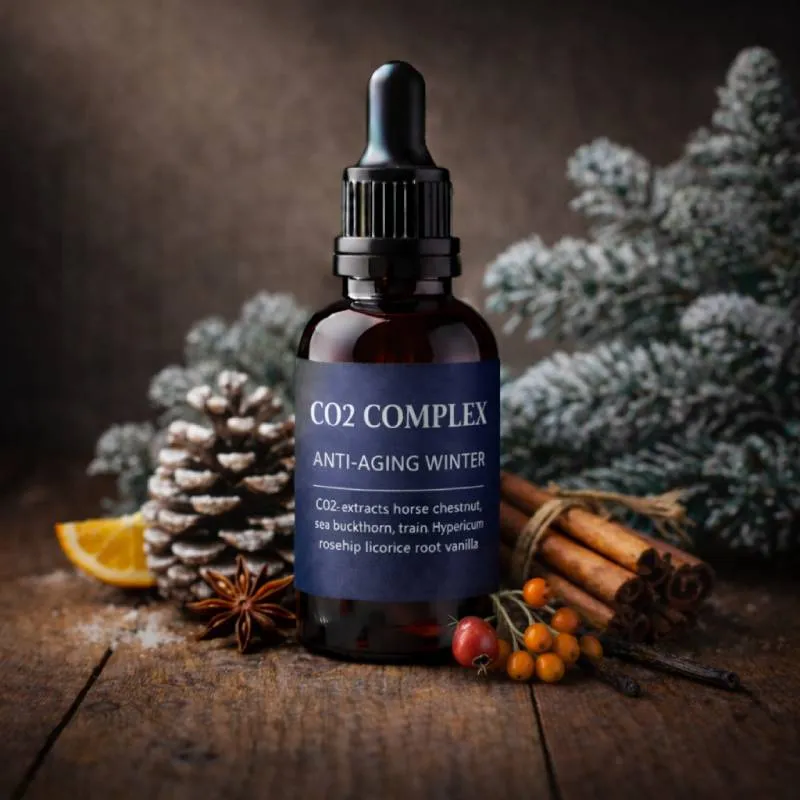
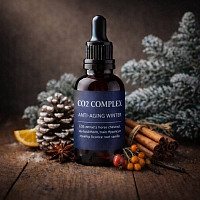
Winter CO2 extract complex is produced in England from horse chestnut, sea buckthorn, train, Hypericum, rosehip, licorice root and vanilla via supercritical extraction. The resulting oily liquid has an amber to deep orange-brown hue and herbal aroma with soft sweet notes. Supplied in 100 g transport packaging, the 100 % natural product contains no solvents or impurities. CO2 Extracts Wholesale supports consistent scaling for contract manufacturers.
Formulation compatibility and input parameters
The lipophilic concentrate dissolves in base oils and polysorbate at 0,05-1 % in the active phase. It remains stable during standard oil-phase heating and integrates with waxes and antioxidant systems without altering final texture balance.
B2B applications across cosmetics and nutrition sectors
Used in protective creams, balms, serums, masks and massage gels for seasonal lines. Winter CO2 extract complex 1 kg offers reproducible colour and sensorial profile in bulk production. Manufacturers of dietary supplements and food industry factories worldwide purchase it as botanical raw material for drinks, confectionery and functional foods, available in wholesale and retail packs.
Processing recommendations
Add after melting the oil phase with thorough mixing. Shelf life until 10.2028 when stored cool and dark in tightly closed containers. Suitable for private-label projects requiring stable organoleptics at industrial volumes.
Example toner formulation
Combine 70 ml jojoba oil, 40 ml rosehip oil and 15 g beeswax, melt. Incorporate 20 g of the complex. Prepare aqueous phase with 480 ml purified water and 45 g glycerin, emulsify, add 2 g preservative system. Yields a lightweight seasonal toner with natural tint.
Stability in scaled production
Maintains uniform colour and viscosity across batches when processed within recommended temperature ranges.
Frequently asked questions
What packaging options exist beyond 100 g?
Check section Extracts Wholesale for larger formats.
Is the complex suitable for beverage blends?
Yes, as botanical raw material in food-grade formulations at permitted levels.
Does it affect emulsion pH?
No measurable impact within standard cosmetic pH ranges.
Can it be used in hair masks?
Yes, at 0,05-0,5 % for added emollience and colour depth.