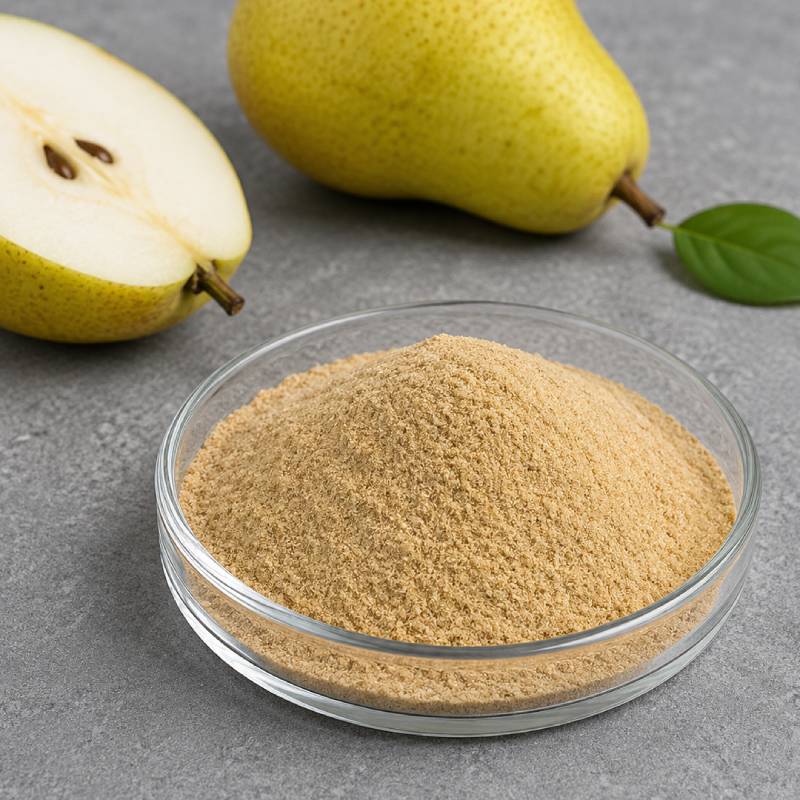
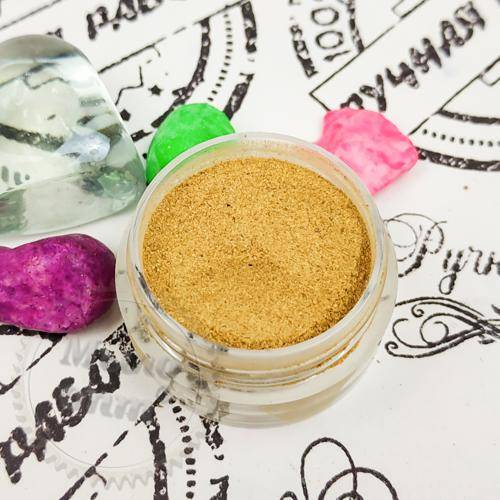
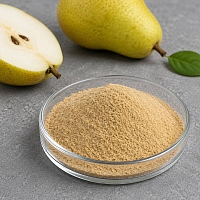
Pear Fiber for cosmetics and natural textured formulations
Pear Fiber is a plant-derived powdered ingredient designed for cosmetic formulations, soap making, body scrubs, cleansing powders, dry masks, textured wash-off products, and professional SPA applications. It is particularly suitable for product concepts where botanical origin, visible natural texture, gentle mechanical exfoliation, and fruit-inspired positioning are important.
As a formulation material, Pear Fiber offers more than a decorative botanical appearance. Depending on particle characteristics, application level, and the structure of the finished base, it can be used as a natural texturizing material, a mild physical exfoliating component, or part of a complex blend containing clays, fruit powders, botanical materials, and other compatible cosmetic ingredients.
The ingredient can be incorporated into artisan products as well as professional cosmetic manufacturing. Its application range includes anhydrous body scrubs, creamy exfoliating products, cleansing pastes, soap bars, dry powder systems, body treatments, and selected hair and scalp cleansing concepts where a textured rinse-off format is required.
Pear Fiber in modern cosmetic formulation
Textured cosmetics remain an important product category because consumers can immediately recognize the physical character of the formulation during application. Pear Fiber helps formulators create a visible botanical identity without relying only on fragrance or packaging to communicate the fruit-inspired concept.
In rinse-off body products, the ingredient can contribute to a gentle massaging sensation. The final exfoliating character depends on the complete formula, including the quantity of Pear Fiber, the presence of sugar or salt crystals, product viscosity, massage duration, and the amount of water used during application.
In dry formulations, Pear Fiber can be combined with mineral and botanical powders. These products may be mixed with water, hydrosol, or another suitable liquid immediately before use. This format is particularly interesting for professional SPA procedures and customizable cosmetic concepts.
The ingredient also provides formulation opportunities for soap makers. Its natural appearance can add visual depth to transparent, opaque, neutral, or softly colored soap bases.
Applications in body care products
Body care is one of the most practical application areas for Pear Fiber. The ingredient can be incorporated into sugar scrubs, oil scrubs, cleansing pastes, creamy exfoliating products, massage preparations, and botanical body treatments.
In anhydrous products, Pear Fiber can be dispersed in a mixture of vegetable oils, cosmetic butters, and emollients. The structure of the lipid base should be designed to maintain even distribution during storage and provide comfortable spreading during application.
For richer body products, Pear Fiber can be combined with Mango Butter, Shea Butter, Cocoa Butter, Sweet Almond Oil, Grape Seed Oil, Jojoba Oil, and other compatible lipids. The balance between solid and liquid materials determines firmness, scoopability, spreading behavior, and the residual skin feel.
Lighter rinse-off formats may use an emulsified or gel structure. In these systems, the formulator should evaluate whether the base has sufficient viscosity and suspension properties to prevent rapid settling of plant particles.
Pear Fiber in soap making
Pear Fiber is suitable for handmade soap and decorative botanical soap concepts. It can be incorporated into clear, white, cream-colored, or tinted soap bases depending on the desired appearance.
The ingredient works particularly well in pear, apple, orchard fruit, vanilla, caramel, floral, herbal, and green fragrance concepts. A pear-themed soap does not necessarily require a single-note pear fragrance. More complex combinations can create a sophisticated product identity.
When working with a ready-made soap base, Pear Fiber is generally incorporated after the base has been prepared for pouring. Gentle but thorough mixing helps distribute the particles throughout the mass.
The behavior of plant particles should be tested in the selected soap base. A very fluid system may allow particles to settle, while a rapidly thickening base may create uneven distribution. The most suitable addition point should therefore be determined during small-batch testing.
Dry masks and cleansing powder concepts
Pear Fiber provides interesting opportunities for dry cosmetic systems. Powder products can be formulated without a permanent water phase and prepared immediately before application.
The ingredient can be blended with Kaolin, cosmetic clays, Oat Powder, Rice Powder, fruit powders, and compatible botanical materials. The exact composition should be selected according to the intended texture and application method.
When developing a dry mask, it is important to evaluate not only the appearance of the powder blend but also its behavior after hydration. The prepared paste should mix easily, spread evenly, and rinse away without unnecessary difficulty.
For professional SPA applications, dry formats allow the practitioner to prepare a fresh portion immediately before the procedure. Different liquid phases may also be selected according to the product concept, provided that ingredient compatibility has been confirmed.
Compatibility with cosmetic raw materials
Pear Fiber can be combined with cosmetic clays, botanical powders, fruit powders, vegetable oils, cosmetic butters, glycerin, emollients, mild surfactants, and fragrance compositions.
In anhydrous scrubs, it works well with Sweet Almond Oil, Grape Seed Oil, Jojoba Oil, Sunflower Oil, and selected cosmetic butters. The formulation can be adjusted from a flowing oil scrub to a dense whipped or balm-like texture.
In water-containing products, plant-derived powders require additional formulation attention. The complete system should be evaluated for physical stability, preservation compatibility, appearance, odor, and changes during storage.
Fragrance selection can significantly influence product positioning. Pear Fiber is compatible with pear-inspired profiles as well as apple, vanilla, caramel, green fruit, floral, spicy, woody, and fresh botanical concepts.
How to use Pear Fiber
The method of incorporation depends on the product format.
For dry powder products, combine Pear Fiber with the remaining powdered ingredients and mix until distribution is uniform. Large-scale production may require controlled blending equipment to maintain batch consistency.
For anhydrous scrubs, prepare the lipid base first. Pear Fiber and other solid exfoliating materials can then be added gradually under continuous mixing.
For emulsified products, the ingredient is generally introduced after the primary emulsion structure has formed and the batch has cooled to a suitable processing temperature. The exact procedure should be adapted to the complete formula.
For gel products, Pear Fiber can be added after the gel structure is fully developed. The finished sample should be observed for particle suspension, viscosity changes, settling, and ease of dispensing from the selected packaging.
Example Pear Fiber body scrub formulation
Fine Sugar 420 g
Sweet Almond Oil 170 g
Grape Seed Oil 120 g
Mango Butter 90 g
Pear Fiber 75 g
Glycerin 50 g
Jojoba Oil 30 g
Botanical Extract 20 g
Lightweight Emollient 10 g
Vitamin E 5 g
Pear Fragrance Composition 10 g
Total Batch Weight 1000 g
Gently melt the Mango Butter without unnecessary overheating. Add Sweet Almond Oil, Grape Seed Oil, Jojoba Oil, and the Lightweight Emollient. Mix until the lipid phase becomes completely uniform.
In a separate container, combine Fine Sugar and Pear Fiber. Gradually add the dry mixture to the prepared lipid base while mixing continuously.
After the batch has cooled to a suitable temperature, add Glycerin, Botanical Extract, Vitamin E, and the Pear Fragrance Composition according to the processing requirements of the selected raw materials.
Mix until the scrub has a uniform appearance and consistent particle distribution. Transfer the finished product into clean, dry containers suitable for the formulation.
This recipe is a formulation development example. Stability, preservation requirements, packaging compatibility, and processing conditions should be evaluated with the actual raw materials selected for production.
Formulation stability and quality evaluation
Products containing Pear Fiber should be evaluated for particle distribution, texture consistency, color changes, odor stability, and behavior throughout storage.
For water-containing formulations, microbiological stability requires particular attention. Plant-derived powders can increase the complexity of the system, so the preservation strategy should be developed and tested for the complete finished formula rather than for individual ingredients separately.
In anhydrous products, formulators should monitor the condition of the lipid phase, fragrance stability, consistency, and possible changes in color. Appropriate packaging and controlled storage conditions also contribute to maintaining product quality.
For larger production batches, mixing time, ingredient addition sequence, processing temperature, and filling conditions should be documented. Scale-up can influence particle distribution and final texture even when the ingredient percentages remain unchanged.
Pear Fiber offers broad formulation opportunities for body scrubs, handmade soap, cleansing powders, dry masks, botanical SPA products, and textured rinse-off cosmetics. Its plant-derived character and distinctive physical texture make it a versatile ingredient for modern products built around fruit-inspired concepts, botanical aesthetics, and engaging sensory experiences.