Product Description
Sourcing and specification details
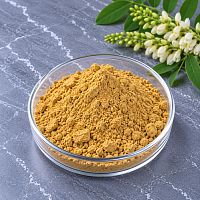
Japanese Sophora buds are processed via supercritical CO2 extraction to yield a pure oily liquid. The material originates from Ukraine and meets 100% natural criteria without added impurities. CO2 Extracts retain key flavonoids and rutin in their native form for consistent performance in formulas.
Product form and handling parameters
Supplied in 5 g transport packaging with INCI designation CO2 Sophora Japonica Extract. The extract is fat-soluble and incorporated into the oil phase below 40 °C. Recommended usage level ranges from 0.2 to 6% according to the target product category. Shelf life extends to December 2028 when stored in a dry cool place in a tightly sealed container.
Integration in cosmetic laboratory work
Formulators add the extract to hair care lines addressing dandruff or hair thinning as well as to products for oily or troubled facial skin. Japanese Sophora Bud CO2 Extract 100 g supports scale-up trials from bench to pilot batch.
Role as raw material for supplements and food manufacturing
Dietary supplement producers and food factories source this botanical extract for functional beverages, confectionery items and fortified foods. Both private formulators and industrial buyers worldwide purchase it in wholesale or retail quantities to enrich finished goods with plant-derived components. Botanical Extracts support diverse global manufacturing needs.
Example hair tonic formulation
Prepare a tonic using 1.5% extract, 25% grapeseed oil, 3% emulsifier and distilled water to 100%. Heat the oil phase to 40 °C, add the extract, combine with the aqueous phase and homogenize briefly. Apply to scalp after washing.
Storage recommendations
Keep the container sealed and protected from light and humidity to maintain original characteristics throughout the declared shelf life.
Frequently asked questions
What is the solubility profile?
The extract disperses readily in oils and butters, making it suitable for anhydrous and emulsion systems.
Is it intended for dietary supplement production?
Yes, manufacturers use it as a botanical raw material in supplement formulations and functional food items.
Can the percentage be adjusted for food applications?
Dosage in food matrices follows the same 0.2-6% range depending on the desired concentration of active plant constituents.