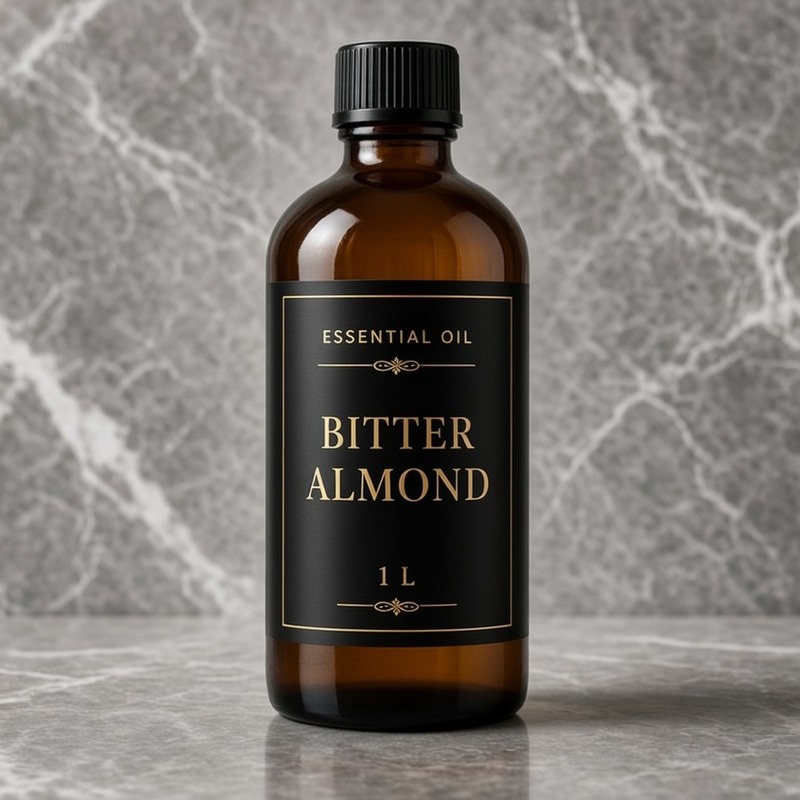
Bitter Almond Oil as a Backbone for Fragrance and Flavor Manufacturing
Bitter almond essential oil in a 1 liter volume is built for manufacturers who need a reliable, larger-scale supply of raw material for continuous production runs with a distinctive almond character. This oil is part of the broader Essential Oils category, which brings together materials used across fragrance, flavor, cosmetic, and household chemical industries. Its main value lies in a rich, instantly recognizable aroma driven by benzaldehyde, the compound responsible for the classic marzipan-like note found in fragrances and flavor blends worldwide.
The primary application of bitter almond oil is in the fragrance and flavor industry. It is widely used in producing perfume compounds, confectionery and liqueur flavorings, and fragrance bases for household chemical products. Within perfumery, bitter almond typically works as a warm, slightly sweet base note and pairs particularly well with citrus materials such as Mandarin Essential Oil or Orange Essential Oil, producing a fresh fruity-nutty accord. For more layered, technically demanding compositions, formulators often introduce Oxygen Essential Oil, which lifts the top notes and gives the overall blend more dimension and diffusion.
Additional options are available in the Natural Essential Oils Wholesale section. It brings together materials for fragrance, cosmetic and household chemical industries. The main value lies in a rich, instantly recognizable aroma.
In cosmetic manufacturing, bitter almond oil is commonly used as a fragrance component in creams, lotions, shampoos, and shower gels, where its distinctive scent helps mask the base odor of underlying formulation ingredients. Candle makers rely on it to build warm, dessert-like scent profiles, while household chemical producers use it as part of fragrance blends for home care products.
Because natural benzaldehyde is highly potent, usage rates in finished formulations are typically modest, generally ranging from 0.1 to 1 percent of total product weight, depending on the application and the intensity of aroma desired. The oil should be added at the final stage of production, once the base has cooled to around 35-40 degrees Celsius, to prevent volatile aromatic compounds from breaking down under heat. When scaling up to larger batches, it is advisable to test compatibility with the specific emulsifiers and preservatives used in a given formulation before full production runs.
Store the oil in a tightly sealed container made of dark glass or metal, in a cool location shielded from direct light and away from heat sources or open flame. Under proper storage conditions, the aroma remains stable over an extended period, which makes the 1 liter format practical for facilities running continuous production cycles and requiring dependable, repeat sourcing of raw material.
Marzipan-Style Fragrance Base for Confectionery Scenting
Bitter almond essential oil 10 ml
Orange essential oil 20 ml
Mandarin essential oil 12 ml
Carrier oil or neutral base 958 ml
Combine all three essential oils in a clean dark glass container at room temperature, stirring thoroughly until fully blended. Add the carrier oil gradually while continuing to mix, then let the composition rest in a cool, dark place for three days to allow the notes to settle. Strain if needed and use the resulting fragrance base at a small percentage within candle wax, confectionery flavoring systems, or household fragrance formulations, adjusting the dosage based on the intensity required for the final product.
INCI name for label declarations: Prunus dulcis var. amara.
FAQ
What are the recommended storage conditions and container choice?
Storage conditions are listed on the label and in the specification.
At what phase and temperature should the oil be added?
Addition guidelines depend on the formulation. Refer to the product specification or request detailed instructions from the supplier.
What are suitable blending notes and pairings?
Blending recommendations are based on the nutty aroma profile. Specific pairings can be verified in the accompanying documentation.
How does it behave in oils, alcohol and water with solubilizers?
Solubility in oil, ether and alcohol is stated in the characteristics. Water solubility with solubilizers should be confirmed via the specification or COA.