-
 DIY: Video master classes
-
 Aromatherapy
-
 Felting master classes
-
 Eating at home
-
 DIY cosmetics for children
-
 Cooking recipes
-
 Detergents, cleaning products with your own hands
-
 Soap making as a business
-
 Natural cosmetics. Raw materials for cosmetics and soap.
-
 Natural oils in cosmetics
-
 News
-
 Recipes for balms and conditioners
-
 Bath Bomb Recipes
-
 Cream recipes. Cream making.
-
 Lotion recipes. Gel recipes.
-
 Mask recipes
-
 Soap recipes. Base soap. Soap from scratch.
-
 Recipes for all occasions
-
 Natural shampoo recipes
-
 Healthy Nutrition Recipes
-
 Scrub recipes. Massage tiles. Ubtan
-
 DIY candles
-
 Reference materials, questions, tips
-
 Startup - soap production
-
 Hair care. Tips, recipes
-
 Facial skin care. Cleansers.
-
 Body care. Tips, recipes
-
 Photo Reviews
-
 Chocolate Handmade


Ceramides NP, AP, EOP: How to properly restore the barrier and what mistakes ruin the effect
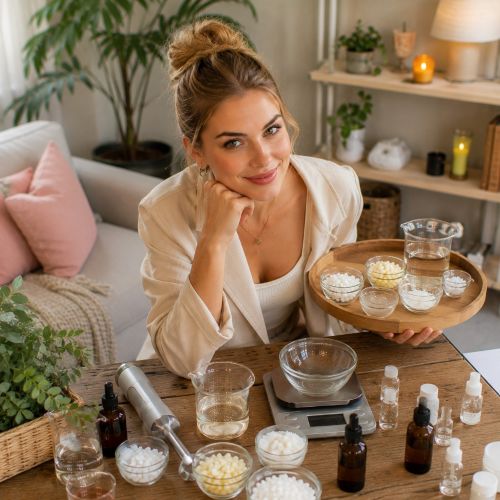 The stratum corneum operates as the essential protective mantle of human skin, preserving internal hydration and shielding against environmental aggressors, pathogens, and allergens. Structurally compared to a brick-and-mortar system, corneal skin cells form the dense bricks, while intercellular lipids serve as the stabilizing mortar. Within this lipid matrix, ceramides account for roughly fifty percent of the total volume, playing an indispensable role in maintaining skin resilience, elasticity, and softness.
Among the various ceramide classes, three specific molecules provide foundational support for barrier repair. Ceramide NP delivers deep moisture retention and integrates seamlessly into the lipid bilayers. Ceramide AP promotes natural keratinocyte differentiation while enhancing cohesion between surface skin cells. Ceramide EOP features a unique long-chain structure that functions as a structural anchor, cross-linking lipid layers into a resilient protective matrix. When any of these core ceramides are depleted, the barrier degrades, leading to chronic dryness, flaking, sensitivity, and heightened inflammation.
The Golden Ratio of Intercellular Lipids and Critical Formulation Errors
Formulating an effective barrier-repair treatment requires strict adherence to biological ratios. The skin naturally requires a precise golden ratio of ceramides, cholesterol, and free fatty acids in a three-to-one-to-one molar proportion. Isolating ceramides without these supporting lipids renders the active ineffective, as standalone ceramides lack the surrounding matrix needed to integrate into compromised skin layers.
A major technical pitfall during compounding involves improper thermal processing or selecting incompatible emulsifiers. Ceramides possess a high melting threshold, requiring the oil phase to be heated to eighty degrees Celsius for full dissolution. However, prolonged exposure to high heat degrades sensitive co-ingredients like botanical extracts and vitamins. Furthermore, incorporating ceramides into standard direct emulsions rather than lamellar structures limits their bio-availability. Only lamellar liquid-crystal systems effectively mimic human skin architecture, allowing ceramides to merge directly into damaged barrier gaps.
Distinct Advantages of Custom Ceramide Formulations Over Mass Market Products
Crafting custom skincare treatments containing Ceramide NP, AP, and EOP offers substantial performance advantages over commercial mass-market products. To reduce production costs, industrial brands often include ceramides at minimal trace concentrations—frequently below one-tenth of a percent—which serves marketing claims rather than clinical skin repair. Custom formulations allow for full therapeutic dosing between one and three percent of a pure, multi-ceramide complex.
Additionally, commercial formulations frequently rely on synthetic fillers, mineral oils, silicones, and harsh synthetic thickeners. While these ingredients create a temporary occlusive surface seal, they fail to reconstruct actual skin tissue and can clog pores. By compounding custom products, you can pair ceramides with plant-derived phytosterols, fresh hydrosols, and unrefined botanical oils rich in essential fatty acids. This provides true physiological repair, building deep skin strength without clogging pores or triggering allergic reactions.
Sanitation Protocols and Equipment Preparation
Creating water- and oil-based emulsions containing active ceramide complexes demands rigorous sanitation to prevent microbial growth. Because handcrafted formulas rely on gentle eco-preservatives, maintaining clean equipment ensures product stability, safety, and shelf life.
Before starting, sanitize all work surfaces with a broad-spectrum disinfectant. Wash hands thoroughly and put on clean nitrile gloves. All laboratory glassware, glass stirring rods, mini whisks, digital precision scales, and final airless pump containers must be thoroughly washed, rinsed with distilled water, and sprayed with a seventy percent solution of isopropyl alcohol. Allow all tools to air-dry completely on clean paper towels. Never use cloth towels, as they harbor microscopic fibers and spores that contaminate active formulations.
Recipe First Soothing Lamellar Repair Cream with Ceramide NP AP and EOP
A deeply restorative, lamellar-structured cream designed for dry, sensitive, or compromised skin requiring intensive moisture barrier recovery.
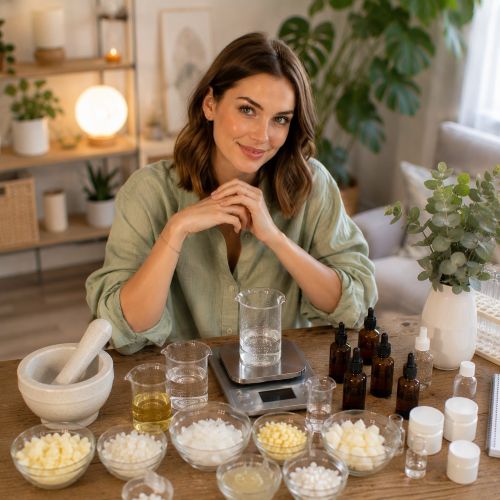
Composition thirty-two milliliters organic cornflower hydrosol two grams pure ceramide complex containing NP AP and EOP four milliliters organic avocado oil three milliliters organic macadamia nut oil three grams natural lamellar emulsifier one gram plant-derived phytosterols one milliliter broad-spectrum eco preservative
Preparation Step first Disinfect heat-safe glass beakers, stirring rods, precision scales, and an airless pump container using isopropyl alcohol. Step second Measure thirty-two milliliters of organic cornflower hydrosol into the first glass beaker to form the water phase. Step third Combine avocado oil, macadamia nut oil, natural lamellar emulsifier, phytosterols, and the ceramide complex in a second heat-safe glass beaker for the oil phase. Step fourth Place the oil phase beaker on a hot water bath and heat gently to eighty degrees Celsius until the ceramides and emulsifier melt completely into a clear liquid. Step fifth Heat the water phase beaker on the water bath to an identical temperature of eighty degrees Celsius. Step sixth Slowly pour the hot water phase into the hot oil phase while blending rapidly with a mini whisk to form a smooth, shimmering lamellar emulsion. Step seventh Stir the cream gently with a glass rod as it cools to room temperature, incorporate the broad-spectrum eco preservative, and transfer into your sanitized airless pump bottle.
Recipe Second Soothing Lipid Serum for Sensitive Skin with Ceramide NP
A rich, water-free fluid engineered to instantly comfort reactive skin, reduce redness, and reinforce the outer lipid mantle.
Composition twenty-eight milliliters plant-derived squalane one gram pure Ceramide NP powder four milliliters organic jojoba oil two milliliters organic evening primrose oil half a milliliter natural vitamin E oil
Preparation Step first Sanitize a heat-safe glass beaker, glass stirring rod, digital precision scale, and a dark glass dropper bottle with isopropyl alcohol. Step second Measure the plant-derived squalane and organic jojoba oil directly into your glass beaker. Step third Add the pure Ceramide NP powder into the oil mixture. Step fourth Place the beaker onto a gentle water bath, heating and stirring continuously with a glass rod until the Ceramide NP powder fully dissolves into a transparent fluid. Step fifth Remove the beaker from heat, allow the mixture to cool slightly, then stir in the evening primrose oil and natural vitamin E oil. Step sixth Mix thoroughly for two minutes to ensure complete homogeneity throughout the lipid solution. Step seventh Decant the finished lipid serum into your sanitized dark glass bottle and seal tightly.
Recipe Third Protective Barrier Fluid with Ceramide AP and EOP Complex
A lightweight, fast-absorbing protective fluid for normal to combination skin types that restores structural resilience without leaving a greasy residue.
Composition thirty-three milliliters organic lavender hydrosol one and a half grams ceramide AP and EOP complex three milliliters plant-derived squalane two milliliters organic argan oil two and a half grams mild natural emulsifier one gram provitamin B5 panthenol powder one milliliter broad-spectrum eco preservative
Preparation Step first Thoroughly sterilize glass beakers, measuring spoons, mini whisk, and an airless pump dispenser with isopropyl alcohol. Step second Dissolve the provitamin B5 panthenol powder into thirty-three milliliters of organic lavender hydrosol in your main glass beaker. Step third Measure squalane, argan oil, natural emulsifier, and the ceramide AP and EOP complex into a second heat-safe beaker. Step fourth Heat both beakers on a water bath until all lipid components and emulsifiers are fully melted and fluid. Step fifth Pour the liquid water phase into the melted oil phase while whisking vigorously to construct a fine hydro-emulsion. Step sixth Allow the fluid to cool to ambient temperature while stirring periodically with a glass rod to prevent phase separation. Step seventh Add the broad-spectrum eco preservative, mix thoroughly for two minutes, and pour the finished fluid into your sanitized airless dispenser.
Application Guidelines and Skincare Integration
Ceramide-based formulations are safe and effective for daily morning and evening use. Apply finished products to freshly cleansed skin on the face, neck, and décolletage, pressing gently with warm palms to aid absorption along facial massage lines.
When using an anhydrous lipid serum containing Ceramide NP, apply two to three drops directly onto slightly damp skin immediately following a hydrating hydrosol or toner to lock in surface moisture. Lamellar creams and fluids pair smoothly with active serums containing vitamin C, niacinamide, or peptides. When incorporating chemical exfoliants or retinoids, apply your ceramide treatment fifteen minutes after active application to calm irritation and protect barrier integrity. Visible improvements in softness, reduced redness, and enhanced hydration typically manifest within three to five days of consistent use.
Storage Conditions and Product Stability
Following proper storage protocols prevents the oxidation of unrefined botanical lipids and maintains the structural integrity of active ceramides. Exposure to direct sunlight, high humidity, and temperature fluctuations degrades formula stability and compromises preservation.
Store completed ceramide serums, fluids, and creams in airtight dark glass bottles or opaque airless pump dispensers in a cool, dark place or on a middle shelf in a dedicated skincare refrigerator at steady temperatures between eight and fifteen degrees Celsius. Keep containers tightly closed when not in use, and avoid touching bottle droppers directly to your skin during application. When prepared under strict sanitary conditions and stored in cool environments, handcrafted ceramide formulas maintain optimal potency and freshness for two to three months.


Cosmetic ingredients and professional formulation blog
This section features expert materials on modern cosmetic actives. We cover peptides, polynucleotides PDRN, different forms of hyaluronic acid, retinoids, ceramides and other key components.
Special focus is given to active stability, ingredient compatibility and correct incorporation into formulas. You will find practical guides on working with anti-age actives, moisturizing complexes and barrier repair ingredients.
We examine how to properly combine myorelaxants with peptides, common mistakes when using unstable vitamin C forms and ways to improve the performance of moisturizing actives.
Separate materials are dedicated to base oils, extracts, emulsifiers and supporting ingredients. This helps create stable and effective formulas for both professional and home cosmetics.
The blog regularly publishes reviews of trending actives, comparisons of similar ingredients and step-by-step formulation recommendations. The content is aimed at formulators, technologists and anyone seriously involved in creating cosmetic products.
Why this blog is useful
Here you will find practical data on eye area care actives, lifting systems and ingredients that improve skin firmness and tone. We rely on real formulation experience and address the actual challenges that arise during product development.
You can also explore materials on skin protection and repair, depigmentation and anti-inflammatory actives. This approach supports a more systematic selection of ingredients.
FAQ
What topics are covered most often
The blog focuses on peptides, PDRN, hyaluronic acid of different molecular weights, retinoids, ceramides and their compatibility rules.
Are there practical recommendations on how to incorporate actives
Yes, most articles include practical notes on pH stability, incorporation temperature and common formulation mistakes.
Is the content only for professionals
The materials are useful both for formulators and technologists and for those who create cosmetics for personal use and want to understand how modern ingredients work.
Where can I go directly to the ingredients
All key actives are collected in the Actives section, while base components are available in base oils and related categories.



