-
 DIY: Video master classes
-
 Aromatherapy
-
 Felting master classes
-
 Eating at home
-
 DIY cosmetics for children
-
 Cooking recipes
-
 Detergents, cleaning products with your own hands
-
 Soap making as a business
-
 Natural cosmetics. Raw materials for cosmetics and soap.
-
 Natural oils in cosmetics
-
 News
-
 Recipes for balms and conditioners
-
 Bath Bomb Recipes
-
 Cream recipes. Cream making.
-
 Lotion recipes. Gel recipes.
-
 Mask recipes
-
 Soap recipes. Base soap. Soap from scratch.
-
 Recipes for all occasions
-
 Natural shampoo recipes
-
 Healthy Nutrition Recipes
-
 Scrub recipes. Massage tiles. Ubtan
-
 DIY candles
-
 Reference materials, questions, tips
-
 Startup - soap production
-
 Hair care. Tips, recipes
-
 Facial skin care. Cleansers.
-
 Body care. Tips, recipes
-
 Photo Reviews
-
 Chocolate Handmade


Shampoo with peptides and caffeine for the scalp
 Modern trichology has proven that the health of the hair is inseparable from the condition of the scalp. A high performance shampoo featuring peptides and caffeine represents a sophisticated approach to treating hair thinning and promoting density at the source. While caffeine acts as a powerful stimulant to local microcirculation peptides work as biological messengers that signal the hair follicles to enter and remain in the growth phase. This combination creates a synergistic effect that addresses both the structural integrity of the hair and the biological activity of the scalp.
This professional article explores the molecular benefits of these ingredients and provides three precise formulations for crafting high potency scalp care at home.
Beneficial Properties of Peptides and Caffeine for Scalp Health
Caffeine is a well known xanthine alkaloid that possesses unique transdermal properties. When applied to the scalp it penetrates the hair follicles and inhibits the activity of 5-alpha-reductase an enzyme responsible for hair loss in androgenetic alopecia. By neutralizing this enzyme caffeine helps maintain the energy supply to the hair bulb. Furthermore its ability to stimulate blood flow ensures that oxygen and essential nutrients are delivered more efficiently to the roots resulting in stronger and more resilient hair strands.
Peptides are short chains of amino acids that act as building blocks for proteins like collagen and keratin. In a scalp formulation specific signal peptides such as Biotinoyl Tripeptide-1 or Copper Peptides work to increase the size of the hair follicles and strengthen the basement membrane of the scalp. They help to anchor the hair more firmly within the follicle reducing premature shedding. Together with caffeine peptides transform a standard cleansing routine into a therapeutic treatment that revitalizes dormant follicles and improves the overall quality of the hair.
Advantages of Handcrafted Peptide Shampoos Over Industrial Analogs
The primary drawback of many industrial growth shampoos is the contact time and active concentration. Mass market products often contain only trace amounts of expensive peptides and use high concentrations of aggressive sulfates (SLS/SLES) that can irritate the scalp and strip away natural oils. When you formulate your own shampoo you can use gentle biodegradable surfactants that respect the scalp barrier while ensuring that caffeine and peptides are present at clinically effective percentages.
Handcrafted shampoos also allow for a targeted pH balance. Most commercial shampoos are formulated with a pH that is too alkaline for the scalp which can lead to inflammation and dryness. By controlling the formulation you can set a physiological pH of five point five which is optimal for maintaining a healthy scalp microbiome. Additionally you avoid synthetic silicones and heavy conditioners that often clog the pores of the scalp and hinder the penetration of active stimulants.
Technical Nuances of Formulating with Active Stimulants
Preparing a peptide and caffeine shampoo requires careful handling of the active ingredients to ensure they remain stable and effective. Caffeine powder must be fully dissolved in the aqueous phase before being added to the surfactant base to prevent grittiness. Using warm distilled water can assist in this process but it is vital to let the solution cool before introducing the peptides.
Peptides are highly sensitive to extreme temperatures and pH shifts. If added to a base that is too hot or too acidic the peptide bonds can break rendering them biologically inactive. Therefore they must always be incorporated during the final cool down phase at room temperature. Furthermore the choice of surfactants is critical; non-ionic and amphoteric surfactants are generally more compatible with peptide complexes than harsh anionic detergents ensuring the finished product is both effective and non-irritating.
Recipe One Intense Growth Stimulation Shampoo
A potent formula designed for those experiencing active hair thinning and seeking to jumpstart the growth cycle.
Composition Fifty milliliters distilled water Thirty milliliters Decyl Glucoside (gentle surfactant) Ten milliliters Cocamidopropyl Betaine (conditioning surfactant) Two grams caffeine anhydrous powder Three milliliters Biotinoyl Tripeptide-1 solution Two milliliters Panthenol (Provitamin B5) Eco certified preservative
Preparation Step one Sanitize all beakers glass rods and storage containers with seventy percent alcohol. Step two Heat the distilled water slightly and add the caffeine powder stirring until the liquid is completely clear. Step three Allow the caffeine solution to cool to room temperature. Step four In a separate beaker combine the Decyl Glucoside and Cocamidopropyl Betaine stirring slowly to avoid creating excess foam. Step five Gradually pour the cooled caffeine water into the surfactant mixture while continuing to stir gently. Step six Add the Biotinoyl Tripeptide-1 and Panthenol to the mixture and fold them in carefully. Step seven Add the preservative check the pH to ensure it is around five point five and transfer to a bottle.
Recipe Two Daily Strengthening Scalp Cleanser
A mild formulation for everyday use that focuses on maintaining follicle health and scalp hydration.
Composition Sixty milliliters Rosemary hydrosol Twenty milliliters Coco Glucoside Ten milliliters Rosehip oil (water soluble) One gram caffeine powder Two milliliters Copper Peptide solution Five milliliters vegetable glycerin Preservative
Preparation Step one Disinfect all laboratory tools and work surfaces thoroughly. Step two Dissolve the caffeine powder directly into the Rosemary hydrosol at room temperature. Step three Add the vegetable glycerin to the hydrosol and stir until uniform. Step four Slowly introduce the Coco Glucoside into the aqueous phase using a glass rod with a slow circular motion. Step five Add the water soluble Rosehip oil which provides essential fatty acids without weighing down the hair. Step six Incorporate the Copper Peptide solution once the base is smooth and homogeneous. Step seven Add the preservative and package the shampoo in an amber glass bottle to protect the botanical extracts.
Recipe Three Soothing Peptide Shampoo for Sensitive Scalp
A specialized formula that combines hair growth stimulation with anti-inflammatory ingredients for an irritated scalp.
Composition Fifty milliliters Aloe Vera juice (filtered) Thirty milliliters Sodium Cocoyl Glutamate (ultra mild surfactant) One gram caffeine powder Three milliliters Palmitoyl Tetrapeptide-7 Two milliliters Allantoin (soothing agent) Two milliliters Hydrolyzed Silk protein Preservative
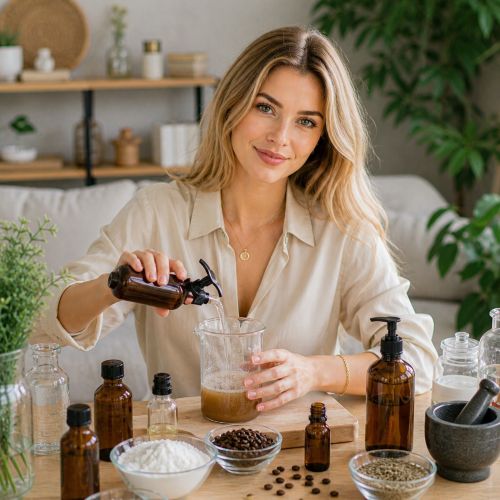
Preparation Step one Prepare a sterile workspace and ensure all measuring tools are precise. Step two Dissolve the Allantoin and caffeine in the Aloe Vera juice stirring until no particles are visible. Step three Add the Hydrolyzed Silk protein to the juice mixture to provide structural support to the hair shaft. Step four Gently fold in the Sodium Cocoyl Glutamate taking care not to create turbulence or bubbles. Step five Verify that the temperature of the liquid is at room temperature. Step six Add the Palmitoyl Tetrapeptide-7 which helps reduce scalp micro-inflammation and supports follicle repair. Step seven Incorporate the preservative and store in a vacuum pump bottle to prevent air contact.
Recommendations for Application and Scalp Massage
To receive the full benefit of a peptide and caffeine shampoo the application technique is just as important as the formula. Apply the shampoo directly to the scalp rather than the ends of the hair. Use the pads of your fingers to perform a circular massage for at least three minutes. This physical stimulation works in tandem with the caffeine to increase blood flow and ensures the peptides have enough contact time to be absorbed by the follicles.
Leave the lather on the scalp for an additional two minutes before rinsing with lukewarm water. Avoid using very hot water as it can increase scalp sensitivity and strip away the active peptides before they can settle. For best results use these formulations three to four times a week. Clinical improvements in hair density and strength are typically observed after eight to twelve weeks of consistent use.
Guidelines for Storage and Product Stability
Because these shampoos contain delicate peptides and botanical juices proper storage is essential. Handcrafted products lack the heavy synthetic stabilizers found in commercial brands making them more sensitive to environmental changes. Store your shampoo in a cool dark place such as a bathroom cabinet or a dedicated cosmetic refrigerator. Avoid leaving the bottle in the shower where heat and moisture fluctuate.
The typical shelf life for these formulations using an eco certified preservative is three months. If you notice a change in the color scent or consistency of the shampoo it is an indication that the actives have degraded or microbial growth has occurred and the product should be discarded. Using opaque or amber colored bottles will help protect the caffeine and peptides from light degradation ensuring the potency of the stimulants remains high until the last use.


Cosmetic ingredients and professional formulation blog
This section features expert materials on modern cosmetic actives. We cover peptides, polynucleotides PDRN, different forms of hyaluronic acid, retinoids, ceramides and other key components.
Special focus is given to active stability, ingredient compatibility and correct incorporation into formulas. You will find practical guides on working with anti-age actives, moisturizing complexes and barrier repair ingredients.
We examine how to properly combine myorelaxants with peptides, common mistakes when using unstable vitamin C forms and ways to improve the performance of moisturizing actives.
Separate materials are dedicated to base oils, extracts, emulsifiers and supporting ingredients. This helps create stable and effective formulas for both professional and home cosmetics.
The blog regularly publishes reviews of trending actives, comparisons of similar ingredients and step-by-step formulation recommendations. The content is aimed at formulators, technologists and anyone seriously involved in creating cosmetic products.
Why this blog is useful
Here you will find practical data on eye area care actives, lifting systems and ingredients that improve skin firmness and tone. We rely on real formulation experience and address the actual challenges that arise during product development.
You can also explore materials on skin protection and repair, depigmentation and anti-inflammatory actives. This approach supports a more systematic selection of ingredients.
FAQ
What topics are covered most often
The blog focuses on peptides, PDRN, hyaluronic acid of different molecular weights, retinoids, ceramides and their compatibility rules.
Are there practical recommendations on how to incorporate actives
Yes, most articles include practical notes on pH stability, incorporation temperature and common formulation mistakes.
Is the content only for professionals
The materials are useful both for formulators and technologists and for those who create cosmetics for personal use and want to understand how modern ingredients work.
Where can I go directly to the ingredients
All key actives are collected in the Actives section, while base components are available in base oils and related categories.



