-
 DIY: Video master classes
-
 Aromatherapy
-
 Felting master classes
-
 Eating at home
-
 DIY cosmetics for children
-
 Cooking recipes
-
 Detergents, cleaning products with your own hands
-
 Soap making as a business
-
 Natural cosmetics. Raw materials for cosmetics and soap.
-
 Natural oils in cosmetics
-
 News
-
 Recipes for balms and conditioners
-
 Bath Bomb Recipes
-
 Cream recipes. Cream making.
-
 Lotion recipes. Gel recipes.
-
 Mask recipes
-
 Soap recipes. Base soap. Soap from scratch.
-
 Recipes for all occasions
-
 Natural shampoo recipes
-
 Healthy Nutrition Recipes
-
 Scrub recipes. Massage tiles. Ubtan
-
 DIY candles
-
 Reference materials, questions, tips
-
 Startup - soap production
-
 Hair care. Tips, recipes
-
 Facial skin care. Cleansers.
-
 Body care. Tips, recipes
-
 Photo Reviews
-
 Chocolate Handmade


Trendy textures in cosmetics in 2025: butters, gels, sorbents, and emulsions with peptides
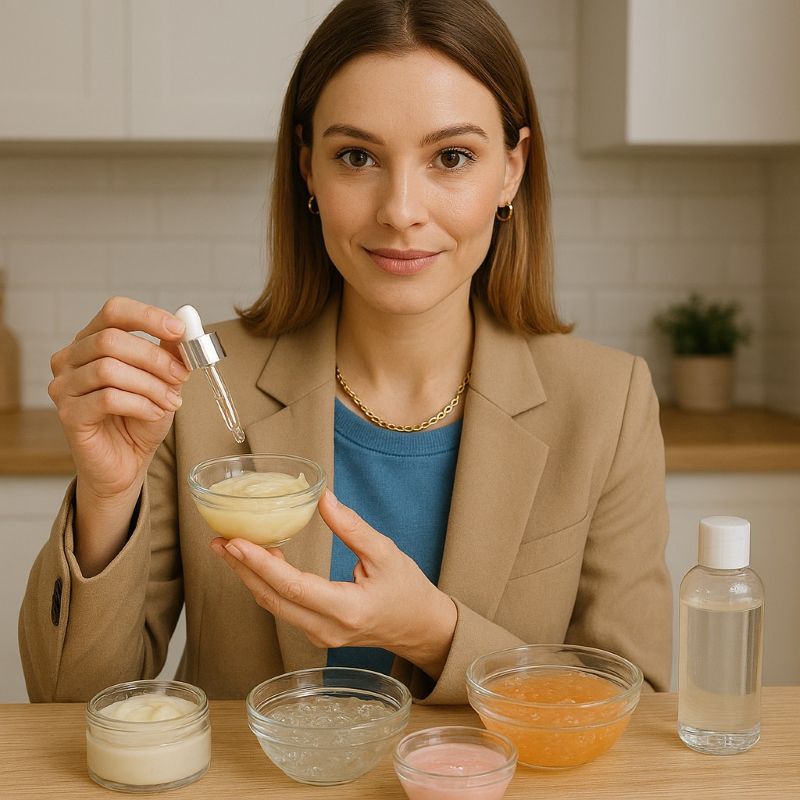 The year 2025 marks a major shift in cosmetic trends, moving beyond simple creams to focus on sensorial textures that enhance both efficacy and user experience. Consumers are demanding products that feel light yet nourishing, absorb instantly, and offer a cooling or melting effect. The most sought-after textures now include airy butter soufflés, refreshing sorbet gels, and intelligent multi-phase emulsions.
Creating these trending textures at home gives you a significant advantage over industrial analogs. You can incorporate a high concentration of expensive actives, such as peptides, directly into a fresh, perfectly tailored base, skipping the industrial fillers and synthetic stabilizers often used in mass production. This guide will walk you through the science and the detailed recipes for mastering these fashionable cosmetic textures.
The Science of Texture: Why Peptides Need the Right Base
The texture of a product isn't just about feel; it dictates how active ingredients penetrate the skin. Peptides, the powerful amino acid chains, require a stable environment to remain potent.
Peptides and Temperature Sensitivity
Peptides, whether they are signaling (like Matrixyl) or neuro-peptides (like Argireline), are heat-sensitive. They must be incorporated into the final, "cold phase" of any formulation, below 35 degrees Celsius. This is the golden rule for preserving their anti-aging signaling capabilities.
Emulsifiers: The Key to Texture Control
The emulsifier you choose controls the final texture, from a light serum to a heavy butter.
-
For Gels/Sorbets: Light hydrophilic gelling agents (like Lecigel or Carbomer) create that desired cooling, non-greasy feel.
-
For Butters/Soufflés: A combination of hard and soft natural butters, combined with waxy emulsifiers (like Montanov 68), provides stability and a luxurious, dense texture.
-
For Emulsions: Intelligent, self-emulsifying bases (like Olivem 1000) create stable oil-in-water systems that are lightweight yet deeply moisturizing.
Three Trending DIY Cosmetic Recipes
To prepare these recipes, you will need accurate electronic scales, a thermometer, a mini-mixer, and strict attention to sanitation. All percentages are based on a 100-gram final product.
Recipe 1: Peptide-Infused Whipped Body Butter Soufflé
This ultra-nourishing yet surprisingly light texture melts instantly on the skin, perfect for tackling dry patches and improving elasticity with a high peptide dose.
Ingredients (Percentage / Grams):
Shea Butter (Hard Oil): 45.0% / 45.0 g Cocoa Butter (Hard Oil): 10.0% / 10.0 g Apricot Kernel Oil (Light Oil): 30.0% / 30.0 g Thickener/Stabilizer (e.g., Cetyl Alcohol): 3.0% / 3.0 g Signaling Peptide (e.g., Palmitoyl Tripeptide-5): 4.0% / 4.0 g Vitamin E (Tocopherol): 1.0% / 1.0 g Allantoin (Soothing): 2.0% / 2.0 g Preservative (e.g., Geogard Ultra): 5.0% / 5.0 g (Note: If using a water-free formula, this may be optional, but adding Allantoin necessitates a preservative).
Preparation Nuances and Texture:
Stage 1: Melting the Butters. Combine the Shea Butter, Cocoa Butter, Apricot Kernel Oil, and Cetyl Alcohol in a beaker. Gently heat them on a water bath until fully melted (around 65 degrees Celsius). Remove from heat.
Stage 2: Cooling. Place the beaker in an ice bath or let it cool naturally. Stir occasionally until the mixture begins to solidify around the edges and reaches a creamy, opaque consistency (below 35 degrees Celsius).
Stage 3: Whipping. Using a hand mixer or stand mixer, begin to whip the mixture vigorously. The texture will transform into a light, airy soufflé.
Stage 4: Adding Cold Actives. Incorporate the Signaling Peptide, Vitamin E, Allantoin, and Preservative. Continue whipping for another two minutes until fully blended and the soufflé holds its peak.
Advantage over Industrial: Commercial whipped butters often use cheap mineral oil or water to bulk up the product. This DIY soufflé is 90% pure, potent oils and butters, providing superior skin barrier repair and deep hydration, while delivering a clinical dose of peptides.
Recipe 2: Cooling Sorbet Gel for Face and Neck
This texture is the epitome of the 2025 trend: an oil-free, water-based gel that provides an instant cooling effect and deep hydration.
Ingredients (Percentage / Grams):
Rose Hydrosol (Water Phase): 80.0% / 80.0 g Gelling Agent (e.g., Carbomer or Xanthan Gum): 1.0% / 1.0 g Glycerin (Humectant): 5.0% / 5.0 g Neuro-Peptide (e.g., Argireline Solution): 5.0% / 5.0 g Niacinamide (Vitamin B3): 3.0% / 3.0 g Hyaluronic Acid (1% Solution): 5.0% / 5.0 g Preservative: 1.0% / 1.0 g
Preparation Nuances and Texture:
Stage 1: Hydrating the Gelling Agent. Slowly sprinkle the Carbomer (or Xanthan Gum) over the Rose Hydrosol while continuously mixing with a mini-mixer. This process creates the basic gel structure. Allow it to hydrate completely (can take 30 minutes).
Stage 2: Adjusting pH. Carbomer requires a high pH to fully thicken. Use a few drops of Triethanolamine (TEA) or Sodium Hydroxide solution until the gel fully thickens to a sorbet consistency (check pH to ensure it is skin-safe, around 5.5-6.0).
Stage 3: Incorporating Cold Actives. Add the Glycerin, Hyaluronic Acid solution, Niacinamide, Neuro-Peptide Argireline, and Preservative. Mix gently to avoid incorporating air bubbles.
Stage 4: Texture Check. The final texture should be a clear, smooth gel that instantly cools the skin and melts away without stickiness.
Advantage over Industrial: This recipe delivers a clinical 5% dose of Argireline, providing a noticeable muscle-relaxing effect on mimic wrinkles, which is rarely found in commercial products due to the peptide's high cost.
Recipe 3: Bi-Phasic Smart Emulsion with Copper Peptides
Smart emulsions are highly stable oil-in-water systems that feel light like a lotion but deliver potent oil-soluble actives. This bi-phasic emulsion is ideal for overall skin repair.
Ingredients (Percentage / Grams):
Distilled Water (Water Phase): 65.0% / 65.0 g Emulsifier (e.g., Olivem 1000): 6.0% / 6.0 g Jojoba Oil (Oil Phase): 10.0% / 10.0 g Avocado Oil (Oil Phase): 5.0% / 5.0 g Copper Peptide GHK-Cu (Liquid or dispersed): 1.0% / 1.0 g Vitamin C (MAP or SAP form): 3.0% / 3.0 g Allantoin: 1.0% / 1.0 g Preservative: 1.0% / 1.0 g Glycerin: 4.0% / 4.0 g Panthenol (Pro-Vitamin B5): 3.0% / 3.0 g Ester Oil/Dry Oil (e.g., Coco-Caprylate): 2.0% / 2.0 g
Preparation Nuances and Texture:
Stage 1: Heating Phases. Combine the Oil Phase (Jojoba, Avocado, Olivem 1000, Ester Oil) and Water Phase (Water, Glycerin) in separate beakers. Heat both phases to 75 degrees Celsius.
Stage 2: Emulsification. Pour the Water Phase into the Oil Phase while stirring rapidly with the mini-mixer for at least three minutes. The mixture will turn into a homogenous white lotion.
Stage 3: Cooling. Transfer the emulsion to a cold water bath and continue stirring until the temperature drops to 35 degrees Celsius.
Stage 4: Adding Cold Actives. Incorporate Panthenol and Allantoin first, then the Copper Peptide GHK-Cu, followed by the Vitamin C derivative (MAP or SAP), and finally the Preservative. Stir well after each addition.
Advantage over Industrial: This emulsion combines the reparative power of Copper Peptides with the antioxidant benefit of Vitamin C in a high concentration (1% and 3%, respectively), providing superior healing, anti-inflammatory, and anti-aging benefits in a perfectly balanced, non-greasy texture.
Recommendations for Use and Storage
Usage Recommendations
-
Patch Test First: Always perform a patch test on your inner elbow before using any new DIY product on your face or body.
-
Application: Apply the body butter (Recipe 1) and smart emulsion (Recipe 3) right after showering when the skin is still slightly damp to lock in moisture.
-
Sorbet Timing: Use the cooling sorbet gel (Recipe 2) in the morning or before bed. Its light texture makes it excellent under makeup or as a primary hydration booster.
Storage and Preservation
Homemade cosmetics lack the robust, long-term stabilization of industrial products, making proper storage crucial.
-
Preservation is Mandatory: Any recipe containing a water phase (Recipes 2 and 3) must contain a cosmetic-grade preservative. Failure to do so risks microbial contamination within days.
-
Optimal Container: Store all products in airless pump bottles or opaque jars to minimize exposure to light and air, which rapidly degrade peptides and vitamins.
-
Temperature: For optimal potency, especially for the Sorbet Gel and Smart Emulsion, store them in the refrigerator (4 to 8 degrees Celsius).
-
Shelf Life: With proper preservation and refrigeration, the shelf life is typically 2-3 months. If you notice any change in color, smell, or texture, discard the product immediately.
Conclusion: Customization is the Ultimate Luxury
Mastering these fashionable textures—from the plush butter soufflé to the cooling sorbet gel and the sophisticated smart emulsion—elevates your DIY skincare routine to a professional level. The ability to precisely dose highly effective actives like peptides into a base that you control offers unmatched efficacy and luxury. This level of customization and concentration far surpasses the offerings of mass-market cosmetic brands.


Cosmetic ingredients and professional formulation blog
This section features expert materials on modern cosmetic actives. We cover peptides, polynucleotides PDRN, different forms of hyaluronic acid, retinoids, ceramides and other key components.
Special focus is given to active stability, ingredient compatibility and correct incorporation into formulas. You will find practical guides on working with anti-age actives, moisturizing complexes and barrier repair ingredients.
We examine how to properly combine myorelaxants with peptides, common mistakes when using unstable vitamin C forms and ways to improve the performance of moisturizing actives.
Separate materials are dedicated to base oils, extracts, emulsifiers and supporting ingredients. This helps create stable and effective formulas for both professional and home cosmetics.
The blog regularly publishes reviews of trending actives, comparisons of similar ingredients and step-by-step formulation recommendations. The content is aimed at formulators, technologists and anyone seriously involved in creating cosmetic products.
Why this blog is useful
Here you will find practical data on eye area care actives, lifting systems and ingredients that improve skin firmness and tone. We rely on real formulation experience and address the actual challenges that arise during product development.
You can also explore materials on skin protection and repair, depigmentation and anti-inflammatory actives. This approach supports a more systematic selection of ingredients.
FAQ
What topics are covered most often
The blog focuses on peptides, PDRN, hyaluronic acid of different molecular weights, retinoids, ceramides and their compatibility rules.
Are there practical recommendations on how to incorporate actives
Yes, most articles include practical notes on pH stability, incorporation temperature and common formulation mistakes.
Is the content only for professionals
The materials are useful both for formulators and technologists and for those who create cosmetics for personal use and want to understand how modern ingredients work.
Where can I go directly to the ingredients
All key actives are collected in the Actives section, while base components are available in base oils and related categories.



