-
 DIY: Video master classes
-
 Aromatherapy
-
 Felting master classes
-
 Eating at home
-
 DIY cosmetics for children
-
 Cooking recipes
-
 Detergents, cleaning products with your own hands
-
 Soap making as a business
-
 Natural cosmetics. Raw materials for cosmetics and soap.
-
 Natural oils in cosmetics
-
 News
-
 Recipes for balms and conditioners
-
 Bath Bomb Recipes
-
 Cream recipes. Cream making.
-
 Lotion recipes. Gel recipes.
-
 Mask recipes
-
 Soap recipes. Base soap. Soap from scratch.
-
 Recipes for all occasions
-
 Natural shampoo recipes
-
 Healthy Nutrition Recipes
-
 Scrub recipes. Massage tiles. Ubtan
-
 DIY candles
-
 Reference materials, questions, tips
-
 Startup - soap production
-
 Hair care. Tips, recipes
-
 Facial skin care. Cleansers.
-
 Body care. Tips, recipes
-
 Photo Reviews
-
 Chocolate Handmade


Hyaluronic acid and peptides are the perfect combination for moisturizing and lifting the skin.
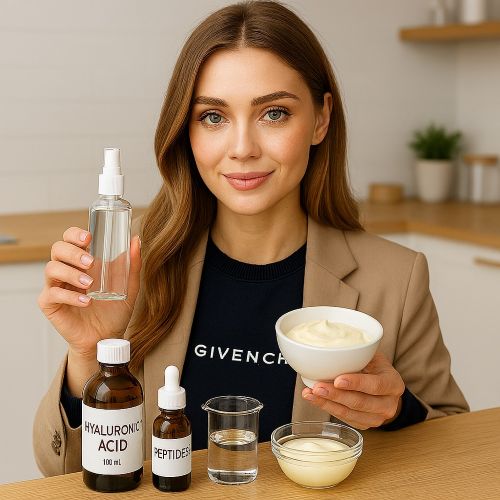 In the quest for youthful, resilient skin, few ingredients are as universally acclaimed as Hyaluronic Acid (HA) and Peptides. HA provides unparalleled hydration, acting as a massive moisture magnet, while peptides work as cellular messengers, signaling the skin to repair itself and produce vital proteins like collagen and elastin. Used individually, they are excellent; when combined, they create a powerful, synergistic partnership that delivers optimal moisturizing, plumping, and lifting effects. By crafting your own formulations at home, you can harness this potent combination at therapeutic concentrations, achieving superior results compared to often-diluted industrial products. This article explores the science behind this perfect pairing, provides three detailed recipes for potent skincare, and highlights the distinct advantages of DIY formulation.
Understanding the Synergistic Duo
The combination of Hyaluronic Acid and Peptides is so effective because they address different, yet equally critical, aspects of aging skin.
The Role of Hyaluronic Acid (The Hydrator)
HA is a naturally occurring molecule in the skin that can hold up to 1,000 times its weight in water. Its benefits vary based on molecular weight:
-
High Molecular Weight (HMW) HA: Stays on the skin's surface, forming a breathable barrier that locks in moisture and provides immediate smoothing and plumping.
-
Low Molecular Weight (LMW) HA: Penetrates deeper into the epidermis, offering long-lasting, deep hydration and improved elasticity.
HA essentially creates a moisture-rich environment within the skin, instantly smoothing fine lines and preparing the dermal matrix for peptide absorption.
The Role of Peptides (The Messenger)
Peptides are short chains of amino acids that serve as communication links. They don't just sit on the surface; they penetrate and tell the cells what to do.
-
Signaling Peptides: Such as Matrixyl, tell fibroblasts to produce new collagen, elastin, and other structural components.
-
Neuropeptides: Such as Argireline, inhibit muscle contractions, smoothing out expression lines.
Crucially, the deep, multi-layered hydration provided by HA acts as a superb delivery system, maximizing the peptides' ability to penetrate and reach the target cells, making the combination more potent than the sum of its parts.
Three Recipes Harnessing HA and Peptides
These recipes utilize different molecular weights of Hyaluronic Acid and various peptides to target hydration, fine lines, and overall lift. Remember, both HA solution and peptides are water-soluble and heat-sensitive, requiring gentle handling and addition to the cool-down phase (below 40∘C).
Recipe 1: Deep Hydration and Collagen-Boosting Serum
This serum uses a blend of HA types and the potent Matrixyl 3000 for comprehensive renewal.
-
Prepare the HA Base. In a sterilized beaker, weigh 80g of distilled water. Slowly add 1g of a Low Molecular Weight HA powder and 1g of a High Molecular Weight HA powder. Stir gently and allow to hydrate completely until a thick, uniform gel forms (this may take several hours).
-
Add the Peptide Complex. Once the gel is uniform, add 5g of Matrixyl 3000 solution. Matrixyl 3000 stimulates new collagen synthesis. Stir gently until fully incorporated.
-
Add Humectant and Preservative. Add 4g of vegetable glycerin for added moisture and 1g of a broad-spectrum preservative like Geogard 221. Stir well.
-
Check the pH and Package. Check the pH; it should be between 5.0 and 6.0. Pour the finished serum into a dark glass dropper bottle.
Recommendations for Use: Apply 2-3 drops to damp, clean skin morning and night. Follow immediately with a face cream or oil to seal in the moisture.
Storage: Store in a cool, dark place. The shelf life is up to 6 months.
Recipe 2: Expression Line Smoothing Cream
This cream is designed to moisturize deeply while using a neuropeptide to relax dynamic wrinkles.
-
Prepare the Water Phase. In a sterilized beaker, weigh 60g of Hyaluronic Acid 1% solution (pre-made or prepared earlier). Heat to 70∘C.
-
Prepare the Oil Phase. In a separate beaker, combine 10g of Jojoba Oil (light and non-comedogenic), 10g of Shea Butter, and 5g of an emulsifying wax like Olivem 1000. Heat to 70∘C.
-
Emulsify. Slowly pour the hot water phase into the hot oil phase, mixing with a hand blender until a stable, creamy emulsion forms. Continue mixing as the cream cools.
-
Add the Relaxing Peptide. When the cream cools below 40∘C, add 4g of Argireline peptide solution (targets expression wrinkles).
-
Add the Final Actives and Preservative. Add 1g of Vitamin E (Tocopherol) and 1g of a broad-spectrum preservative. Stir well and transfer to a clean jar.
Recommendations for Use: Apply daily to the face, paying extra attention to areas prone to expression lines (forehead, crow's feet).
Storage: Store in a cool, dark place. The shelf life is up to 3 months.
Recipe 3: Intensive Weekly Lifting Mask
This mask provides an intense boost of both hydration and lifting peptides for weekly use.
-
Prepare the Base Gel. In a sterilized beaker, weigh 85g of distilled water. Add 5g of vegetable glycerin and 0.5g of a High Molecular Weight HA powder. Stir and allow to fully gel.
-
Add the Lifting Peptides. Add 5g of Syn-Coll solution. Syn-Coll specifically stimulates TGF-β, boosting structural collagen production for a lifting effect.
-
Add a Soothing Agent. Add 4g of D-Panthenol (Vitamin B5) for enhanced moisture retention and soothing properties.
-
Add the Preservative. Add 0.5g of a broad-spectrum preservative. Stir well.
-
Package. Pour the finished gel into a clean, airless pump container.
Recommendations for Use: Apply a thick layer to the entire face, jawline, and neck. Leave on for 15-20 minutes, then gently pat the excess into the skin or rinse lightly. Use once or twice a week.
Storage: Store in a cool, dark place. The shelf life is up to 6 months.
Advantages Over Industrial Analogues
Choosing to make your own HA and Peptide formulas offers significant superiority over store-bought products.
-
Therapeutic Concentrations: Both peptides and high-quality HA are costly. Commercial brands often use minimal amounts to keep prices down. DIY allows you to use the optimal and most effective concentration of both HA (up to 2%) and Peptides (up to 10% depending on the type).
-
Purity and Clean Formulation: You eliminate unnecessary fillers, thickeners, synthetic fragrances, and harsh preservatives that can be irritating and counter-productive. Your formulas are minimalist and biocompatible.
-
Targeted HA Weight: Commercial products often state "Hyaluronic Acid" without specifying the molecular weight. You can strategically combine HMW HA (for surface plumping) and LMW HA (for deep hydration) in one product, ensuring multi-layered benefits.
-
Cost-Effectiveness: High-quality serums featuring both these active ingredients are typically sold at luxury prices. The raw material cost for making a superior, fresh batch at home is dramatically lower, offering premium results without the premium price tag.
By formulating your own products, you take a powerful, educated step towards visible skin rejuvenation, ensuring your skin receives the best possible combination for hydration and lift.


Cosmetic ingredients and professional formulation blog
This section features expert materials on modern cosmetic actives. We cover peptides, polynucleotides PDRN, different forms of hyaluronic acid, retinoids, ceramides and other key components.
Special focus is given to active stability, ingredient compatibility and correct incorporation into formulas. You will find practical guides on working with anti-age actives, moisturizing complexes and barrier repair ingredients.
We examine how to properly combine myorelaxants with peptides, common mistakes when using unstable vitamin C forms and ways to improve the performance of moisturizing actives.
Separate materials are dedicated to base oils, extracts, emulsifiers and supporting ingredients. This helps create stable and effective formulas for both professional and home cosmetics.
The blog regularly publishes reviews of trending actives, comparisons of similar ingredients and step-by-step formulation recommendations. The content is aimed at formulators, technologists and anyone seriously involved in creating cosmetic products.
Why this blog is useful
Here you will find practical data on eye area care actives, lifting systems and ingredients that improve skin firmness and tone. We rely on real formulation experience and address the actual challenges that arise during product development.
You can also explore materials on skin protection and repair, depigmentation and anti-inflammatory actives. This approach supports a more systematic selection of ingredients.
FAQ
What topics are covered most often
The blog focuses on peptides, PDRN, hyaluronic acid of different molecular weights, retinoids, ceramides and their compatibility rules.
Are there practical recommendations on how to incorporate actives
Yes, most articles include practical notes on pH stability, incorporation temperature and common formulation mistakes.
Is the content only for professionals
The materials are useful both for formulators and technologists and for those who create cosmetics for personal use and want to understand how modern ingredients work.
Where can I go directly to the ingredients
All key actives are collected in the Actives section, while base components are available in base oils and related categories.



