-
 DIY: Video master classes
-
 Aromatherapy
-
 Felting master classes
-
 Eating at home
-
 DIY cosmetics for children
-
 Cooking recipes
-
 Detergents, cleaning products with your own hands
-
 Soap making as a business
-
 Natural cosmetics. Raw materials for cosmetics and soap.
-
 Natural oils in cosmetics
-
 News
News
-
 Recipes for balms and conditioners
-
 Bath Bomb Recipes
-
 Cream recipes. Cream making.
-
 Lotion recipes. Gel recipes.
-
 Mask recipes
-
 Soap recipes. Base soap. Soap from scratch.
-
 Recipes for all occasions
-
 Natural shampoo recipes
-
 Healthy Nutrition Recipes
-
 Scrub recipes. Massage tiles. Ubtan
-
 DIY candles
-
 Reference materials, questions, tips
-
 Startup - soap production
-
 Hair care. Tips, recipes
-
 Facial skin care. Cleansers.
-
 Body care. Tips, recipes
-
 Photo Reviews
-
 Chocolate Handmade


Antioxidants in Serums: Vitamin E, Ferulic Acid, and Resveratrol - How to Combine
 Oxidative stress triggered by ultraviolet radiation, urban pollution, and daily psychological strain is a leading catalyst for premature skin aging, hyperpigmentation, collagen loss, and inflammation. Free radicals constantly seek to strip electrons from healthy cellular structures, causing cellular dysfunction and lipid peroxidation. Antioxidant serums offer a primary line of defense, neutralizing these reactive oxygen species before they can damage skin proteins and cellular membranes.
Combining vitamin E, ferulic acid, and resveratrol creates a comprehensive multi-layered antioxidant network. Vitamin E is a potent lipophilic antioxidant that lodges within cell membranes, shielding lipid structures from oxidation. Ferulic acid, a hydroxycinnamic acid derivative, stabilizes vitamin E and significantly enhances its photo-protective capabilities. Resveratrol, a natural polyphenol found in red grapes and knotweed, functions as both a direct free radical scavenger and an activator of sirtuin proteins, stimulating cellular longevity and collagen production.
When these three ingredients are formulated together, they don't merely sit side by side; they interact dynamically. Ferulic acid regenerates spent vitamin E, recycling it back into an active state, while resveratrol targets deeper cellular pathways. This biochemical synergy multiplies the protective capacity of the serum far beyond what any single ingredient can achieve alone.
Formulating Dynamics Phase Solubility and pH Boundaries
Integrating vitamin E, ferulic acid, and resveratrol into a single stable serum requires overcoming distinct solubility and pH challenges.
Vitamin E is strictly oil-soluble and hydrophobic. In contrast, ferulic acid dissolves poorly in pure water, preferring organic solvents, glycols, or slightly alkaline aqueous solutions before being stabilized. Resveratrol is hydrophobic and dissolves best in propanediol, ethanol, or specialized lipid carriers. Combining these ingredients into a single-phase serum requires a carefully balanced carrier medium or a delicate emulsion base.
Furthermore, acidity plays a crucial role in maintaining active stability. Ferulic acid performs best and remains structurally stable within a slightly acidic environment around pH three point five to four point zero. Maintaining this exact pH window ensures maximum skin permeability and prevents premature degradation of the active antioxidants during storage.
Technical Challenges Temperature Sensitivity and Oxidation Control
Antioxidants are inherent reductants designed to react with oxidizing agents, making them inherently delicate during formulation and heating cycles.
Excessive heat exposure during preparation causes thermal degradation of both resveratrol and ferulic acid, turning a pale formulation dark amber and rendering the actives ineffective. Formulators must strictly limit heat exposure, adding these heat-sensitive compounds only during the cool-down phase after any emulsification steps have taken place below forty degrees Celsius.
Air exposure during mixing also introduces dissolved oxygen into the liquid matrix, accelerating active breakdown. Utilizing vacuum dispensers, minimizing high-shear whipping during final stages, and incorporating chelation agents such as sodium phytate will prevent metal-catalyzed oxidation and prolong the serum's functional potency.
Advantages of Freshly Formulated Serums Over Mass-Market Products
Mass-market commercial serums face extensive supply chains, requiring product stability for up to three years on retail shelves under variable lighting and temperature conditions.
To achieve this extreme shelf life, commercial manufacturers frequently use derivative forms like tocopheryl acetate rather than pure alpha-tocopherol. These derivatives are far more shelf-stable, but they possess lower biological activity on the skin because cellular enzymes must first convert them into pure active forms. Industrial formulations also rely heavily on synthetic stabilizers, artificial colors to hide oxidation yellowing, and heavy silicones that sit on the skin without adding real nutritional value.
Creating custom, small-batch serums enables the use of pure, highly bioactive forms of alpha-tocopherol, trans-resveratrol, and natural ferulic acid at peak therapeutic concentrations. By producing smaller batches fresh every few weeks, you avoid heavy chemical stabilizers and synthetic dyes, delivering a pure, active-rich treatment directly into the dermal layers.
Sanitation Protocols and Equipment Sterilization
Working with active antioxidants and aqueous phases mandates flawless lab sanitation to eliminate micro-organisms and ensure long-term stability.
Sanitize your work area thoroughly with a broad-spectrum disinfectant spray. Wash your hands with antibacterial soap and put on sterile nitrile gloves. All heat-resistant glass beakers, stirring rods, digital scales, glass pipettes, and airless pump bottles must be washed, rinsed thoroughly with distilled water, and sprayed with seventy percent isopropyl alcohol. Allow all instruments and vessels to air-dry completely on clean paper towels prior to measuring raw materials.
Recipe First Advanced Triple Antioxidant Shield Serum
A high-performance fluid serum designed to neutralize free radicals, bright skin tone, and prevent environmental photo-aging.
Composition thirty-two milliliters distilled water four milliliters propanediol two milliliters jojoba oil one milliliter pure alpha-tocopherol vitamin E zero point five grams ferulic acid powder zero point five grams trans-resveratrol powder one milliliter broad-spectrum eco preservative
Preparation Step first Sanitize glass beakers, glass stirring rods, digital scale, and an airless pump container with isopropyl alcohol. Step second Measure four milliliters of propanediol into a clean glass beaker and add zero point five grams of ferulic acid powder and zero point five grams of trans-resveratrol powder. Step third Stir the propanediol mixture continuously until both antioxidant powders are completely dissolved into a clear fluid. Step fourth Add thirty-two milliliters of distilled water to the propanediol solution and mix thoroughly. Step fifth In a separate small vessel, combine two milliliters of jojoba oil and one milliliter of pure vitamin E, then slowly blend this oil mixture into the main solution using a high-efficiency solubilizer or mini whisk. Step sixth Add one milliliter of broad-spectrum eco preservative and mix for two minutes until completely uniform. Step seventh Test the pH and adjust it to sit precisely between three point five and four point zero, then decant the serum into your sanitized airless pump bottle.
Recipe Second Soothing Lipid Antioxidant Nectar for Sensitive Skin
An anhydrous oil-based antioxidant elixir formulated for sensitive or dry skin types needing barrier support along with free radical protection.
Composition eighteen milliliters squalane oil ten milliliters rosehip seed oil eight milliliters jojoba oil two milliliters pure alpha-tocopherol vitamin E zero point five grams trans-resveratrol powder one milliliter bisabolol
Preparation Step first Thoroughly sanitize a glass beaker, glass stirring rod, digital scale, and a dark glass dropper bottle with isopropyl alcohol. Step second Pour eighteen milliliters of squalane oil and ten milliliters of rosehip seed oil into the glass beaker. Step third Add eight milliliters of jojoba oil and two milliliters of pure vitamin E, stirring gently to form a uniform lipid phase. Step fourth Add zero point five grams of trans-resveratrol powder into the oil mixture. Step fifth Warm the beaker gently in a warm water bath to thirty-five degrees Celsius while stirring continuously until the resveratrol powder dissolves completely into the oils. Step sixth Remove the beaker from the water bath, allow it to cool to room temperature, and stir in one milliliter of bisabolol. Step seventh Pour the completed lipid nectar into your sanitized dark glass dropper bottle.
Recipe Third Emulsion-Based Youth Recovery Serum with Resveratrol and Vitamin E
A lightweight creamy emulsion serum combining water-soluble and lipid-soluble actives to restore skin density, elasticity, and radiance.
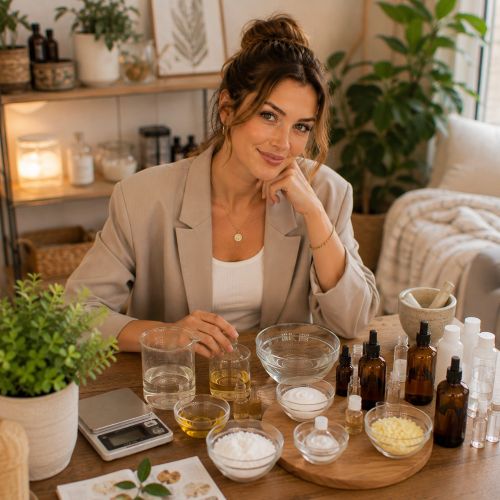
Composition thirty milliliters distilled water five milliliters meadowfoam seed oil three milliliters propanediol two grams Olivem 1000 emulsifier one milliliter pure alpha-tocopherol vitamin E zero point five grams trans-resveratrol powder zero point five grams ferulic acid powder one milliliter broad-spectrum eco preservative
Preparation Step first Disinfect heat-safe glass beakers, mini whisk, digital scale, and an airless pump bottle with isopropyl alcohol. Step second Combine thirty milliliters of distilled water and three milliliters of propanediol in the first heat-safe beaker, then dissolve zero point five grams of ferulic acid powder into it. Step third Place five milliliters of meadowfoam seed oil and two grams of Olivem 1000 emulsifier into the second heat-safe beaker. Step fourth Heat both beakers in a water bath to seventy degrees Celsius until the emulsifier melts completely. Step fifth Pour the water phase into the oil phase while whisking rapidly with a mini whisk until a smooth, fluid emulsion forms. Step sixth Cool the emulsion below thirty-five degrees Celsius, then stir in one milliliter of pure vitamin E, zero point five grams of trans-resveratrol powder, and one milliliter of eco preservative. Step seventh Check that the final pH sits at four point zero and transfer the emulsion into your sanitized airless pump container.
Application Guidelines and Usage Recommendations
Antioxidant serums deliver optimal protective results when integrated consistently into morning and evening routines.
Apply three to four drops of serum to freshly cleansed and lightly hydrated skin every morning prior to sun exposure. Gently press the serum into the skin of the face, neck, and décolleté using flat palms rather than rubbing vigorously. Allow the serum to absorb fully for two minutes before applying your daily moisturizer and broad-spectrum sunscreen. Because resveratrol and ferulic acid are highly bioactive, always conduct a patch test on the inner forearm twenty-four hours before full facial application to rule out sensitivities.
Storage Conditions and Product Preservation
Pure antioxidants are light-sensitive and oxygen-sensitive, requiring precise storage conditions to maintain efficacy.
Store finished serums in opaque airless pump containers or dark amber glass bottles to block ultraviolet radiation and prevent air exposure. Keep products in a cool, dark environment at stable temperatures between ten and fifteen degrees Celsius; storing serums in a dedicated cosmetic refrigerator is ideal. Always close container lids immediately after use. Custom aqueous antioxidant serums preserved with broad-spectrum eco systems remain stable for six to eight weeks, while anhydrous oil elixirs remain fresh for up to three months.


Cosmetic ingredients and professional formulation blog
This section features expert materials on modern cosmetic actives. We cover peptides, polynucleotides PDRN, different forms of hyaluronic acid, retinoids, ceramides and other key components.
Special focus is given to active stability, ingredient compatibility and correct incorporation into formulas. You will find practical guides on working with anti-age actives, moisturizing complexes and barrier repair ingredients.
We examine how to properly combine myorelaxants with peptides, common mistakes when using unstable vitamin C forms and ways to improve the performance of moisturizing actives.
Separate materials are dedicated to base oils, extracts, emulsifiers and supporting ingredients. This helps create stable and effective formulas for both professional and home cosmetics.
The blog regularly publishes reviews of trending actives, comparisons of similar ingredients and step-by-step formulation recommendations. The content is aimed at formulators, technologists and anyone seriously involved in creating cosmetic products.
Why this blog is useful
Here you will find practical data on eye area care actives, lifting systems and ingredients that improve skin firmness and tone. We rely on real formulation experience and address the actual challenges that arise during product development.
You can also explore materials on skin protection and repair, depigmentation and anti-inflammatory actives. This approach supports a more systematic selection of ingredients.
FAQ
What topics are covered most often
The blog focuses on peptides, PDRN, hyaluronic acid of different molecular weights, retinoids, ceramides and their compatibility rules.
Are there practical recommendations on how to incorporate actives
Yes, most articles include practical notes on pH stability, incorporation temperature and common formulation mistakes.
Is the content only for professionals
The materials are useful both for formulators and technologists and for those who create cosmetics for personal use and want to understand how modern ingredients work.
Where can I go directly to the ingredients
All key actives are collected in the Actives section, while base components are available in base oils and related categories.