-
 DIY: Video master classes
-
 Aromatherapy
-
 Felting master classes
-
 Eating at home
-
 DIY cosmetics for children
-
 Cooking recipes
-
 Detergents, cleaning products with your own hands
-
 Soap making as a business
-
 Natural cosmetics. Raw materials for cosmetics and soap.
-
 Natural oils in cosmetics
-
 News
-
 Recipes for balms and conditioners
-
 Bath Bomb Recipes
-
 Cream recipes. Cream making.
-
 Lotion recipes. Gel recipes.
-
 Mask recipes
-
 Soap recipes. Base soap. Soap from scratch.
-
 Recipes for all occasions
-
 Natural shampoo recipes
-
 Healthy Nutrition Recipes
-
 Scrub recipes. Massage tiles. Ubtan
-
 DIY candles
-
 Reference materials, questions, tips
-
 Startup - soap production
-
 Hair care. Tips, recipes
-
 Facial skin care. Cleansers.
-
 Body care. Tips, recipes
-
 Photo Reviews
-
 Chocolate Handmade


Comparison of soft non-ionic amphoteric surfactants which are suitable for children and sensitive skin
 In the world of cosmetics, surfactants are the workhorses of any cleansing product. They are the ingredients responsible for creating lather, lifting dirt and oil from the skin, and allowing them to be rinsed away. However, not all surfactants are created equal. Traditional, harsh cleansing agents like SLS (Sodium Lauryl Sulfate) and SLES (Sodium Laureth Sulfate) can be too aggressive for delicate facial skin, sensitive body areas, or the tender skin of a child. This has led to a growing demand for milder, gentler alternatives. Understanding the difference between non-ionic and amphoteric surfactants is the key to formulating effective yet ultra-gentle cleansing products. This article will demystify these ingredients, provide a head-to-head comparison, outline the advantages of a DIY approach, and share three detailed recipes for creating safe and soothing formulas.
What are Surfactants and Why Gentleness Matters?
A surfactant is a molecule with a dual nature: one end is attracted to water, and the other is attracted to oil. This unique structure allows it to lower the surface tension between water and oil, enabling them to mix. When you wash your skin, surfactants surround the oil, dirt, and debris, allowing water to carry them away.
Harsh surfactants, while excellent at cleansing, often strip the skin's natural protective lipid barrier. This can lead to:
-
Dryness and Flakiness: The skin loses its ability to retain moisture.
-
Irritation and Redness: The compromised barrier allows irritants to penetrate more easily.
-
Worsening of Conditions: For those with eczema, psoriasis, or acne, a harsh cleanser can exacerbate symptoms.
For children and individuals with sensitive skin, choosing a mild surfactant is not a matter of preference but a necessity for maintaining skin health and comfort.
Understanding Gentle Surfactants: Non-Ionic vs. Amphoteric
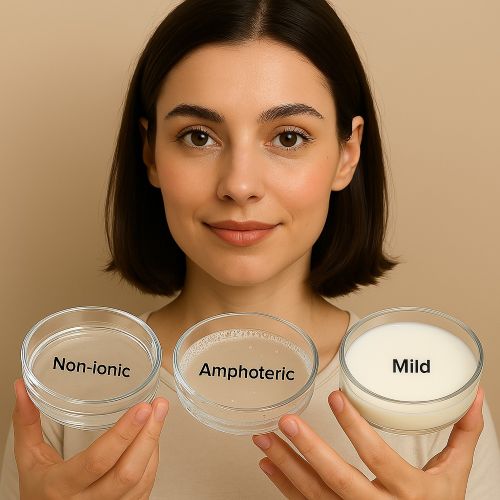
Gentle surfactants fall into several categories, but the two most commonly used in mild, high-quality formulas are non-ionic and amphoteric.
Non-Ionic Surfactants: Mild on Skin, Subtle Foam
Non-ionic surfactants have a neutral electrical charge. This lack of charge makes them exceptionally mild and gentle on the skin, as they do not disrupt the skin's pH or protective barrier.
-
Key Properties:
-
Very mild cleansing: They are not aggressive degreasers, making them ideal for gentle, daily use.
-
Good for thickening: They can help to increase the viscosity of a formula, creating a more gel-like texture.
-
Low to moderate foam: They typically produce a soft, creamy lather rather than an abundant, airy one.
-
Derived from plants: Many popular non-ionic surfactants are derived from coconut oil and glucose (sugar), aligning with a natural, plant-based cosmetic philosophy.
-
-
Common Examples: Coco Glucoside, Decyl Glucoside, Lauryl Glucoside.
Amphoteric Surfactants: The Perfect Partners
Amphoteric surfactants have a unique dual electrical charge (both positive and negative), allowing them to behave differently depending on the formula's pH. This dual nature makes them incredibly versatile.
-
Key Properties:
-
Foam Boosters: They are excellent at enhancing the lather of other surfactants, providing a richer, more luxurious foam.
-
Irritation Mitigators: This is their most important function. They effectively reduce the irritation potential of other, even harsher, surfactants. When combined with a non-ionic surfactant, they create an incredibly mild blend.
-
Conditioning Feel: They can leave a soft, conditioned feel on the skin and hair after rinsing.
-
Derived from plants: Like their non-ionic counterparts, they are often derived from coconut oil.
-
-
Common Examples: Cocamidopropyl Betaine, Coco-Betaine, Disodium Cocoamphodiacetate.
The Power of Synergy: Why Non-Ionic and Amphoteric Surfactants Work Best Together
The gold standard for a gentle cleansing product is not to use just one type of surfactant, but to combine them. A formula that uses a primary non-ionic surfactant (like Decyl Glucoside) for gentle cleansing and a secondary amphoteric surfactant (like Cocamidopropyl Betaine) to boost the foam and mitigate any potential for mild irritation is the ideal solution for sensitive skin. This synergistic blend provides a rich, satisfying lather and effective cleansing without compromising the skin's delicate balance.
Advantages of DIY Formulas for Sensitive Skin
Creating your own cleansing products using these gentle surfactants offers significant benefits over industrial analogs.
-
Complete Ingredient Control: You eliminate all potential irritants, such as harsh preservatives, synthetic fragrances, and dyes that are common in commercial products.
-
Customization: You can adjust the surfactant concentration and add calming ingredients like chamomile hydrosol or oat extract to perfectly suit your skin's unique needs.
-
Freshness and Purity: Homemade products are made in small batches, ensuring the potency of all natural actives and ingredients.
-
Cost-Effectiveness: Purchasing gentle surfactants in bulk and making your own formulas is far more economical than buying premium, natural-based commercial cleansers.
Three Detailed Recipes for Gentle Cleansing Formulas
Each recipe is designed for 100 grams of finished product. All recipes require a broad-spectrum preservative as they contain water.
Recipe 1: Ultra-Gentle Baby & Child Shampoo
This simple formula is incredibly mild, producing a soft lather that is gentle on both the scalp and skin.
Ingredients:
-
Decyl Glucoside: 40 g (Primary non-ionic surfactant)
-
Cocamidopropyl Betaine: 30 g (Secondary amphoteric surfactant, foam booster)
-
Distilled Water: 25 g
-
Glycerin: 3 g (Humectant, moisturizing)
-
Preservative (e.g., Geogard 221): 1 g
Preparation:
-
Weigh all liquid ingredients in a sterilized beaker.
-
Gently combine the surfactants, mixing slowly with a glass rod to avoid creating excessive foam.
-
Add the water and glycerin to the surfactant mixture and continue to stir until the mixture is uniform.
-
Add the preservative at a temperature below 40°C and stir thoroughly for a few minutes.
-
Check the final pH (it should be around 5.0-6.0) and adjust if needed.
-
Transfer to a sterilized bottle.
Recommendations for Use: Lather a small amount in your hands and gently massage onto wet hair and skin. Rinse thoroughly. This formula is safe for daily use.
Storage: Store in a cool, dark place. The shelf life is typically 3 to 6 months with a preservative.
Recipe 2: Soothing Shower Gel for Sensitive Adults
This formula is a light gel with extra soothing ingredients to calm and hydrate sensitive skin.
Ingredients:
-
Coco Glucoside: 30 g (Primary non-ionic surfactant)
-
Cocamidopropyl Betaine: 20 g (Secondary amphoteric surfactant)
-
Distilled Water: 40 g
-
Chamomile Hydrosol: 5 g (Soothing and anti-inflammatory)
-
Xanthan Gum: 1 g (Thickener)
-
Glycerin: 3 g (Humectant)
-
Preservative (e.g., Euxyl PE 9010): 1 g
-
Essential Oil (optional, e.g., Lavender): 5-10 drops
Preparation:
-
Create the Xanthan Gum gel. In a small beaker, sprinkle the Xanthan Gum over the Glycerin and mix to create a slurry. Add this slurry to the Distilled Water and Chamomile Hydrosol, whisking constantly until a gel forms.
-
Add the surfactants. Add the Coco Glucoside and Cocamidopropyl Betaine to the gel base and stir gently until combined.
-
Add the preservative and fragrance. Add the Euxyl PE 9010 preservative at a temperature below 40°C. If using essential oils, add them now. Stir thoroughly.
-
Check and adjust the pH. The final pH should be between 5.0 and 6.0.
-
Transfer to a sterilized bottle.
Recommendations for Use: Apply to a wet loofah or directly to the skin. Lather well and rinse. The chamomile provides a calming effect.
Storage: Store in a cool, dark place. The shelf life is typically 3 to 6 months with a preservative.
Recipe 3: Hydrating Facial Cleanser for Reactive Skin
This formula is designed to be very mild with minimal lather, focusing on gentle, non-stripping cleansing.
Ingredients:
-
Decyl Glucoside: 15 g (Primary non-ionic surfactant)
-
Cocamidopropyl Betaine: 10 g (Secondary amphoteric surfactant)
-
Distilled Water: 60 g
-
Oat Extract: 10 g (Soothing and anti-inflammatory)
-
Vegetable Glycerin: 4 g
-
Preservative (e.g., Leucidal Liquid SF): 1 g
Preparation:
-
Weigh and combine the ingredients. In a sterilized beaker, combine the Distilled Water, Oat Extract, and Vegetable Glycerin.
-
Add the surfactants. Slowly add the Decyl Glucoside and Cocamidopropyl Betaine. Stir very gently to avoid creating a thick foam.
-
Add the preservative. Add your chosen preservative and stir thoroughly to ensure it is evenly distributed.
-
Check the pH. The final pH should be between 5.0 and 6.0.
-
Transfer to a sterilized bottle.
Recommendations for Use: Massage a small amount onto a wet face. The lather will be minimal. Rinse well. The oat extract will leave your skin feeling calm and hydrated.
 Storage:
Store in a cool, dark place. The shelf life is typically 3 to 6 months with a preservative.
Conclusion: The Power of Informed Choices in Cleansing
Understanding the difference between non-ionic and amphoteric surfactants is the first step towards creating a safe and effective cleansing routine for sensitive skin. These gentle ingredients, when used in a synergistic blend, provide the perfect balance of cleansing power and skin-friendly mildness. By choosing a DIY approach, you gain the power to customize your formulas, ensuring that every product you use is not only effective but also a pure, fresh, and soothing treat for your skin.


Cosmetic ingredients and professional formulation blog
This section features expert materials on modern cosmetic actives. We cover peptides, polynucleotides PDRN, different forms of hyaluronic acid, retinoids, ceramides and other key components.
Special focus is given to active stability, ingredient compatibility and correct incorporation into formulas. You will find practical guides on working with anti-age actives, moisturizing complexes and barrier repair ingredients.
We examine how to properly combine myorelaxants with peptides, common mistakes when using unstable vitamin C forms and ways to improve the performance of moisturizing actives.
Separate materials are dedicated to base oils, extracts, emulsifiers and supporting ingredients. This helps create stable and effective formulas for both professional and home cosmetics.
The blog regularly publishes reviews of trending actives, comparisons of similar ingredients and step-by-step formulation recommendations. The content is aimed at formulators, technologists and anyone seriously involved in creating cosmetic products.
Why this blog is useful
Here you will find practical data on eye area care actives, lifting systems and ingredients that improve skin firmness and tone. We rely on real formulation experience and address the actual challenges that arise during product development.
You can also explore materials on skin protection and repair, depigmentation and anti-inflammatory actives. This approach supports a more systematic selection of ingredients.
FAQ
What topics are covered most often
The blog focuses on peptides, PDRN, hyaluronic acid of different molecular weights, retinoids, ceramides and their compatibility rules.
Are there practical recommendations on how to incorporate actives
Yes, most articles include practical notes on pH stability, incorporation temperature and common formulation mistakes.
Is the content only for professionals
The materials are useful both for formulators and technologists and for those who create cosmetics for personal use and want to understand how modern ingredients work.
Where can I go directly to the ingredients
All key actives are collected in the Actives section, while base components are available in base oils and related categories.



