-
 DIY: Video master classes
-
 Aromatherapy
-
 Felting master classes
-
 Eating at home
-
 DIY cosmetics for children
-
 Cooking recipes
-
 Detergents, cleaning products with your own hands
-
 Soap making as a business
-
 Natural cosmetics. Raw materials for cosmetics and soap.
-
 Natural oils in cosmetics
-
 News
-
 Recipes for balms and conditioners
-
 Bath Bomb Recipes
-
 Cream recipes. Cream making.
-
 Lotion recipes. Gel recipes.
-
 Mask recipes
-
 Soap recipes. Base soap. Soap from scratch.
-
 Recipes for all occasions
-
 Natural shampoo recipes
-
 Healthy Nutrition Recipes
-
 Scrub recipes. Massage tiles. Ubtan
-
 DIY candles
-
 Reference materials, questions, tips
-
 Startup - soap production
-
 Hair care. Tips, recipes
-
 Facial skin care. Cleansers.
-
 Body care. Tips, recipes
-
 Photo Reviews
-
 Chocolate Handmade


Solubility and pH: why is this important when creating cosmetics
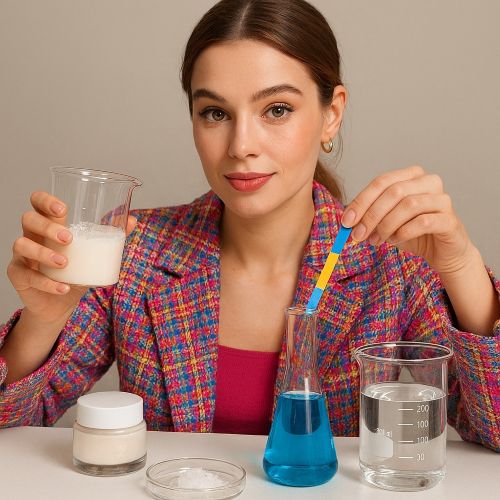 Creating effective and stable cosmetic products is more than just mixing ingredients. It's a precise science governed by fundamental chemical principles. Two of the most critical concepts for any formulator to master are solubility and pH. These two factors directly influence a product's stability, efficacy, and safety. Ignoring them can lead to a formula that separates, loses its potency, or, even worse, irritates the skin. This article will demystify the roles of solubility and pH, explain how they affect common cosmetic ingredients, and provide three detailed recipes that demonstrate how to properly manage these parameters to create professional-grade skincare products.
The Two Pillars of Formulation: Solubility and pH
Understanding these concepts is the key to moving beyond simple recipes to true cosmetic chemistry.
Solubility: The "Like Dissolves Like" Rule
Solubility determines which ingredients can dissolve in a specific medium. In cosmetic formulation, this primarily refers to a substance's ability to dissolve in either water or oil.
-
Water-Soluble Ingredients: These substances, like Hyaluronic Acid, Niacinamide, and many herbal extracts, dissolve in the water phase of a formula. They are often humectants that draw moisture to the skin or actives that work in the upper layers of the epidermis.
-
Oil-Soluble Ingredients: These are substances that dissolve in the oil phase. This includes most carrier oils (Jojoba Oil, Almond Oil), butters (Shea Butter), and oil-soluble vitamins like Vitamin E and Vitamin C derivatives (e.g., Tetrahexyldecyl Ascorbate). These ingredients moisturize, soften, and form an occlusive barrier on the skin.
-
Dual Solubility: Some ingredients, like certain emulsifiers, can interact with both water and oil, making them the perfect bridge between the two phases to create a stable emulsion (a cream or lotion).
pH: The Measure of Acidity and Alkalinity
pH measures the hydrogen ion concentration in a solution, indicating its acidity or alkalinity on a scale from 0 to 14. A pH of 7 is neutral, below 7 is acidic, and above 7 is alkaline.
-
Skin's pH: The healthy skin barrier, or acid mantle, has a natural pH of around 4.5 to 5.5. This slightly acidic environment protects against pathogens and helps the skin retain moisture.
-
Product Efficacy: Many active ingredients, particularly AHA and BHA acids (Glycolic Acid, Salicylic Acid) and L-Ascorbic Acid (Vitamin C), are only effective within a very specific, often low, pH range. If the pH is too high, the ingredient becomes unstable and loses its potency.
-
Product Safety: A product's pH directly affects its safety. Formulas that are too acidic or too alkaline can irritate or damage the skin's protective barrier.
-
Preservative Efficacy: Many preservatives, like those containing Benzoic Acid or Sorbic Acid, only work effectively within a specific pH range. If the pH is outside this range, the preservative can't do its job, and the product can become contaminated with bacteria.
The Importance of Measurement: Using a pH Meter and Adjusters
To ensure a product's stability and efficacy, you need to measure and adjust its pH.
-
pH Meter: A digital pH meter is a crucial tool. pH strips are a good starting point for learning but lack the precision needed for many formulas, especially those with sensitive actives.
-
pH Adjusters: You'll use a pH adjuster to bring your formula to the desired level. Citric Acid or Lactic Acid dissolved in water can be used to lower the pH, while a solution of Sodium Bicarbonate or Arginine can be used to raise it. Always add these adjusters in very small amounts, stirring well and re-checking the pH after each addition.
Three Detailed Recipes Demonstrating pH and Solubility Control
These recipes highlight the importance of managing solubility and pH to create safe, stable, and effective products.
Recipe 1: Brightening Vitamin C Serum (Low pH)
This serum relies on a low pH to ensure the stability and efficacy of L-Ascorbic Acid, a key water-soluble active.
-
Prepare the water phase. In a sterilized beaker, weigh 25g of distilled water.
-
Dissolve the actives. In a separate small beaker, dissolve 5g of L-Ascorbic Acid powder in 5g of distilled water. Once dissolved, slowly add this solution to the main water phase, stirring thoroughly.
-
Add antioxidant and humectant. Add 0.5g of Ferulic Acid and 2g of Glycerin. Stir until all ingredients are dissolved.
-
Check and adjust pH. The pH must be low for Vitamin C to work. Check the pH. It should be around 3.5. If it is higher, add a few drops of Citric Acid solution until the desired pH is reached.
-
Add preservative and pour. Add 0.5g of a broad-spectrum preservative that is effective at a low pH, such as Geogard 221. Pour into a dark, air-tight dropper bottle.
Recommendations for Use: Apply 2-3 drops to a clean face in the morning. Follow with a moisturizer and sunscreen.
Storage: Store in a cool, dark place. The shelf life is short, approximately 3-4 weeks.
Recipe 2: Hydrating Niacinamide Serum (Neutral pH)
This serum uses Niacinamide, a water-soluble active that works best at a pH close to the skin's natural balance.
-
Prepare the gel phase. In a sterilized beaker, weigh 85g of distilled water. Slowly sprinkle 0.5g of Xanthan Gum over the surface, stirring vigorously until a uniform gel forms. Let it sit for 30 minutes.
-
Dissolve the actives. In a separate small beaker, dissolve 5g of Niacinamide powder in 5g of distilled water. Stir until fully dissolved.
-
Combine and stir. Add the Niacinamide solution to the main gel. Stir gently but thoroughly.
-
Check and adjust pH. Check the pH. It should be between 5.5 and 6.5 for Niacinamide to be most effective. If it's too low, add a few drops of Sodium Bicarbonate solution.
-
Add preservative and pour. Add 1g of a broad-spectrum preservative like Euxyl PE 9010. Pour into a clean bottle with a pump or dropper.
Recommendations for Use: Apply to a clean face in the morning or evening before a moisturizer.
Storage: Store in a cool, dark place. The shelf life is 3-6 months.
Recipe 3: Soothing Oil-Based Balm (No pH)
This formula is a great example of an oil-soluble product that does not have a pH, simplifying the formulation process.
-
Prepare the butter and wax phase. In a heat-safe beaker, weigh 20g of Shea Butter and 5g of Beeswax. Gently melt them in a double boiler.
-
Add the oils. Once the butter and wax are fully melted, add 10g of Jojoba Oil and 5g of Sweet Almond Oil. Stir until the mixture is uniform.
-
Add the oil-soluble active. Remove from heat and, when the mixture has cooled slightly but is still liquid, add 1g of Vitamin E (Tocopherol). Stir to combine.
-
Add fragrance and pour. Add a few drops of a skin-safe essential oil (e.g., lavender). Pour the liquid balm into a clean tin or pot.
Recommendations for Use: Massage a small amount onto dry skin or lips as needed.
Storage: Store in a cool, dry place away from direct sunlight. The shelf life is up to one year.
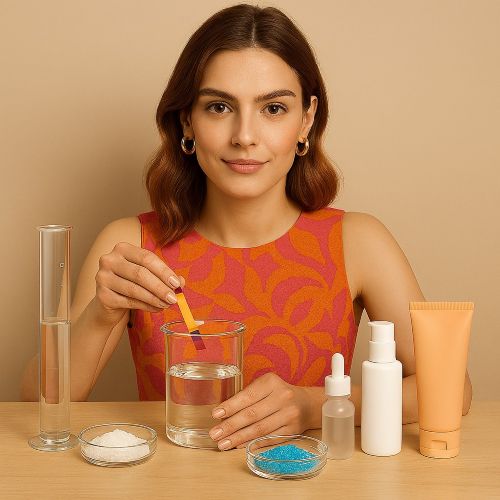
Advantages of a DIY Formula with Controlled Solubility and pH
Mastering solubility and pH gives your homemade products a significant edge over industrial alternatives.
-
Maximum Potency: By ensuring the actives are in their optimal pH range and fully dissolved, you can guarantee that they are working at their highest possible potency, unlike commercial products that may have degraded on the shelf.
-
Tailored Safety: You can create products with a pH that is perfectly suited to your skin's needs, avoiding the irritation that can be caused by mass-market products with an incorrect pH.
-
Avoidance of Conflicts: You can carefully select ingredients to ensure they are compatible, preventing deactivation of actives and providing a stable, reliable product.
-
Ingredient Purity: You control what goes into your formula, avoiding fillers and additives that provide no benefit. You are using precisely the ingredients you need, in the form they need to be in.
By understanding solubility and pH, you elevate your cosmetic formulation skills from a hobby to a truly professional practice, creating products that are superior in their effectiveness, safety, and purity.


Cosmetic ingredients and professional formulation blog
This section features expert materials on modern cosmetic actives. We cover peptides, polynucleotides PDRN, different forms of hyaluronic acid, retinoids, ceramides and other key components.
Special focus is given to active stability, ingredient compatibility and correct incorporation into formulas. You will find practical guides on working with anti-age actives, moisturizing complexes and barrier repair ingredients.
We examine how to properly combine myorelaxants with peptides, common mistakes when using unstable vitamin C forms and ways to improve the performance of moisturizing actives.
Separate materials are dedicated to base oils, extracts, emulsifiers and supporting ingredients. This helps create stable and effective formulas for both professional and home cosmetics.
The blog regularly publishes reviews of trending actives, comparisons of similar ingredients and step-by-step formulation recommendations. The content is aimed at formulators, technologists and anyone seriously involved in creating cosmetic products.
Why this blog is useful
Here you will find practical data on eye area care actives, lifting systems and ingredients that improve skin firmness and tone. We rely on real formulation experience and address the actual challenges that arise during product development.
You can also explore materials on skin protection and repair, depigmentation and anti-inflammatory actives. This approach supports a more systematic selection of ingredients.
FAQ
What topics are covered most often
The blog focuses on peptides, PDRN, hyaluronic acid of different molecular weights, retinoids, ceramides and their compatibility rules.
Are there practical recommendations on how to incorporate actives
Yes, most articles include practical notes on pH stability, incorporation temperature and common formulation mistakes.
Is the content only for professionals
The materials are useful both for formulators and technologists and for those who create cosmetics for personal use and want to understand how modern ingredients work.
Where can I go directly to the ingredients
All key actives are collected in the Actives section, while base components are available in base oils and related categories.



