-
 DIY: Video master classes
-
 Aromatherapy
-
 Felting master classes
-
 Eating at home
-
 DIY cosmetics for children
-
 Cooking recipes
-
 Detergents, cleaning products with your own hands
-
 Soap making as a business
-
 Natural cosmetics. Raw materials for cosmetics and soap.
-
 Natural oils in cosmetics
-
 News
-
 Recipes for balms and conditioners
-
 Bath Bomb Recipes
-
 Cream recipes. Cream making.
-
 Lotion recipes. Gel recipes.
-
 Mask recipes
-
 Soap recipes. Base soap. Soap from scratch.
-
 Recipes for all occasions
-
 Natural shampoo recipes
-
 Healthy Nutrition Recipes
-
 Scrub recipes. Massage tiles. Ubtan
-
 DIY candles
-
 Reference materials, questions, tips
-
 Startup - soap production
-
 Hair care. Tips, recipes
-
 Facial skin care. Cleansers.
-
 Body care. Tips, recipes
-
 Photo Reviews
-
 Chocolate Handmade


Anti-aging care: how to combine peptides, vitamins, and oils in a single cream formula
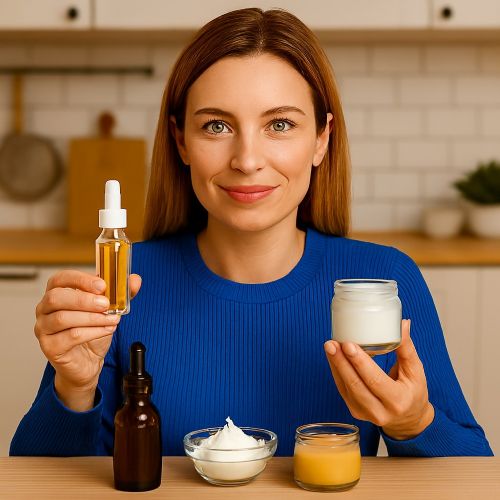 Creating a truly effective anti-aging cream requires more than just mixing potent ingredients; it demands an understanding of cosmetic synergy and compatibility. A superior formula must combine three essential pillars of anti-aging care: Peptides (for cellular communication and repair), Vitamins (for antioxidant protection and collagen support), and Nourishing Oils (for barrier function and moisture). The magic lies in ensuring these active molecules remain stable and work together without canceling each other out. By mastering the delicate art of emulsification and proper active introduction, you can formulate a single, comprehensive cream that outperforms a complex regimen of separate serums. This article details the synergy of these components, outlines critical compatibility rules, and provides three detailed recipes for advanced anti-aging creams.
The Triad of Anti-Aging: Peptides, Vitamins, and Oils
To effectively combat the signs of aging, a cream must address multiple issues simultaneously: loss of firmness, oxidative stress, and moisture depletion.
1. Peptides: The Communicators
Peptides are short chains of amino acids that act as messengers in the skin. They are crucial for addressing structural aging.
-
Signal Peptides (e.g., Matrixyl): Stimulate collagen, elastin, and glycosaminoglycan production, leading to firmer, denser skin.
-
Neuro-Peptides (e.g., Argireline, X50 Myocept): Temporarily interrupt nerve signals to facial muscles, reducing the appearance of dynamic wrinkles (like frown lines).
2. Vitamins: The Protectors
Vitamins function primarily as powerful antioxidants that shield skin cells from environmental damage.
-
Vitamin C (Ascorbic Acid and derivatives): A vital cofactor for collagen synthesis and a potent antioxidant that brightens the skin and reduces hyperpigmentation.
-
Vitamin E (Tocopherol): A fat-soluble antioxidant that protects the skin's lipid barrier and works synergistically with Vitamin $\text{C}$ to enhance stability.
3. Nourishing Oils: The Foundation
Carrier oils and plant butters provide essential fatty acids that repair the skin's moisture barrier, prevent transepidermal water loss (TEWL), and act as delivery vehicles for fat-soluble vitamins.
-
Rosehip Oil: Rich in natural Retinoic acid precursors and essential fatty acids (Omegas 3 and 6).
-
Argan Oil/Shea Butter: Provides deep nourishment and excellent barrier repair benefits.
Critical Compatibility Rules for a Stable Formula
The biggest challenge in combining these actives is managing their stability, particularly their dependence on $\text{pH}$ and temperature.
-
Peptides are $\text{pH}$-Sensitive: Most peptides perform optimally in a narrow $\text{pH}$ range, usually between $4.5$ and $6.5$. Extreme $\text{pH}$ can denature the peptide structure, rendering it inactive.
-
Vitamin C Stability: L-Ascorbic Acid requires a very low $\text{pH}$ (below $3.5$) for penetration but is highly unstable. To safely include Vitamin $\text{C}$ in a stable emulsion with peptides, use stable oil-soluble derivatives like Tetrahexyldecyl Ascorbate or encapsulated forms, which are stable at a neutral $\text{pH}$.
-
Heat is the Enemy: Peptides and many vitamins (especially $\text{C}$) are heat-sensitive. They must be added to the final emulsion only during the cool-down phase (when the temperature is below $40^{\circ}\text{C}$). The only exceptions are heat-stable vitamins like Vitamin $\text{E}$, which can be added to the oil phase.
The overall goal is to create a cream with a final $\text{pH}$ around $5.5$ to $6.0$, which is optimal for both peptide activity and general skin health.
Three Advanced Anti-Aging Cream Recipes
These recipes demonstrate how to properly layer and combine the active components for maximum efficacy and stability.
Recipe 1: Peptide and Oil-Soluble Vitamin C Cream
This formula is designed for daytime use, focusing on antioxidant protection and collagen stimulation.
-
Prepare the Water Phase. In a sterilized beaker, weigh $65\text{g}$ of distilled water and $5\text{g}$ of Vegetable Glycerin (for humectancy). Heat to $70^{\circ}\text{C}$.
-
Prepare the Oil Phase. In a separate beaker, combine $8\text{g}$ of Jojoba Oil, $5\text{g}$ of Shea Butter, $5\text{g}$ of an emulsifier like Olivem 1000, and $1\text{g}$ of Vitamin E (Tocopherol). Heat to $70^{\circ}\text{C}$.
-
Emulsify. Slowly pour the hot water phase into the hot oil phase, mixing with a hand blender until a uniform emulsion forms. Continue mixing gently as the cream cools.
-
Add the Cool-Down Actives. When the cream cools below $40^{\circ}\text{C}$, gently stir in $4\text{g}$ of Matrixyl 3000 solution (Signal Peptide) and $2\text{g}$ of Tetrahexyldecyl Ascorbate (stable Vitamin $\text{C}$ derivative, usually oil-soluble, but added here with gentle mixing as the emulsion is forming).
-
Add the Preservative. Add $1\text{g}$ of a broad-spectrum preservative. Adjust $\text{pH}$ if necessary to $5.5$ and transfer to an airless pump bottle.
Recommendations for Use: Apply to the face and neck every morning. Follow with sun protection.
Storage: Store in a cool, dark place, ideally in an airless container to protect the Vitamin $\text{C}$. Shelf life is up to 3 months.
Recipe 2: Retinol and Barrier Repair Night Balm
This intense night formula focuses on cellular turnover (Retinol) and deep barrier repair (Oils), with added neuro-peptides for expression lines.
-
Prepare the Water Phase. In a sterilized beaker, weigh $60\text{g}$ of distilled water and $5\text{g}$ of Hydrolyzed Collagen solution. Heat to $70^{\circ}\text{C}$.
-
Prepare the Oil Phase. In a separate beaker, combine $10\text{g}$ of Avocado Oil, $5\text{g}$ of Cocoa Butter, $5\text{g}$ of an emulsifier like Lecigel, and $4\text{g}$ of a co-emulsifier (e.g., Cetearyl Alcohol) for stabilization. Heat to $70^{\circ}\text{C}$.
-
Emulsify. Combine phases using a hand blender until a thick balm consistency is achieved.
-
Add the Neuro-Peptide. When the balm cools below $40^{\circ}\text{C}$, gently stir in $3\text{g}$ of Argireline or X50 Myocept solution (Neuro-Peptide).
-
Add Retinol and Preservative. Add $2\text{g}$ of Nanolipid Retinol Complex solution (a stable form of Retinol that requires no heat) and $1\text{g}$ of preservative. Stir slowly and transfer to an opaque jar.
Recommendations for Use: Apply in the evening only, focusing on areas with deep expression lines. Avoid the immediate eye area.
Storage: Due to Retinol, store in a dark, cool environment. Shelf life is up to 3 months.
Recipe 3: Total Renewal Eye Cream
A lighter formula specifically designed for the delicate skin around the eyes, combining peptides for crow's feet and oils for hydration.
-
Prepare the Water Phase. In a sterilized beaker, weigh $75\text{g}$ of distilled water and $5\text{g}$ of Aloe Vera Juice. Heat to $70^{\circ}\text{C}$.
-
Prepare the Oil Phase. In a separate beaker, combine $8\text{g}$ of light Apricot Kernel Oil, $5\text{g}$ of an emulsifier like Protelan $\text{AW} 10$ (for light textures), and $1\text{g}$ of Bisabolol (soothing active). Heat to $70^{\circ}\text{C}$.
-
Emulsify. Combine phases, mixing until a light fluid cream is formed.
-
Add Peptides and Antioxidant. When the fluid cools below $40^{\circ}\text{C}$, add $3\text{g}$ of Copper Peptide solution (for firming) and $2\text{g}$ of Green Tea Extract solution (antioxidant).
-
Add Preservative. Add $1\text{g}$ of preservative. Gently stir with a spatula and fill into a small, sterile container.
Recommendations for Use: Apply a rice-grain amount around each eye contour area, morning and evening, using a gentle patting motion.
Storage: Use a small container and store in a cool place to maintain peptide stability. Shelf life is up to 3 months.
Advantages Over Commercial Anti-Aging Analogs
Formulating a bespoke cream that expertly combines these three active groups offers significant advantages over mass-market products.
-
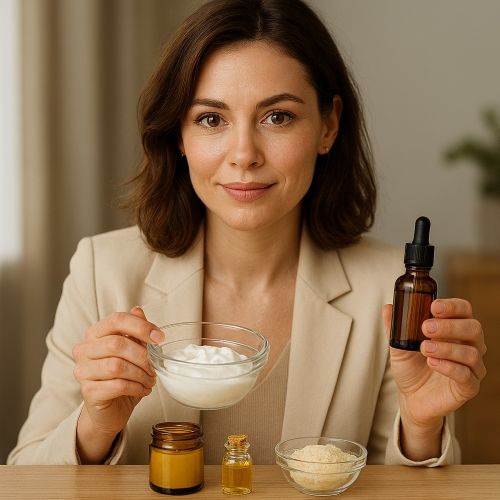 Optimized Active Concentration. Premium peptides and stabilized vitamins are very expensive. Commercial brands often use them in sub-optimal, minimal concentrations to save cost, despite advertising them prominently. By formulating yourself, you use the proven therapeutic dosage of $3\%$ to $5\%$ for peptides and adequate vitamin percentages.
-
Guaranteed Compatibility and Freshness. You control the process to strictly observe the temperature and $\text{pH}$ windows critical for peptide and Vitamin $\text{C}$ stability. You also create the product in small, fresh batches, preventing the gradual degradation that occurs during the long shelf life of industrial products.
-
Superior Oil Quality. Your formula utilizes high-quality, cold-pressed carrier oils (Rosehip, Argan, etc.) chosen for their specific fatty acid profile. Commercial creams often rely on mineral oil or cheap synthetic esters that offer little nutritional value to the skin barrier.
-
Absence of Irritants. You can exclude common irritants that undermine anti-aging efforts, such as harsh synthetic fragrances, excessive alcohol, or unnecessary colorants, making your cream far safer and more effective for sensitive, mature skin.
By meticulously blending peptides, vitamins, and nourishing oils in a stable, well-designed emulsion, your homemade anti-aging cream transforms from a hobby product into a personalized, professionally effective skincare solution.


Cosmetic ingredients and professional formulation blog
This section features expert materials on modern cosmetic actives. We cover peptides, polynucleotides PDRN, different forms of hyaluronic acid, retinoids, ceramides and other key components.
Special focus is given to active stability, ingredient compatibility and correct incorporation into formulas. You will find practical guides on working with anti-age actives, moisturizing complexes and barrier repair ingredients.
We examine how to properly combine myorelaxants with peptides, common mistakes when using unstable vitamin C forms and ways to improve the performance of moisturizing actives.
Separate materials are dedicated to base oils, extracts, emulsifiers and supporting ingredients. This helps create stable and effective formulas for both professional and home cosmetics.
The blog regularly publishes reviews of trending actives, comparisons of similar ingredients and step-by-step formulation recommendations. The content is aimed at formulators, technologists and anyone seriously involved in creating cosmetic products.
Why this blog is useful
Here you will find practical data on eye area care actives, lifting systems and ingredients that improve skin firmness and tone. We rely on real formulation experience and address the actual challenges that arise during product development.
You can also explore materials on skin protection and repair, depigmentation and anti-inflammatory actives. This approach supports a more systematic selection of ingredients.
FAQ
What topics are covered most often
The blog focuses on peptides, PDRN, hyaluronic acid of different molecular weights, retinoids, ceramides and their compatibility rules.
Are there practical recommendations on how to incorporate actives
Yes, most articles include practical notes on pH stability, incorporation temperature and common formulation mistakes.
Is the content only for professionals
The materials are useful both for formulators and technologists and for those who create cosmetics for personal use and want to understand how modern ingredients work.
Where can I go directly to the ingredients
All key actives are collected in the Actives section, while base components are available in base oils and related categories.



