-
 DIY: Video master classes
-
 Aromatherapy
-
 Felting master classes
-
 Eating at home
-
 DIY cosmetics for children
-
 Cooking recipes
-
 Detergents, cleaning products with your own hands
-
 Soap making as a business
-
 Natural cosmetics. Raw materials for cosmetics and soap.
-
 Natural oils in cosmetics
-
 News
-
 Recipes for balms and conditioners
-
 Bath Bomb Recipes
-
 Cream recipes. Cream making.
-
 Lotion recipes. Gel recipes.
-
 Mask recipes
-
 Soap recipes. Base soap. Soap from scratch.
-
 Recipes for all occasions
-
 Natural shampoo recipes
-
 Healthy Nutrition Recipes
-
 Scrub recipes. Massage tiles. Ubtan
-
 DIY candles
-
 Reference materials, questions, tips
-
 Startup - soap production
-
 Hair care. Tips, recipes
-
 Facial skin care. Cleansers.
-
 Body care. Tips, recipes
-
 Photo Reviews
-
 Chocolate Handmade
Solubilizer vs emulsifier: what to use in water based formulas
 Solubilizer vs emulsifier: what to use in water based formulas is written for formulators, small manufacturers and product developers who need a practical route from ingredient selection to a testable prototype. Search behavior in 2026 increasingly combines ingredient names with questions about compatibility, use level, pH, texture and processing. The article therefore focuses on formulation decisions and verifiable process controls rather than broad promotional claims.
For raw material selection, explore Peptides • Anti Age Actives
Build the formula around functions
Start with the product format and phase structure, then assign a clear role to each raw material. Water-soluble actives, lipid ingredients, surfactants, polymers and delivery systems have different processing needs. Every addition should be evaluated against the complete system rather than considered in isolation.
Compatibility, pH and processing temperature
Select the target pH from the overlapping compatible ranges of pH-sensitive materials. Peptides, ferments, liposomal systems and some vitamin derivatives are commonly handled during cool-down unless the technical data for the specific raw material states otherwise. Any water-containing product also needs a justified preservation strategy.
Why a narrow formulation intent supports SEO and AI discovery
This page answers a defined formulation problem rather than duplicating generic ingredient explainers. Clear subtopics, explicit processing parameters and concise question-and-answer sections create self-contained passages that search engines and AI systems can understand while keeping the original site as the source of the complete formulation context.
Solubilizer example: Polysorbate 20
Practical 100 g formulation
Laboratory starting prototype. All quantities are given in grams. Target pH after manufacture is 5.2–5.8 unless a specific raw material requires a narrower range.
|
Ingredient |
Weight |
|
Distilled water |
90 g |
|
Polysorbate 20 |
4 g |
|
Fragrance or essential oil blend |
1 g |
|
Propanediol |
3 g |
|
Panthenol |
1 g |
|
Euxyl PE 9010 |
0.8 g |
|
Lactic acid solution q.s. |
0.2 g |
Manufacturing procedure
1. Sanitize the work area, equipment and packaging, then weigh each raw material separately.
2. Prepare the water phase and dissolve water-soluble materials completely. Pre-disperse polymers to avoid agglomerates.
3. Add surfactants slowly to limit foaming; for an emulsion, prepare the oil phase and emulsifier separately.
4. Add temperature-sensitive actives below 40 °C unless the technical data for the specific material requires another process.
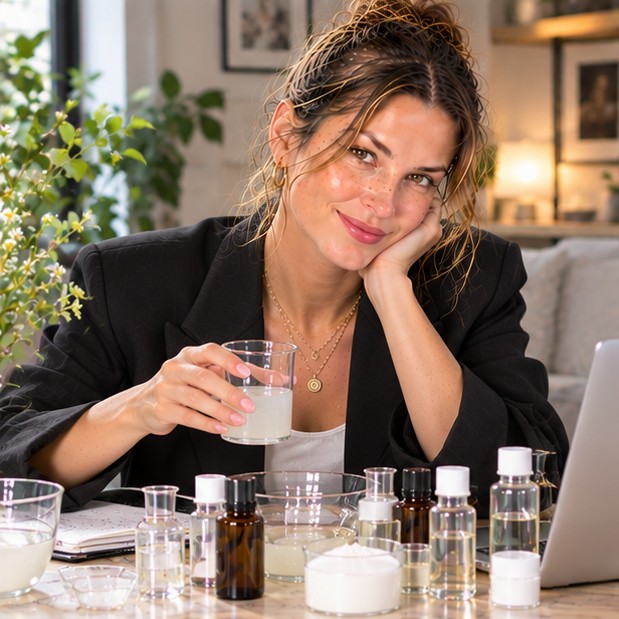 5. Add the preservative, measure pH with a calibrated meter and adjust in small increments with a suitable acid or alkali solution.
6. Allow the batch to equilibrate, then recheck pH, appearance and viscosity. Commercial production requires stability, challenge and packaging compatibility testing.
Can the active level be increased?
Only after checking the supplier use range and repeating stability, pH and sensory evaluation.
Can the formula be scaled directly to 1 kg?
The arithmetic is simple, but a pilot batch is still required because mixing, aeration, heat transfer and polymer hydration change with scale.
How is shelf life established?
Shelf life should not be assigned from a recipe alone. Commercial products require stability work, microbiological validation and packaging compatibility testing.





