-
 DIY: Video master classes
-
 Aromatherapy
-
 Felting master classes
-
 Eating at home
-
 DIY cosmetics for children
-
 Cooking recipes
-
 Detergents, cleaning products with your own hands
-
 Soap making as a business
-
 Natural cosmetics. Raw materials for cosmetics and soap.
-
 Natural oils in cosmetics
-
 News
-
 Recipes for balms and conditioners
-
 Bath Bomb Recipes
-
 Cream recipes. Cream making.
-
 Lotion recipes. Gel recipes.
-
 Mask recipes
-
 Soap recipes. Base soap. Soap from scratch.
-
 Recipes for all occasions
-
 Natural shampoo recipes
-
 Healthy Nutrition Recipes
-
 Scrub recipes. Massage tiles. Ubtan
-
 DIY candles
-
 Reference materials, questions, tips
-
 Startup - soap production
-
 Hair care. Tips, recipes
-
 Facial skin care. Cleansers.
-
 Body care. Tips, recipes
-
 Photo Reviews
-
 Chocolate Handmade
GHK-Cu formulation guide: controlling copper peptide stability from bench to batch
 GHK-Cu and Copper Tripeptide-1 should be formulated according to the supplied raw material rather than the ingredient name alone. The GHK-Cu 5 ml listing identifies Aqua, Glycerin and Copper Tripeptide-1, which means it is a commercial solution rather than neat peptide powder. Other technologies can be compared in the cosmetic peptides category.
Solution and powder use levels are not interchangeable
A use level for a supplied solution applies to the whole commercial ingredient, including its carrier. A powder specification can describe a very different active concentration. Record INCI, lot, recommended use level, pH window and storage requirements before making the first prototype.
Use color as an observation, not as proof of quality
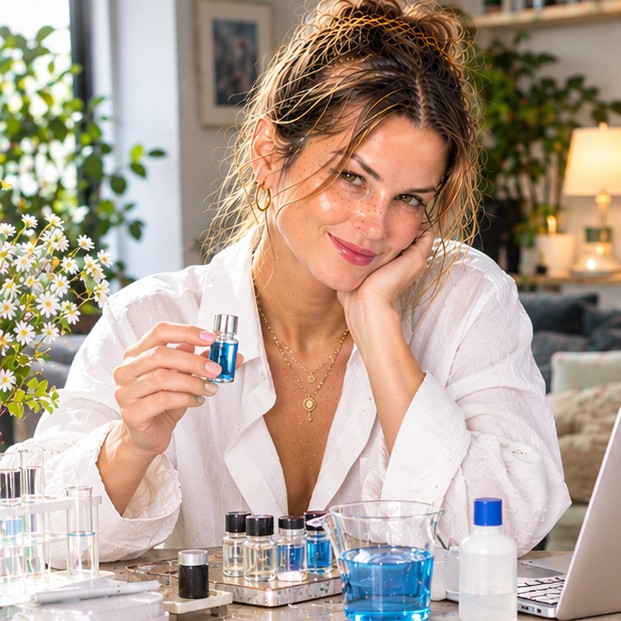
Copper peptide has a characteristic color that is useful for comparing retained samples. Record color together with clarity, pH, odor, sediment and viscosity. A visual check is not an assay, but unexpected color drift is a reason to investigate the system.
Measure pH in the finished formula
The product listing for the liquid material gives a pH range of 5.0–6.5. Final pH should still be measured after humectants, extracts, preservative and peptide are incorporated. A strongly acidic concept should not automatically be combined with GHK-Cu without compatibility evidence.
Addition stage matters
For an emulsion, establish the base first and introduce the peptide during an appropriate cool-down stage within the supplier's temperature limits. In a cold-process serum, monitor whether the active changes polymer viscosity or clarity.
A useful first compatibility screen
· purified water
· one compatible humectant
· one rheology modifier if needed
· GHK-Cu at the documented level for the exact product
· a compatible preservation system
· pH adjustment only after measurement
The first prototype should answer a technical question, not showcase the longest INCI. Once the base is stable, add secondary actives one at a time and compare retained samples.
Scale-up checklist
1. Lock the bench formula in weight percent.
2. Account for the carrier in commercial GHK-Cu solution.
3. Preserve the addition sequence and temperature limits.
4. Recheck final pH after scale-up.
5. Compare color and viscosity with the bench control.
6. Retain a sample for stability observation.
Common mistakes
· using a powder dosage for a supplied solution
· adding peptide to a hot phase without specification support
· combining it with a low-pH system because both actives are popular
· adjusting pH before the peptide is added and never rechecking
· scaling a fresh prototype before observing stability
Internal routes for further formulation work
Compare additional systems in cosmetic peptides, use wholesale peptides for larger-scale sourcing, or review the larger GHK-Cu 100 ml format when consumption becomes predictable.
FAQ
Is GHK-Cu 5 ml neat Copper Tripeptide-1?
No. Its listed INCI includes water and glycerin as the carrier.
Should a serum be made blue with colorant?
No. Do not add dye to imitate the natural appearance of a copper peptide system.
Can several peptides be added immediately?
They can be evaluated, but a simpler control formula makes compatibility problems much easier to identify.
Conclusion
Reliable GHK-Cu development depends on the exact supplied form, final pH, processing temperature, color and time-based stability. Treating copper peptide as its own formulation system makes scale-up more reproducible than copying a recipe designed for a different concentration or raw-material format.





